Richard House - The Kills
Здесь есть возможность читать онлайн «Richard House - The Kills» весь текст электронной книги совершенно бесплатно (целиком полную версию без сокращений). В некоторых случаях можно слушать аудио, скачать через торрент в формате fb2 и присутствует краткое содержание. Год выпуска: 2013, Издательство: Picador, Жанр: Современная проза, на английском языке. Описание произведения, (предисловие) а так же отзывы посетителей доступны на портале библиотеки ЛибКат.
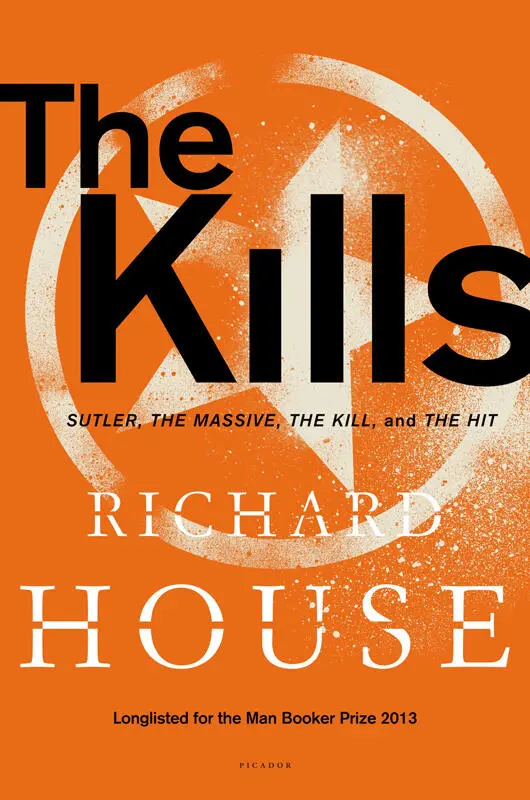
- Название:The Kills
- Автор:
- Издательство:Picador
- Жанр:
- Год:2013
- ISBN:нет данных
- Рейтинг книги:3 / 5. Голосов: 1
-
Избранное:Добавить в избранное
- Отзывы:
-
Ваша оценка:
The Kills: краткое содержание, описание и аннотация
Предлагаем к чтению аннотацию, описание, краткое содержание или предисловие (зависит от того, что написал сам автор книги «The Kills»). Если вы не нашли необходимую информацию о книге — напишите в комментариях, мы постараемся отыскать её.
The Kills — читать онлайн бесплатно полную книгу (весь текст) целиком
Ниже представлен текст книги, разбитый по страницам. Система сохранения места последней прочитанной страницы, позволяет с удобством читать онлайн бесплатно книгу «The Kills», без необходимости каждый раз заново искать на чём Вы остановились. Поставьте закладку, и сможете в любой момент перейти на страницу, на которой закончили чтение.
Интервал:
Закладка:
The cleaners along these lake-front houses arrived in vans labelled Maintenance Technician. The trash collectors — Waste Managers. Decorators — Design Consultants.
* * *
Two thousand. Four thousand. Five thousand.
* * *
Twenty minutes later Rem met with Martin and Samantha Rosen in their house with its Tudor frontage. Said he wouldn’t come in because he was wet, and thought it kind when Samantha Rosen returned with a towel, asked if he wanted a coffee, and behaved with less embarrassment than her husband. Rem left the money on the kitchen counter, and didn’t look at the package as he sipped the coffee and calculated the cost of the appliances. Those cabinets are engineered and handcrafted, you can’t slam the doors, even if you kick them they slide home with a sigh.
It wasn’t green they’d wanted but chartreuse. Rem wasn’t a housepainter, but an interior decorator. The money he brought wasn’t anything other than satisfaction, under the circumstances.
* * *
At the Colemans’, Rem spoke with a housekeeper who said that Marie Coleman had just left, and Rem wondered what was going on. They have these people in their houses, coming and going, and yet they figured the problem came from some sticky decorator. Cathy had a point, he shouldn’t be so easy to ride. A Yorkshire terrier, small even for the breed, scuttled for the door, and the housekeeper held it back with her foot and called it Lucy. Andy Coleman — nicknamed ‘turd-cutter’ by either Matt or Mike for his tight mouth and pudgy cheeks — worked for the Lake View office of the Chief of Police. A portrait of the man and wife, black-and-white head shots, mounted on the wood panelling.
Rem held on to the money; while he didn’t want to return, he didn’t trust leaving an envelope containing this much cash. The Colemans held the deepest grievance. The ring was an heirloom piece. The housekeeper recognized the logo on Rem’s car and told him: You need to speak with the Stahls.
* * *
Before he reached Chicago, Rem received two calls from Andy Coleman. Both abusive. The first call nothing but an indignant sulk: ‘You said you’d be here. We gave you a specific time. We had an agreement.’
The second message was less constrained and the man shouted. ‘How would you feel if someone broke into your home? How would that feel, Gunnersen? Hey? You tell me? How about I come to your home and take something of yours? How will that feel?’
Rem wanted to tell him to go to his apartment, no worries, help himself to whatever he wanted. Instead he managed to sound reasonable, even made himself smile so his voice would carry some colour.
‘Sorry to miss you. There’s a misunderstanding. I came by earlier but you weren’t there. I didn’t want to leave anything as the house didn’t look secure. Let me know when you’re about. I can come back tomorrow. Mornings aren’t a problem.’
* * *
The last visit promised to be the most difficult, and Rem waited a long time in the car, and smoked despite his sore throat. You need to speak to the Stahls. The point of the exercise already undermined. If Rem was paying people to keep their mouths shut he wouldn’t need to speak with the Stahls, because the Stahls wouldn’t know. Just as some slack-mouthed housekeeper shouldn’t know either.
Nobody but the Robinsons and the Rosens had any business with him. These were the people named by Matt. The only two. The Colemans were included for containment.
Cissie let him in, wrong-footed him with a kiss on the cheek, said breezily that Matt was in the back and how about a coffee? Rem couldn’t calculate if this was bravado, because they’d known each other for so long — was she supposed to answer the door in sackcloth? Weep? Cower? What did he expect? She hadn’t done anything wrong. Even so, her cheeriness made him sore.
No such breeziness from Matt. Sequestered on a dark internal porch, Matt wiped his hands down his legs but didn’t offer to shake hands. His expression fixed in a gawp, a slap-red rash ran up his neck. He moved in slow counterpoise to Rem, a greasy movement, distrustful to the core.
Rem laid out the papers for the loan agreement, the book of payment slips, a separate sheet listing the names and amounts he’d paid. Payments that counted into thousands of dollars. He outlined them one at a time, but didn’t mention the Stahls.
While Rem spoke Matt hastily gathered the papers and looked to the door, and Rem guessed that Cissie knew nothing, had no idea.
When he asked, Matt drew a small in-breath that sounded like incredulity, perhaps even scorn. ‘I’ll pay every cent back. As long as I have work I can pay you.’
Rem closed his eyes, quarried for an explanation.
‘There isn’t any work. No one wants to hire us, Matt. We’re done.’ Rem let the fact sit before venturing. ‘I have to explain the situation to Mike and the others. I have to find reasons why.’ Rem stood, hands to his knees, a simple, pneumatic movement. ‘You pay in each month. That’s all you need to do. We don’t need to be in contact otherwise.’
Cissie busied herself in the kitchen as he left. No coffee being made, instead it looked like a supper of pasta and eggs and ham and sour cream. Rem had left his cigarettes on the table, had set them down when he’d taken out the papers. He didn’t want to return for them, didn’t want them at all.
* * *
Rem arrived home to find the lobby unlocked, the mail picked up, which meant that Cathy was home — although she never left the door open, this was his habit, and his problem when people came in and fouled in the hallway. At the top of the stairs he found the outer, heavy warehouse door, metal-sheathed, open. The second apartment door also open. No welcoming dog. No Cathy either.
* * *
He searched the neighbourhood with the leash wrapped about his knuckles, hopeful at every corner and block-long view that Nut would be there, shivering — because this is what he did when he was lost, he shivered, he cowered, he whimpered. This was Coleman’s doing. No doubt. Rem couldn’t imagine anything more provocative than breaking into a house and letting a dog out on the street.
* * *
Unlike Kuwait City, Amrah City had no central business zone, and only one building higher than four storeys, the Ministry of Oil, a honey-coloured, hive-like building of twenty-five storeys, which could be seen some distance from the city. Rem looked for similarities to other cities, but three factors — the vast plane of squat oblong houses, the pounding heat, and how disturbingly vacant the city appeared — dominated any familiar elements.
Amrah City Section Base (aka: ACSB, The Station) lay four miles from the Regional Government Office, Southern-CIPA. Pinched between Shi’a and Sunni districts, the former light-industrial complex had once housed a packing plant, a cannery, a coach station, and an ice factory. The buildings wore scars from the conflict, and there was evidence that the Palace Guard had used the complex as a garrison. The compound was barely adequate in scale and location, and housed nearly twelve hundred non-Iraqi foreign nationals, Fobbits, who bedded down in stacked container units — alongside a further fifteen hundred Americans and other allies, although this number declined by the day. The recent increase in security breaches made the post less attractive for contractors who had no military experience. Protected by a fortified outer wall, Section Base housed a cinema, a sports hall, stores, and a PX, and in the courtyard a row of cabins, referred to as ‘the ovens’. The electricity seldom ran longer than four hours, so the compound rang to the thrum of generators.
The job fell short of expectation on the first day. Rem, assigned to Unit 409, was told that he couldn’t stay inside the compound, as ACSB was classified as home territory. If he wanted the Strategic Placement Bonus he’d have to leave the compound every day.
Читать дальшеИнтервал:
Закладка:
Похожие книги на «The Kills»
Представляем Вашему вниманию похожие книги на «The Kills» списком для выбора. Мы отобрали схожую по названию и смыслу литературу в надежде предоставить читателям больше вариантов отыскать новые, интересные, ещё непрочитанные произведения.






Обсуждение, отзывы о книге «The Kills» и просто собственные мнения читателей. Оставьте ваши комментарии, напишите, что Вы думаете о произведении, его смысле или главных героях. Укажите что конкретно понравилось, а что нет, и почему Вы так считаете.