Richard House - The Kills
Здесь есть возможность читать онлайн «Richard House - The Kills» весь текст электронной книги совершенно бесплатно (целиком полную версию без сокращений). В некоторых случаях можно слушать аудио, скачать через торрент в формате fb2 и присутствует краткое содержание. Год выпуска: 2013, Издательство: Picador, Жанр: Современная проза, на английском языке. Описание произведения, (предисловие) а так же отзывы посетителей доступны на портале библиотеки ЛибКат.
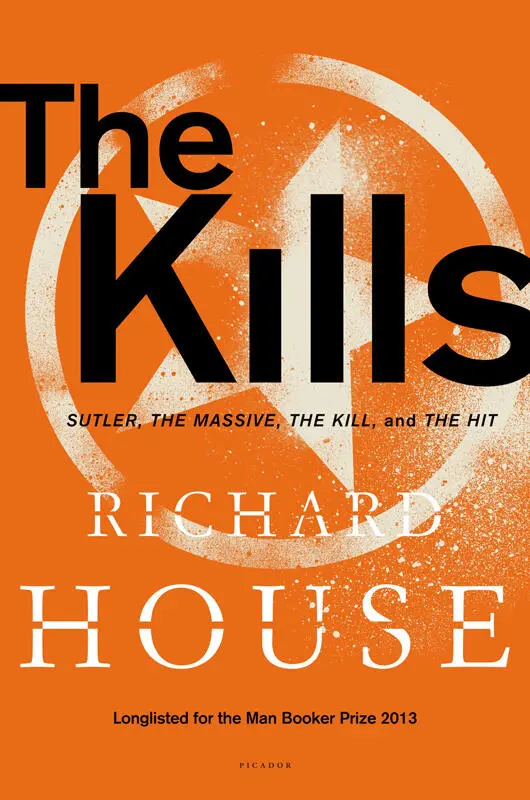
- Название:The Kills
- Автор:
- Издательство:Picador
- Жанр:
- Год:2013
- ISBN:нет данных
- Рейтинг книги:3 / 5. Голосов: 1
-
Избранное:Добавить в избранное
- Отзывы:
-
Ваша оценка:
The Kills: краткое содержание, описание и аннотация
Предлагаем к чтению аннотацию, описание, краткое содержание или предисловие (зависит от того, что написал сам автор книги «The Kills»). Если вы не нашли необходимую информацию о книге — напишите в комментариях, мы постараемся отыскать её.
The Kills — читать онлайн бесплатно полную книгу (весь текст) целиком
Ниже представлен текст книги, разбитый по страницам. Система сохранения места последней прочитанной страницы, позволяет с удобством читать онлайн бесплатно книгу «The Kills», без необходимости каждый раз заново искать на чём Вы остановились. Поставьте закладку, и сможете в любой момент перейти на страницу, на которой закончили чтение.
Интервал:
Закладка:
‘We volunteer? This is your idea?’
‘It’s a good idea. You’ve no idea how much they pay. By the time they go in everything’s over. It’s meat, it’s not even people, what’s left over.’
Rem didn’t like it, but Santo persisted. ‘You put together a team. They want people just like you. Big white people who do things.’
Rem wouldn’t consider it. He’d seen enough devastation from a distance, and had trouble forgetting the cabins obliterated by the attack, the stink of scorched blood and fat, his fear over what had happened to the men inside.
* * *
The shifts altered once the buildings had been cleared either side of the new routes: so they began to work during the day. Every night, after Santo returned to the cabins, Rem spread out his mat and lay under a table in the cafeteria and knew he would not sleep. Santo’s idea stuck under his skin. Them and us. They blew up markets, employment queues, clinics, schools, colleges, funerals, any protest or procession. They bombed exit routes, corridors, roadways, targeted surgeries, emergency vehicles, so that there could be no escape. And when this was done they went to the hospitals and blew up the arriving ambulances, the waiting rooms, targeting relatives, the doctors and nurses. How many times did Rem, Santo, and the crew of Unit 409 listen to the attacks then wait for the follow-up blasts? Rem had no language for this, but understood that he was part of the dynamic. However separate Santo and the others might regard themselves, Rem at least admitted that he was, in some way, connected.
* * *
Three in the morning Rem woke to see Fatboy stacking candy bars into the vending machines. A slight nervous energy ran through the boy, his feet jiggered as he unloaded the boxes.
Rem watched him walk away, arms full of snacks and cardboard flats, and told himself he wanted company. He followed Fatboy through the complex, a small channel of light marked a corridor to an exit, a set of folding doors. He found his cigarettes in his pocket, caught up, and offered the boy a smoke.
‘Can’t sleep?’
‘Don’t seem to need it.’ Fatboy looked at the sky, at a yellow horizon edged by shadowy palms and the distant square hulks of buildings. He pointed at the cabins with boards secured behind the windows to prevent blast damage. ‘Like a face,’ he said. ‘See? Eyes? Mouth?’
Rem looked back to the PX, worried about the light from the corridor.
Fatboy’s thoughts were often disconnected and Rem became used to the chaotic switches: ‘What’s the most people you ever saw?’
Rem said he didn’t know.
‘The most people — in one moment. Right in front of you? Face to face?’
Rem wasn’t sure, and Fatboy led him back through the PX, past the Stores, the commissary, the humming fridges; the canteen seeming longer in the half-darkness, its recesses deeper. The boy leaned against the door before he pushed. ‘Tell me how many you think there are.’
The door opened to a series of interlinked spaces — a loading dock, a parking lot, the remnants of a boulevard — one large area bordered on two sides by blast walls, and along the far side, by low-rise prefab buildings. Lamps mounted on the buildings cast an acid wash over the compound. To Rem’s amazement the ground was covered with sleeping bodies.
Fatboy leaned against the door to keep it open. ‘Wild, right? TCNs. Third-country nationals. They run the facilities. Everything.’
From their feet to the far perimeter slept the drivers, shelf-stackers, cleaners, sales clerks, barbers — he couldn’t account for the numbers.
‘They don’t have anywhere to sleep?’
‘Most do. There’s an area behind with shipping containers. They’re modified for sleeping, each container holds around nine men. They’re mounted one on top of the other. Not everyone’s working. Some are going home, others are being shipped out, or transferred. If you aren’t working, you aren’t assigned quarters. You ever seen anything so wild?’
‘I don’t see how this is any safer?’
‘The containers get hot. A while back some of them were burned out. After that most people started sleeping like this. It’s better to be outside, especially when there’s trouble.’
From what Rem could see the bodies were male, men sleeping side by side, fitted together, on and under vehicles, lodged crazily, puzzlelike, head to toe, with little space between them. Most slept in thin T-shirts, trousers, with rags or paper or newspaper over their heads and faces. Rem couldn’t absorb the detail, so that group immediately at his feet stood in for the many laid out before him.
* * *
Rem and Fatboy began to spend their nights together.
Fatboy’s habit would be to smoke, pause, then ask a question, as if there was something on his mind.
‘You ever pray?’
Rem answered no.
‘Your parents alive?’
Rem shook his head but didn’t answer. He finished one cigarette, lit another.
‘My mom lives in Michigan. Doesn’t do much but eat.’
There were times when Rem thought the boy wasn’t right, that somewhere along the spectrum of normal and crazy Fatboy pulled up short. When he noticed how poorly the boy looked after himself he took on duty of care and presented him with food, fruit, nuts, things he thought would be good, and sat with him as he ate. Fatboy, for his part, began to open up.
‘There’re these marsh Arabs. They live east of here between the Tigris and the Euphrates, and they build these huts out of reeds on these stilts. Real small. And there’s one big hut, this place where everyone meets. You just go in and you ask anything you want to ask, like, where are all the fish, and someone will tell you. Or you go there because you’re troubled, or you want an answer to something, and someone always has an answer. Someone always knows what you’re supposed to do.’
Rem thought the boy was homesick, but not for home. ‘You’ve seen these people?’
‘I will do. Some day.’ Suddenly the boy choked up, and Rem wondered, if he ever made it to this place, this raised hut set above the marsh, what question he would ask.
‘You have someone at home?’ the boy asked.
Rem said yes, he had someone. ‘My wife comes from Texas,’ he explained. ‘A place called Seeley.’
‘Same as the mattress?’
‘Same as the mattress. I think she’s happy to be out of there, but I think she misses Texas.’
‘You think you did the right thing coming here?’
Rem shrugged. ‘My mother had these ideas. She’d say something like: everything you do puts you one step forward. Some things are better not known.’
‘You wish you hadn’t come?’
Rem looked up and took in the sky, blank because of the light-spill from the compound. Fatboy came from a small town himself. He never could have imagined these things or such a place. This wasn’t their home.
* * *
The idea that Rem Gunnersen should take employment away from home came from his wife, Cathy, because, she said, she needed a vacation.
Cathy Gunnersen’s realization came to her after her sister’s wedding. This being no special night and no special occasion, except Rem had started drinking at midday as a party of one and left a full beer in the utility room right on top of the washer, so when the spin-cycle kicked on, the can tipped over and the beer saturated the laundered clothes. She found him splayed across the couch, feet on the armrest, heels digging a groove, with another beer gripped between finger and thumb, jiggling to some rhythm or some other agitation. Cathy wanted to know was wrong with the first beer. Hey? And the second? What was wrong with that? Come on? An open can on the kitchen counter, another in the fridge, another beside the couch — she could map his afternoon. Did he have any clue how much he was drinking? Seriously, was anyone keeping track? It wasn’t the drinking that bothered her, no, what angered her was the idea of him drinking while she worked. And why, could he please explain, was the dog out in the hall?
Читать дальшеИнтервал:
Закладка:
Похожие книги на «The Kills»
Представляем Вашему вниманию похожие книги на «The Kills» списком для выбора. Мы отобрали схожую по названию и смыслу литературу в надежде предоставить читателям больше вариантов отыскать новые, интересные, ещё непрочитанные произведения.







Обсуждение, отзывы о книге «The Kills» и просто собственные мнения читателей. Оставьте ваши комментарии, напишите, что Вы думаете о произведении, его смысле или главных героях. Укажите что конкретно понравилось, а что нет, и почему Вы так считаете.