Richard House - The Kills
Здесь есть возможность читать онлайн «Richard House - The Kills» весь текст электронной книги совершенно бесплатно (целиком полную версию без сокращений). В некоторых случаях можно слушать аудио, скачать через торрент в формате fb2 и присутствует краткое содержание. Год выпуска: 2013, Издательство: Picador, Жанр: Современная проза, на английском языке. Описание произведения, (предисловие) а так же отзывы посетителей доступны на портале библиотеки ЛибКат.
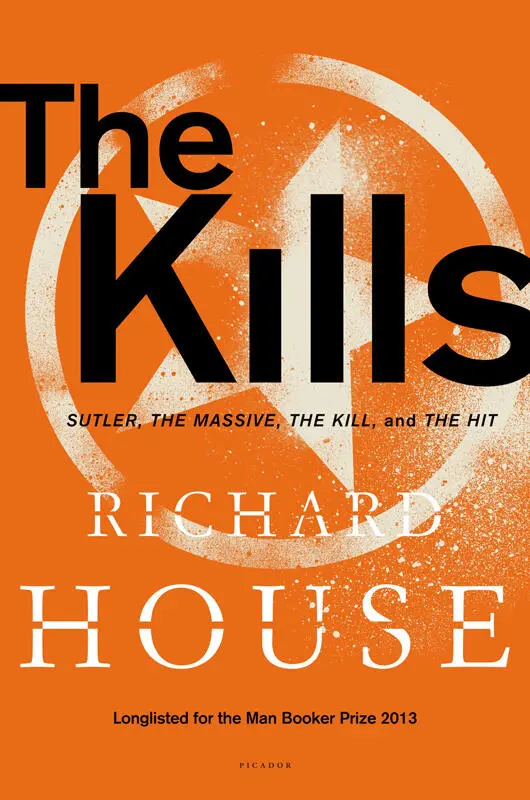
- Название:The Kills
- Автор:
- Издательство:Picador
- Жанр:
- Год:2013
- ISBN:нет данных
- Рейтинг книги:3 / 5. Голосов: 1
-
Избранное:Добавить в избранное
- Отзывы:
-
Ваша оценка:
The Kills: краткое содержание, описание и аннотация
Предлагаем к чтению аннотацию, описание, краткое содержание или предисловие (зависит от того, что написал сам автор книги «The Kills»). Если вы не нашли необходимую информацию о книге — напишите в комментариях, мы постараемся отыскать её.
The Kills — читать онлайн бесплатно полную книгу (весь текст) целиком
Ниже представлен текст книги, разбитый по страницам. Система сохранения места последней прочитанной страницы, позволяет с удобством читать онлайн бесплатно книгу «The Kills», без необходимости каждый раз заново искать на чём Вы остановились. Поставьте закладку, и сможете в любой момент перейти на страницу, на которой закончили чтение.
Интервал:
Закладка:
Pakosta was missed by the regulars at the Flat Earth Café, and by the tour guides on the whale-watching boats who were used to his bullying rants, and how he’d stand at the pier and disabuse the tourists, asking what, seriously, what did they expect to see out there? You take pictures, he said, pictures. You can’t eat the whales. In Pakosta’s last months, time folded over itself and he forgot to eat, began to slip from his routine, and the comings and goings of day-trippers, the simple matter of people departing, became unbearable for him. On his last day he ran after the boats and shouted that the sea would swallow them and they would vanish as if they had never been born.
* * *
Rem Gunnersen lived long enough to celebrate his second wedding at St Lawrence’s on Lunt Avenue on Chicago’s Northside. For that one day he assured his guests that he was comfortable and grateful that they had come to witness him rectifying an earlier mistake: his separation from his first wife, Cathy, which he was now correcting by re-marrying her, and making her, simultaneously, his first and second wife. Shrunken, unable to eat solid food, he insisted that everything that could be done had been done many times already. It was now a matter of keeping one stride ahead with his medication, of keeping comfortable. The weekend after the wedding Rem’s lung collapsed, and following directions downloaded from the internet his wife administered the morphine she had stored in preparation and sat with him as he faded.
Before his funeral, conducted in the same church, the doctor gave general answers about the source of Rem’s cancer, and while he could not be absolute he agreed that Rem had sickened after his return from Europe, two years after his time in Iraq, and never properly picked up.
Rem’s guests returned to the church, sat in the same small groups, wore the same suits, and learned how, when exchanging vows, Rem had whispered that he was sorry, that life just cheats you, robs time from you right at the moment you find yourself to be truly content. His daughter, Elsa, presented the eulogy, and refused to find comfort. Rem Gunnersen was a good man who had suffered for no reason. Through all of their troubles, despite all of their years apart, neither Cathy nor Elsa had imagined life completely without him. I want to know why, she asked. I want to know what all of this is for.
Rem had come into money in his last year through the sale of land and the settlement of a dispute, and he had decided, with Cathy’s agreement, that the money would be entrusted to a Quaker fund to support veterans returning from combat.
Rem Gunnersen’s wake was held in his house on the night before the funeral. As per his instructions, Cathy opened the casket and undressed him, and he was buried naked in a coffin of compressed cardboard, along with a handwritten note stating that while he’d tried his level best to protect the people under his care, some had come to harm, and while he could not rectify these mistakes he asked to be received with forgiveness.
* * *
Chimeno (Spider) returned to Iraq nine months after his time at Camp Liberty and was killed in a direct strike. His remains were flown back to Fort Dover, repatriated, and taken directly to his hometown, Peoria, Illinois, to his parents’ farm. The attack occurred in daylight and was the first killing that year. As the helicopter cleared the bulk of the abandoned Ministry of Oil in Amrah City the pilot turned to Spider to say that one day all this would be automatic. An ops team on the other side of the world would feed in every known piece of information about a suspect, every god-damned thing, their taste in women, shoes, the side of the bed they slept on, and predictions would be made about where this person would most likely be at any given time. They’d know, before it even occurred to the target, where they wanted to go that day. With this information they would take out insurgents without ever being present. No armies. Computers and drones. They’d show it on the news, like they showed the Scuds in Libya dropping onto bunkers, targets braced with digital sights. Unseen, inside the building, lay a simple IED; triggered by the ‘copter’s down-thrust it blew a funnel of debris between the floors.
On the day of his funeral the Department of Defense released a video of the incident. After it was hit, the helicopter, an HH-60, spun into the side of the building to fold into the concrete honeycomb with a cold familiarity, pieces of it ricocheting out and down.
* * *
Steven (christened Stefan) Kiprowski was the first of the group to die at the government offices in Amrah City.
* * *
Kiprowski, Chimeno, Pakosta, Samuels, Watts, Clark, and Hernandez were Rem Gunnersen’s men for six weeks; known as Unit 7, the men were handpicked to work at the burn pits at Camp Liberty in the southern desert of Al-Muthanna.
TWO CITIES
A year after the events at Camp Liberty, while Rem Gunnersen was living in Europe (Halsteren, Amsterdam, and afterward Bruges), he was asked in a casual discussion to describe two bad days. They didn’t have to be the worst days he’d ever had, just two stinkers. It’s a game, the man, a Norwegian, said. If your story’s worse than mine, I’ll buy the next drink.
While the men did not know each other, they’d passed the day in a canal-side bar drinking shots and chatting with ease, and a game, whatever the premise, would add purpose to the late afternoon.
Rem had two stories in mind before he’d properly considered the idea. When he did consider it, he realized that he’d chosen these days not because they were his worst, but because they worked as parentheses either side of a year he wished to set behind him.
On the first bad day (story one), his dog, Nut, a dirty white insecure Staffordshire bull terrier, went missing.
On the second (story two), a man he’d worked with kidnapped another man, then drove halfway across the country with him in the boot of his car.
The thing is, Rem explained, he’d almost certainly kidnapped the wrong man.
* * *
If the Norwegian had asked for one story Rem would have chosen the first.
Nut slept in the same room as Rem and his wife. The dog suffered gas (no diet would cure it), and being timid the creature didn’t like surprises. He ignored other dogs; was never heard to bark or growl; sat between people as they talked and appeared to understand their conversations.
Rem loved the routine. The early walks, the late walks. The lake-front at Rogers Park dusted with mist. How Nut waited to be told to run. How the dog loved water. How, every year, he rediscovered ice. Nut doted on Rem and Cathy, walked jauntily in their company, shone with affection, would lean against a door if he was shut out of a room, just to be close.
Nut disappeared before Rem left for Iraq, and Rem later realized that if the dog hadn’t vanished, he would have stayed in Illinois. Nuts’ needs and routines set a perimeter they never questioned; without that perimeter, their horizons automatically broadened.
* * *
Rem set his morning in order. First the Robinsons, then the Rosens, the Colemans, then Matt.
He found Martin Robinson on the driveway of his home in Lake Forest. The man leaving, car pointed downhill, the weather turning from indeterminate drizzle to a harder, full-on rain. Rem ran from his car with his jacket pulled over his head and leaned through the passenger window, and Robinson pushed Rem’s head back and kept his hand out for the money.
As the car drove away Rem looked back to the house. He never envied people money, seldom felt bruised at others’ entitlement and excess, even now, handing over cash on a broad driveway curved to give a last long view of the lake, the landscaped garden, treeless until the incline, the flat-roofed house, the lap pool, the edge of a Chihuly chandelier, those slab windows reflecting a sombre two-tone view. Grey lake. Grey sky. These people didn’t need money, not in the same way Rem needed money.
Читать дальшеИнтервал:
Закладка:
Похожие книги на «The Kills»
Представляем Вашему вниманию похожие книги на «The Kills» списком для выбора. Мы отобрали схожую по названию и смыслу литературу в надежде предоставить читателям больше вариантов отыскать новые, интересные, ещё непрочитанные произведения.









Обсуждение, отзывы о книге «The Kills» и просто собственные мнения читателей. Оставьте ваши комментарии, напишите, что Вы думаете о произведении, его смысле или главных героях. Укажите что конкретно понравилось, а что нет, и почему Вы так считаете.