Richard House - The Kills
Здесь есть возможность читать онлайн «Richard House - The Kills» весь текст электронной книги совершенно бесплатно (целиком полную версию без сокращений). В некоторых случаях можно слушать аудио, скачать через торрент в формате fb2 и присутствует краткое содержание. Год выпуска: 2013, Издательство: Picador, Жанр: Современная проза, на английском языке. Описание произведения, (предисловие) а так же отзывы посетителей доступны на портале библиотеки ЛибКат.
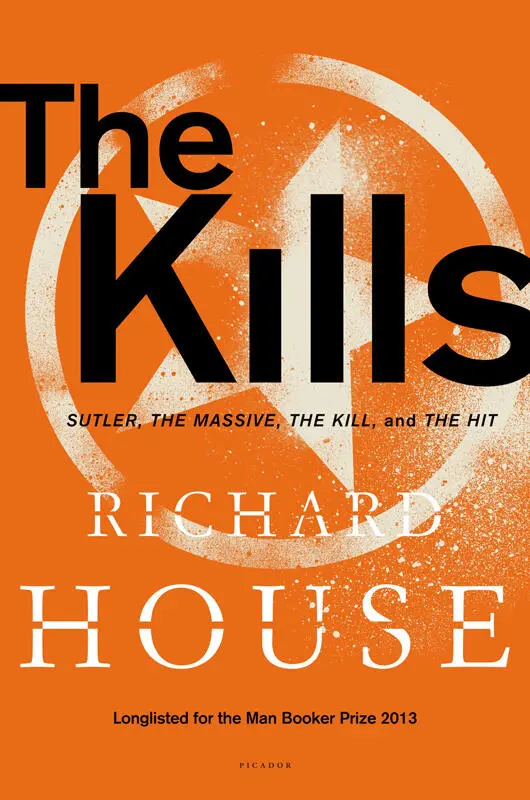
- Название:The Kills
- Автор:
- Издательство:Picador
- Жанр:
- Год:2013
- ISBN:нет данных
- Рейтинг книги:3 / 5. Голосов: 1
-
Избранное:Добавить в избранное
- Отзывы:
-
Ваша оценка:
The Kills: краткое содержание, описание и аннотация
Предлагаем к чтению аннотацию, описание, краткое содержание или предисловие (зависит от того, что написал сам автор книги «The Kills»). Если вы не нашли необходимую информацию о книге — напишите в комментариях, мы постараемся отыскать её.
The Kills — читать онлайн бесплатно полную книгу (весь текст) целиком
Ниже представлен текст книги, разбитый по страницам. Система сохранения места последней прочитанной страницы, позволяет с удобством читать онлайн бесплатно книгу «The Kills», без необходимости каждый раз заново искать на чём Вы остановились. Поставьте закладку, и сможете в любой момент перейти на страницу, на которой закончили чтение.
Интервал:
Закладка:
The next moment she was equally certain that he was alive. You hear these stories about people, who for no reason start a new life. Define an entirely new path. There’s no logic to it, but everything old has to be discarded. Some people can’t settle, it just isn’t in them. They just aren’t attached to the world. They can’t see the damage they cause. Some people. It isn’t deliberate. They just can’t see it.
‘I don’t mean you,’ she said. ‘I’m sorry, I really don’t. I mean Eric. I think he can do that sometimes. Just drop everything and start from nothing. School. University. The move to New York. Each time it was a reinvention.’ She turned to Ford, who looked ahead, the dim light from the dashboard soft on his face, a scar under his eye. ‘I’m just not ready. You know. It’s too soon.’ She whispered to herself. ‘I think you understand?’
She wiped her face, her sweater curled over the heel of her hand. ‘I’ll go back,’ she decided. ‘I’ll find out what’s happening. I’ll come back in the morning. I’ll bring food and coffee. I’ll come back tomorrow.’
* * *
He found the climbing hut further up the road, beyond where the ploughs had stopped, so the path became deep and uncertain, hard to follow, and difficult to stride through. He saw the car idle, red lights blooming on the snow, the exhaust funnelling thin and low, before it slipped quietly out of view.
He pushed through the door, looked back down the path but could not see the road, and could not see any suggestion of the car. The night now entirely silent. Some people, she’d said, I think you understand. Despite her explanation, he knew that she was talking about him.
The building, a strong black stone house, similar to the houses in the village, stood as a block on a steep ridge below the stark walls of the gorge; the valley extending before it in a soft white swoop.
Some people.
The door wasn’t locked, but the building was cold, entirely without heat. There were five rooms upstairs, in the first three the beds were stripped down to the wire springs. In the last two he found mattresses and thin blankets. There was nothing to burn in the kitchen, and in the communal rooms the windows, jammed open, tipped snow over the slate lintel and onto the floors. A smaller drift had settled in the fire-place. He found no food, no water, only an old travelling alarm clock and a torch with one battery that clattered about inside when it was lifted up. There were blankets, thick, army grey, and rubber wellingtons stuck upside down on pegs on the walls.
He prepared to sleep. Took off his socks and laid them out beside him. He lay on the mattress, curled into himself. His feet, his hands, quickly lost sensation, and his thoughts began to run scattershot over the same ideas:
She isn’t coming back.
She’s changed her mind about helping.
She’s bringing the police.
She’s bringing the investigators.
She knows who I am.
She believes I am responsible for the disappearance of her son.
She has abandoned me.
This is a punishment.
She wants me to disappear.
* * *
The snow continued through the night, so that it did not become dark, and the room held a faint luminescence. He considered what he should do. The road would be lost now, buried. If he had climbing boots he would have better hopes of making his way forward. She wasn’t coming back. His only hope now would be to walk out of the mountains.
* * *
In the morning the storm had worsened, and the flakes thickened, so that the house appeared to crouch under the weight of the snow. His hands and feet remained numb and his thinking seemed disjointed, inarticulate.
* * *
Grey rock rose close and steep on either side of the path, and although it was cold Ford began to sweat. The path ascended through a narrow pass, over small bridges, packs of ice which spanned a rivulet so blue it appeared thick with dye. Ahead of him, perhaps four or five hundred feet from the house, the valley opened to a bowl, snow-covered and rutted in broken folds, and stained with dirt: a mammoth’s skin. Far below the skyline brightened along the horizon, and he imagined the streets of a vast city laid out in the plain, the dark curve of a river cutting through. In this city he would not be Sutler, he would not be Ford, but someone entirely new.
The cold, so bitter, sharpened everything to the present, and tempted him further into the snow. He shed his jacket and determined that he would walk for as long as he could manage, out and down from the mountain, into a field of white.
THE MASSIVE
MEAT
By the time he arrived at the Pioneer Residential Home in Normal, Illinois, Luis Francesco Hernandez (Santo) had discarded his full family name and much of his past. Throughout his final seven years at the home he never spoke about his family, his business, the time he spent with Rem Gunnersen at the burn pits in Camp Liberty, or his participation in two killings. Only once, in direct answer to a question, did Luis Hernandez admit that when he was thirty-two he had abducted a man from his home, drugged him with a horse tranquillizer, and abandoned him in a secure room without food and water. While he couldn’t be certain he’d caused the man’s death, he didn’t doubt that this had been achieved.
For thirty-six years Luis suffered from psoriasis and crescent-shaped sores at his elbows and the base of his scalp which sometimes bled and set an irritation deep into his bones — about which he never complained. In the year before he died he lost his sight and became so absent that when residents spoke with him they expected no reply. The staff washed and dressed him, fed and managed him from room to room; in the afternoons they sat him in the parlour, where he leaned toward the window, his face turned to and following the sun. Everyone noticed in that last fall less and less response.
Luis died quietly, watched over by another resident, Dorothy Salinas, who’d known him from the day he arrived. And while Salinas could be counted as a friend, she knew little about him — except that he’d spent time in Montreal, and slept rough for a period before returning to the Midwest, where, eventually, he set up a smallholding in Lansing, to which he devoted the majority of his working life. In the month prior to his move to Normal, Luis signed his house and business over to his sons, who in turn sold up as soon as they could then moved their families out of state and did not stay in contact. Luis had no complaints. Only once did he open up and mention that a long time ago he’d followed a course of action he shouldn’t have, and she supposed that Canada was the way he worked this out, and that isolation helped compress this problem to a manageable size.
While preparing his body the funeral home found a tattoo on his right shoulder, an eagle with a standard emblazoned with the word ‘Santo’.
Luis’s family, his two sons with their wives and five children, drove from Florida in a shabby three-day convoy. On the morning of the funeral, under a clean winter sky, the attendants hid in the parking lot between the fat-backed pickups and smoked dope, and they were soon joined by Luis’s younger son, Rick, who spoke without emotion about his father. Luis, by his report, was a man who would not settle, a man agitated at life, deliberately at odds with everything about him. He’d lived with his father just long enough, then fled like his brother before him, because you can only spend so much time with a man who always seems to be in another room or another town, just someplace else. Although he knew that his father had spent time in the Middle East, he wasn’t sure in which country — the subject never came up. There were no stories, no accounts of service, nothing to help him admire the old man. The attendants shared their marijuana and dug their boots into the gravel as they listened. After two deep tokes Rick glanced back at the figures outside the funeral home and said that he should get going, yep, they were off already; then, to their embarrassment, he began to cry. He wiped his eyes with the heels of his hands and said that he didn’t understand why he was crying because he didn’t, no, he never had loved the old man. It wasn’t either that he hated him. Luis was difficult to be with, difficult to like, difficult to love. And when you’re young aren’t you supposed to be unconditionally loved, just loved without having to earn or deserve it? Rick looked across the parking lot for an answer, and found a colourless prospect of tract houses, a scuffed sky, low-slung telegraph cables. When they drove away, he said, that would be it, finito: no reason to return. The attendants shifted back on their heels and said, yeah, they supposed it went something like that.
Читать дальшеИнтервал:
Закладка:
Похожие книги на «The Kills»
Представляем Вашему вниманию похожие книги на «The Kills» списком для выбора. Мы отобрали схожую по названию и смыслу литературу в надежде предоставить читателям больше вариантов отыскать новые, интересные, ещё непрочитанные произведения.



Обсуждение, отзывы о книге «The Kills» и просто собственные мнения читателей. Оставьте ваши комментарии, напишите, что Вы думаете о произведении, его смысле или главных героях. Укажите что конкретно понравилось, а что нет, и почему Вы так считаете.