Richard House - The Kills
Здесь есть возможность читать онлайн «Richard House - The Kills» весь текст электронной книги совершенно бесплатно (целиком полную версию без сокращений). В некоторых случаях можно слушать аудио, скачать через торрент в формате fb2 и присутствует краткое содержание. Год выпуска: 2013, Издательство: Picador, Жанр: Современная проза, на английском языке. Описание произведения, (предисловие) а так же отзывы посетителей доступны на портале библиотеки ЛибКат.
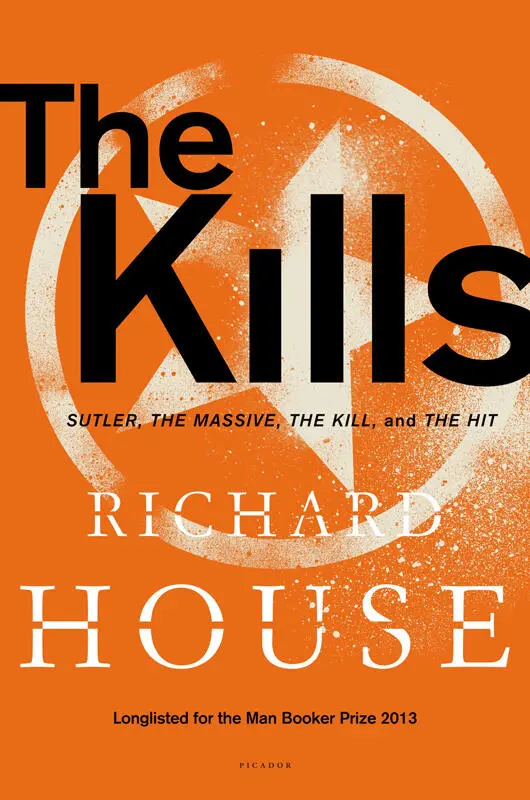
- Название:The Kills
- Автор:
- Издательство:Picador
- Жанр:
- Год:2013
- ISBN:нет данных
- Рейтинг книги:3 / 5. Голосов: 1
-
Избранное:Добавить в избранное
- Отзывы:
-
Ваша оценка:
The Kills: краткое содержание, описание и аннотация
Предлагаем к чтению аннотацию, описание, краткое содержание или предисловие (зависит от того, что написал сам автор книги «The Kills»). Если вы не нашли необходимую информацию о книге — напишите в комментариях, мы постараемся отыскать её.
The Kills — читать онлайн бесплатно полную книгу (весь текст) целиком
Ниже представлен текст книги, разбитый по страницам. Система сохранения места последней прочитанной страницы, позволяет с удобством читать онлайн бесплатно книгу «The Kills», без необходимости каждый раз заново искать на чём Вы остановились. Поставьте закладку, и сможете в любой момент перейти на страницу, на которой закончили чтение.
Интервал:
Закладка:
She exhausted herself examining the DVDs and decided to return to Grenoble that night. Although the weather remained foul with a storm pushing from the mountains into the plains, she was determined to make the journey.
* * *
In the car she could smell Eric’s clothes, musty, unaired; the cardboard boxes gave off an odour of something long forgotten, ignored. The stink of stored clothes soured her stomach. Her first husband had left the house with the clothes he was wearing, money, and nothing else. A year later she had cleared away his belongings, a task which took almost no time, as there were no photographs, few keepsakes, only bundles of clothes, as if he had deliberately lived provisionally, spent his life waiting to disengage. This, she understood, was different: despite Eric’s love for order, he’d left too much behind, too many pieces — she drove carefully, a little hesitant, intimidated by the traffic, and realized that she wanted this over. She wanted the investigation to stop. She wanted an end, some kind of mercy. The entire enquiry was built on an idea about her son that she no longer wanted to consider.
At nine thirty the promised storm broke and snow began to fall, wet and heavy, mesmerizing as it zipped over the windscreen, the wind picking white whorls in a black sky. Anne drew off the motorway and waited for the call from Colson Burns. She waited on the hard shoulder, hazard lights blinking, the snow quickly thickening and limiting her view. The car shuddered as traffic passed on the motorway. When the call came it brought only disappointment.
‘There’s nothing,’ they said. ‘He admits to being in Narapi, but his information adds nothing new. He delivers cars for a dealership in Koblenz. He was helpful but this gives us nothing. We showed him the notebooks, and he apologized for not being able to meet you; he’s leaving early tomorrow morning. We’re checking his information now, but much of what he says tallies with what we already know.’
Anne had trouble starting the car. The engine turned, slow and cold, resistant, and when it finally started it gave a feeble tremble. As the traffic passed the wind seemed to batter harder, rocking the car, and she could not see clearly enough to turn back onto the motorway. She drove along the hard shoulder at a timid pace, but the traffic would neither slow nor make room for her to merge into the lane. Where the hard shoulder ended at roadworks and a bridge she stopped the car, alarmed that she was trapped, she could not now move forward, and was locked into place by the passing traffic. She spoke out loud, leaned her head against the steering wheel, hands gripped either side, whispering, I-don’t-know-what-to-do, I-don’t-know-what-to-do. Somebody, tell me what to do. She thought to abandon the car, thinking it better to brave the weather than wait to be hit.
She called her husband. Woke him, and managed, until she heard his voice, to keep herself calm and then immediately began to cry. She heard him panic, tried to draw herself in, then quickly explained her situation. ‘I’m trapped on the hard shoulder. I can’t turn. I’m stuck. I don’t think they can see me. I don’t know what to do.’
She listened to his voice, how he came out of sleep, worried for her, advised her to stay with the car, to keep calm, to stay on the phone. ‘Wait,’ he said, ‘and the traffic will clear. Keep talking to me.’
Why had she come alone? Why had she insisted on this trip? What had seemed important, a necessary step, she understood to be completely beside the point. She had told strangers facts about her son, facts she had not spoken over with her husband. Facts which had seemed huge, transformative, which were now a small part of a larger picture.
‘I want this to stop,’ she said. ‘I can’t do this. I can’t. I don’t want them to investigate him any more. It’s too soon. It’s all too soon. It’s too fast. I want them to stop. I want this to stop. I want you to call them. I want you to ask them to stop.’ Colson Burns were the wrong people, the wrong approach. What had they achieved? What had they discovered? What was their purpose except to regurgitate the same facts, strike the same bruise, insist day after day on her son’s absence? I want this over. I want this to stop. I want to talk with you about Eric.
7.4
Late in the evening, Anne received a second call from Mark Mathews telling her to come directly to the Hotel Lux. He gave directions, and told her the room number. She readied herself for the discussion.
Mark Mathews waited for her in the lobby. He stood as she came through the door, and with an air of intimate care he guided her through to the guest lounge. He had news, he said, she should sit down.
Anne took a chair at one of the small tables and asked if he had spoken with her husband. The man paused and said no.
‘Tell me what you have, but there is something we need to discuss,’ she said, collected now, determined that this was the right decision. Heat from a small radiator hit her legs and she changed her position so that she faced the man, appeared ready for news, although, in truth, she wanted to tell him that she’d had enough. She’d practised on the way in, refining the words: You’ve done excellent work. Thank you. I’m very grateful for everything that you’ve done. But I don’t feel that this is helping. I’m sorry, she would say, I think this is too soon. I want you to stop what you are doing. Immediately. I do not want this to continue.
Mathews passed over a small device and a pair of headphones and told her to listen, his voice low, but containing excitement.
‘Listen to this,’ he said, ‘we have a development. He’s speaking about himself.’
Anne took the earphones and looked at the investigator as she listened, uncertain about what she was hearing. Ford’s voice sounded as part of the texture of the room, coherent, calm, measured, not quite rambling, the alcohol unlocked stories which came not quite free enough, elliptic, busy with potential.
She took out the ear-buds, uncertain about what she had heard. ‘I don’t know what this means? Did he know he was being recorded? He sounds drunk.’
Mathews shook his head. ‘We have informed the police. My partner is with them now. The name he’s given us doesn’t check out. There is no Tom Michael or Thomas Michaels. He isn’t who he says he is. The numbers, his travelling in Turkey. We gave the police photographs and a copy of the interview earlier this evening—’ He drew a folded sheet of paper out of his pocket. ‘What do you know about this man?’
Anne found herself blinking. Uncomfortable. ‘I don’t understand what this has to do with finding Eric. He said he didn’t know anything.’
Mark Mathews flattened the paper on the table. ‘There are other issues here. He isn’t the man he says he is. We can’t allow this to pass. We have an obligation to confirm what he has told us.’ He asked her to look at the photograph. ‘Do you know who this man is?’
Anne looked at the image, a printout of an ID, a man looking slightly stupid, a little lost.
‘I don’t know who this is. Is it him? I don’t know?’
Mathews sat upright, unable to suppress a smile. ‘We’re not entirely sure, but the scars on his face, his travelling close to the border in eastern Turkey, it’s suspicious. At the very least.’
Anne shook her head, caught up in his words. How easy it was to deliver. We can’t allow this to pass, as if she also agreed, as if this decision was something she would naturally follow. ‘I don’t know who this is. What does this have to do with my son? Is he responsible for what has happened to Eric? Does he know where my son is?’
Mark Mathews shook his head. ‘Mrs Powell? Anne—’
Читать дальшеИнтервал:
Закладка:
Похожие книги на «The Kills»
Представляем Вашему вниманию похожие книги на «The Kills» списком для выбора. Мы отобрали схожую по названию и смыслу литературу в надежде предоставить читателям больше вариантов отыскать новые, интересные, ещё непрочитанные произведения.




Обсуждение, отзывы о книге «The Kills» и просто собственные мнения читателей. Оставьте ваши комментарии, напишите, что Вы думаете о произведении, его смысле или главных героях. Укажите что конкретно понравилось, а что нет, и почему Вы так считаете.