Richard House - The Kills
Здесь есть возможность читать онлайн «Richard House - The Kills» весь текст электронной книги совершенно бесплатно (целиком полную версию без сокращений). В некоторых случаях можно слушать аудио, скачать через торрент в формате fb2 и присутствует краткое содержание. Год выпуска: 2013, Издательство: Picador, Жанр: Современная проза, на английском языке. Описание произведения, (предисловие) а так же отзывы посетителей доступны на портале библиотеки ЛибКат.
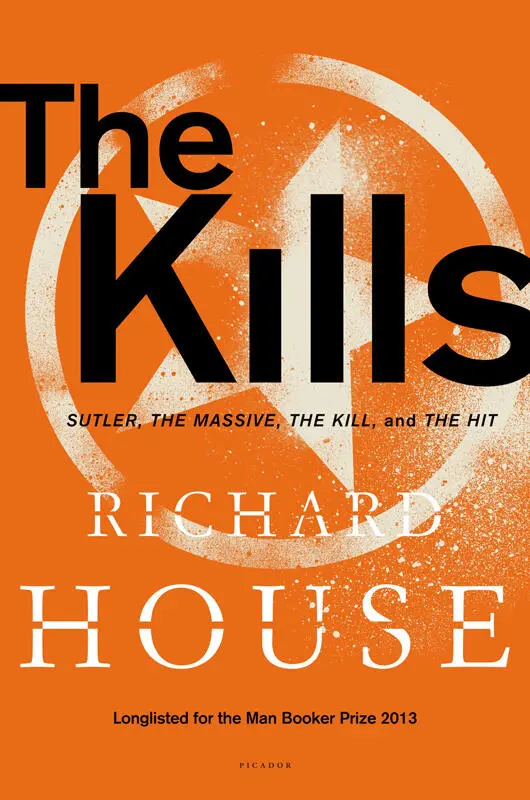
- Название:The Kills
- Автор:
- Издательство:Picador
- Жанр:
- Год:2013
- ISBN:нет данных
- Рейтинг книги:3 / 5. Голосов: 1
-
Избранное:Добавить в избранное
- Отзывы:
-
Ваша оценка:
The Kills: краткое содержание, описание и аннотация
Предлагаем к чтению аннотацию, описание, краткое содержание или предисловие (зависит от того, что написал сам автор книги «The Kills»). Если вы не нашли необходимую информацию о книге — напишите в комментариях, мы постараемся отыскать её.
The Kills — читать онлайн бесплатно полную книгу (весь текст) целиком
Ниже представлен текст книги, разбитый по страницам. Система сохранения места последней прочитанной страницы, позволяет с удобством читать онлайн бесплатно книгу «The Kills», без необходимости каждый раз заново искать на чём Вы остановились. Поставьте закладку, и сможете в любой момент перейти на страницу, на которой закончили чтение.
Интервал:
Закладка:
7.2
Stéphane arrived early and sat with Ford as he finished his breakfast. The hotel’s comfort was increased by knowledge of the snow outside. Stéphane sat without speaking in a thick coat that seemed to hold cold about it. Ford thought that he was wrong about the man, he wasn’t inept at all but shy, he stuttered slightly, blinked, shut his eyes when he spoke, and found English uncomfortable, as if his thoughts did not quite lend themselves to this language. He passed Ford a leaflet and suggested that they both go. Martin’s exhibition was open, and it was very close. They could visit Magazin before the university. It would be on their way.
* * *
The exhibition centre, a refurbished factory with a large glass roof, a flat front, and broad hangar doors, was located at the edge of the city in an old industrial estate. Ford came into the building through a small metal door. The word ‘Magazin’ ran in a signature pale blue across the entire front. Inside, incongruous with the arcane industrial iron and glass building, sat an immense white cube, bigger than a house, with one curtained wall. Through this — and it took Ford’s eyes a moment to adjust — was what he took to be a cinema, although there were no seats and one wall, being larger than any screen he had seen before, held a massive, pulsing and shifting digital image. An image so immense that the people standing inside the cube appeared irrelevant, diminished; mites in an upturned box.
* * *
Overawed by the scale, Ford looked up. Hands crossed the screen, red fingers of spangled light, before the blur clarified to a close shot of scrubland, or rocks and sand: a rock face. The image twisted in and out of focus, showing a sinew, white then pink, the sky, the rock face, a strange beat to the pace, slowed down and almost soundless: the entire space brightened and plunged into darkness as light swelled from the screen. When the picture came into focus it showed the wide bowl of a dusty valley, and Ford felt a pang of recognition. The shot held for a brief moment, and Ford could recognize Mehmet’s van, and stopped some distance before it two figures: Nathalie, himself. Breathing filled the space, intimate, laboured, drawing down the air and calling upon the people watching to breathe in time. Not one word spoken, but Eric’s breath, husky, edged with tone, just about to speak, a hesitation between thoughts. And there, bright for one moment, the camera turned to show the boy himself, his hand wedged into the rock face, hanging by one arm and smiling — dark eyes, jet black; a generous mouth — another hesitation, a half-smile held and lost.
His first sense that he was running to a plan outside of any agreement he might have made came as they returned to Stéphane’s car, and Stéphane mentioned that Eric’s mother, Anne Powell, was in Grenoble collecting her son’s belongings from the university. The statement, which was supposed to sound casual, came out of Stéphane’s mouth as a brittle and predetermined fact. Nothing casual about it.
‘She would like to meet you.’
And how interesting would that be? How dangerous? Already seated and belted, Ford could see the trap, and guessed that they had no idea what they had set up. Anne Powell would recognize him from Malta, without doubt, and there would be no rational way to explain this coincidence. For a mother missing her son she would see only plots and intrigue. This simply couldn’t happen.
‘Will she be at the university? Now?’
Stéphane half-turned. He didn’t think so, but his explanation sounded untruthful. ‘I heard from her yesterday, she’s staying at Nathalie’s in Lyon. She has a car to collect. I think she’s in town tonight, but I can organize something for you.’
‘Tonight?’
‘Yes. Tonight.’ The man nodded to himself. ‘I think so?’
They discussed times and suitable restaurants, Ford knew he would be long gone. As soon as he had the information from the notebooks he would leave.
* * *
It wasn’t until he came into the room that he realized he’d been tricked. Stéphane’s slowness that morning, his suggestion that they visit Magazin, was calculated to bring him to the university at a specific time.
On the table, set deliberately in view, laid side by side, were six of Eric’s small black notebooks. Behind the table sat two investigators from Colson Burns who rose immediately, hands offered in introduction, beside them two vacant seats. One of the men was the man from the bar, Mark Mathews, and he offered his hand a little apologetically, admitting that yes, it was quite a coincidence that they were staying at the same hotel.
‘I didn’t see you at breakfast.’
The man flushed and admitted it was a long night. Ford doubted that any of this was coincidental.
Once the men had introduced themselves they suggested that they wait. They were hoping that someone else would join them.
After an awkward wait they started. Whoever else was coming would arrive later, if Ford didn’t mind the interruption. The men apologized, and seemed a little uneasy, fidgeting with their jackets and hands. First, there was the question of his name: in Eric’s notebook he was first referred to as Michael, not Tom? It is Tom?
Ford nodded, ‘Tom Michael.’ He held Mark Mathews’ eye then smiled.
Mark Mathews said, ‘Oh,’ simply, and returned Ford’s smile, ‘I see,’ and drew a pen across something he’d written. ‘Do you have any form of identification?’
Ford titled his head and said that his passport was back at the hotel.
‘A driver’s licence?’
‘Hotel.’
A poor performer under stress, Ford was surprised to find that he had the situation in hand. As a man who actively disliked the pressure of small negotiations and interviews, he decided upon presenting the facts, and presented them in their simplicity, starting with the coach station at Kopeckale. These people wanted answers, he told himself, plain statements, they did not want questions or doubts.
He gave a brief description of his first encounter with the boy, and allowed the investigators to interrupt. When he answered questions he made sure that he appeared thoughtful, and made allowances for interpretation. Between them the group explored the inconsistencies that rose between the three versions: Nathalie, Martin, and Ford.
‘He stayed on the coach, and said nothing about where he’d been. I later saw bruises and scratches down his side when he was changing, and he asked me to keep quiet because Nathalie wasn’t comfortable with him climbing on his own. He said he’d made a promise to her.’
About Martin: ‘Nathalie told me about the project, and Eric let me know some of the tensions. I think his interest in the project was sincere. Martin was clearly his tutor, and Eric worked for him, as you’d expect. I didn’t see anything that looked otherwise. In private, I think he wasn’t impressed by Martin, he didn’t have much respect for him. I think he found Martin hard work. They bickered in the way that people bicker when they’ve spent too much time together.’
About Eric’s interest in him: ‘I didn’t have any idea. The last time we spoke, as I’ve said, I was waiting for a bus and I wasn’t paying much attention, and he was annoyed with me. I really didn’t catch what he was talking about. He was looking forward to leaving, but it didn’t sound like he had an immediate plan. I think he was going to meet his mother. We had a couple of drinks, just tea, then he left, he seemed frustrated, but nothing out of the ordinary. When I paid the bill he came back, and that’s when he approached me. It wasn’t much, but I wasn’t expecting it. I think it was obvious that I was surprised and that I wasn’t interested.’
‘This is when he kissed you?’
Читать дальшеИнтервал:
Закладка:
Похожие книги на «The Kills»
Представляем Вашему вниманию похожие книги на «The Kills» списком для выбора. Мы отобрали схожую по названию и смыслу литературу в надежде предоставить читателям больше вариантов отыскать новые, интересные, ещё непрочитанные произведения.





Обсуждение, отзывы о книге «The Kills» и просто собственные мнения читателей. Оставьте ваши комментарии, напишите, что Вы думаете о произведении, его смысле или главных героях. Укажите что конкретно понравилось, а что нет, и почему Вы так считаете.