Richard House - The Kills
Здесь есть возможность читать онлайн «Richard House - The Kills» весь текст электронной книги совершенно бесплатно (целиком полную версию без сокращений). В некоторых случаях можно слушать аудио, скачать через торрент в формате fb2 и присутствует краткое содержание. Год выпуска: 2013, Издательство: Picador, Жанр: Современная проза, на английском языке. Описание произведения, (предисловие) а так же отзывы посетителей доступны на портале библиотеки ЛибКат.
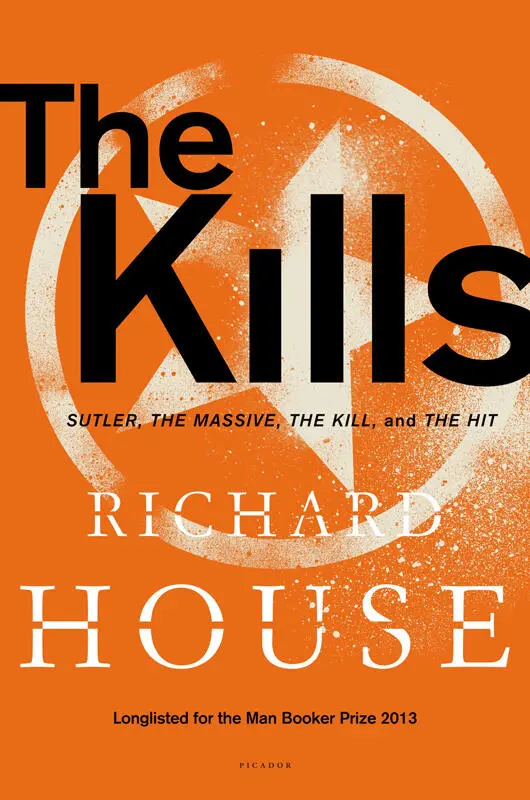
- Название:The Kills
- Автор:
- Издательство:Picador
- Жанр:
- Год:2013
- ISBN:нет данных
- Рейтинг книги:3 / 5. Голосов: 1
-
Избранное:Добавить в избранное
- Отзывы:
-
Ваша оценка:
The Kills: краткое содержание, описание и аннотация
Предлагаем к чтению аннотацию, описание, краткое содержание или предисловие (зависит от того, что написал сам автор книги «The Kills»). Если вы не нашли необходимую информацию о книге — напишите в комментариях, мы постараемся отыскать её.
The Kills — читать онлайн бесплатно полную книгу (весь текст) целиком
Ниже представлен текст книги, разбитый по страницам. Система сохранения места последней прочитанной страницы, позволяет с удобством читать онлайн бесплатно книгу «The Kills», без необходимости каждый раз заново искать на чём Вы остановились. Поставьте закладку, и сможете в любой момент перейти на страницу, на которой закончили чтение.
Интервал:
Закладка:
The man — smart, trim, black hair, white skin as if he never spent time outdoors — watched Rem, unabashed. Dressed in a smarter suit, with smarter shoes, a trimmer haircut, the man appeared separate from the other businessmen gathered in the lobby. You come to a town, any town, you stay in a hotel, you do business. This could be any week of the year.
Rem decided to go, toasted the businessman and drank down the beer. The man turned his head to the side, glanced at leisure along the bar, then back at Rem, and Rem wondered if he was missing something. He couldn’t suppose what the other man was thinking, and thought the exchange so blank that it bore a hint of hostility.
The man stood and came up to the bar, and while he didn’t face Rem, it was clear, by the way he spoke and the turn of his shoulder that he was being addressed.
‘One of my favourite novels opens on a street in New York. The main character thinks he’s being followed, so he slips into a bar to lose him, and this man follows right after. Another?’
The businessman watched the last foam spitline slide down Rem’s empty glass. Did he want another drink? Hooded eyes. Dark lashes. A man so carefully presented that he might be playing himself. His accent, Southern, not a drawl so much as an affectation, pronounced and aware.
‘Another?’
Rem said he would, though he shouldn’t. The businessman nodded. ‘Same. I’m supposed to meet with people.’ He signalled to the waiter for two more beers. ‘ Business. They talk figures. Statistics. Money.’ He took a twenty from his wallet and folded it around his forefinger.
‘You were talking about a book?’
The man drew a quick breath. ‘He thinks he’s being followed. It’s a great moment, because he’s right, he is being followed, although he’s wrong about the reason.’ The businessman leaned against the bar, all smooth friendliness, a light turned on. ‘It’s just. Well, it’s just very strong, how he thinks he’s being followed because he’s done something, and he thinks he’s been found out — and, you know, you never find out what that trouble was, the reason for him being so anxious. You never learn. Instead this man offers him a job. He wants him to go someplace and find someone because he’s mistaken this man for someone else. So both men are mistaken. It’s a really nice place to start.’
Rem looked to the elevator. The doors opened to an empty cab. ‘I never read.’
The man smiled at Rem’s accent. ‘You sound British,’ he said, ‘but I’m guessing you’re not. I’m hearing something else?’
‘Scandinavian. Raised in the Netherlands. Norwegian father. Dutch mother.’ Rem spoke as if giving evidence. Nearly four years in his early twenties working ad-hoc jobs in London had fixed his accent, and once in a while it struck him, came to his ears at a wrong angle, and he’d wonder at the foreignness of his speech, of the assumptions people made, the unintended deceit of belonging to one place but sounding like another.
‘Family?’
‘Wife.’ Rem raised his glass. ‘From Texas. You?’
‘Pittsburgh, then North Carolina, then Virginia, now Europe. You don’t look like you’re here for the expo?’
Rem said no and set his glass on the counter. No he was not.
‘You look preoccupied.’
‘I do?’
‘You do. So tell me, what do you do for work?’
‘I have my own business, house painting, decorating, but…’ Rem opened his hands, showed them to be empty.
‘It’s like that?’
‘Most definitely.’ Rem sucked in air, slow and deliberate. ‘I’m thinking of letting everyone go. Putting it aside and waiting out whatever we’re going through.’ He looked at the man. ‘To be honest, I don’t know.’
‘How many people do you have?’
‘Three full time. Seven part — or casual — depending on the job.’
‘Small. I don’t know if that makes it easier or harder. And this means what? You’ll go self-employed?’
‘Natural step.’
‘Self-employed, you’d be looking at, annual?’
Rem shrugged, stretched his back against the bar; he had no idea. ‘Twenty-seven?’
The man gave a laugh as if this was a good joke. Twenty-seven, now that was funny.
‘I meant twenty-seven is what I owe.’
The businessman hesitated, absorbed the statement, then offered, ‘Twenty-seven isn’t so bad. If it’s fixed.’
‘If you have work.’ Rem explained himself in a low voice, keen not to be overheard. ‘Twenty-seven. That’s what I owe in wages and loans, debt I’ve taken on.’
The man drew a wallet then a business card out of his pocket. His suit, tailored, black, a little feminine with a sharp-blue lining, behind or ahead of the times, Rem couldn’t tell. Paul Geezler, Advisor to the Division Chief, Europe, HOSCO International. Rem shook the man’s hand and repeated his name. Geezler. German?
‘Pennsylvania Dutch. If you’re serious about looking for work,’ Paul Geezler took back the card and wrote a booth number on the back, ‘take a look at the expo. If this doesn’t interest you there are others recruiting, and they’ll be looking for people with skills.’ He pointed to Rem’s paint-specked hands. ‘They’re looking for anyone who’ll take on a challenge. People who don’t mind a little hardship as long as the money is good. And the money is good.’
Rem couldn’t help but smile. ‘Where’s the work?’
‘Dubai, less and less. Now it’s Kuwait. Kuwait and Iraq.’
‘I can’t do that.’
‘You’ll clear your debt.’
‘That’s how I raised the start-up money: Kuwait, worked on the hotels.’
‘Construction?’
‘Six weeks. Fitting, finishing, painting. They kept building. You could watch them go up. Fourteen new builds in six weeks.’ Rem raised his hand and tower blocks grew around them. ‘Every one a hotel.’
The businessman nodded. Rem referred to the card, the memory of those six weeks caught with him.
And when was Kuwait? Before the surge or after? He couldn’t remember. He could hardly say he’d seen Kuwait, just views from hotel rooms in which buildings grew faster than flowers. It wasn’t even six full weeks on site, closer really to five. Five short weeks with a team of men, one from St Louis, one from Cedar Rapids, and two Brits from Dev-un, that’s how they pronounced it, Dev- uhn, all particular and resentful, not Dev- on, the way it’s spelled. For five or six weeks the men barely spoke and worked in high-rise high-class hotels, progressing floor by floor, and paid in cash by the completed unit. Money rained down. Tax-free. Divine.
Paul Geezler nodded, brisk and dismissive. ‘There’s a good number of possibilities.’ He became distracted as four men, all suited, came out from the elevator and drifted across their line of view. Paul Geezler fixed on them the same attention he’d fastened earlier on Rem.
‘You know them?’
‘I know him.’ Geezler gave a nod to the man in the middle of the group. ‘In six months his company won’t exist.’
‘You know this?’
‘Intimately. It’s a volatile world.’
‘And you?’ Rem asked.
‘It would take something to shake us. Something newsworthy. Monumental. Can I ask about your business? Can I ask what the problem was?’
‘Sorry?’
‘The problem. With your business.’
Rem straightened his back. ‘There isn’t any problem, except there isn’t any business. People stopped calling.’
‘I ask, because people ordinarily tell you why things haven’t worked out. You gave no explanation.’
‘It’s a small business. People stopped calling.’ He changed the subject. ‘You’re serious about having work?’
Читать дальшеИнтервал:
Закладка:
Похожие книги на «The Kills»
Представляем Вашему вниманию похожие книги на «The Kills» списком для выбора. Мы отобрали схожую по названию и смыслу литературу в надежде предоставить читателям больше вариантов отыскать новые, интересные, ещё непрочитанные произведения.





Обсуждение, отзывы о книге «The Kills» и просто собственные мнения читателей. Оставьте ваши комментарии, напишите, что Вы думаете о произведении, его смысле или главных героях. Укажите что конкретно понравилось, а что нет, и почему Вы так считаете.