J. Ledgard - Submergence
Здесь есть возможность читать онлайн «J. Ledgard - Submergence» весь текст электронной книги совершенно бесплатно (целиком полную версию без сокращений). В некоторых случаях можно слушать аудио, скачать через торрент в формате fb2 и присутствует краткое содержание. Год выпуска: 2011, ISBN: 2011, Издательство: Random House UK, Жанр: Современная проза, на английском языке. Описание произведения, (предисловие) а так же отзывы посетителей доступны на портале библиотеки ЛибКат.
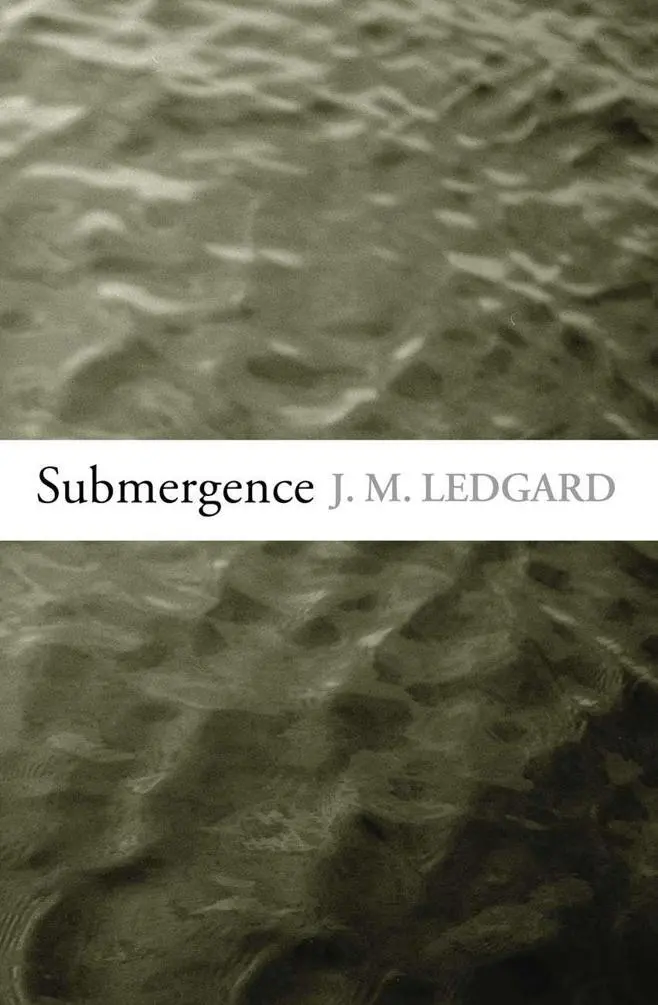
- Название:Submergence
- Автор:
- Издательство:Random House UK
- Жанр:
- Год:2011
- ISBN:9781446496831
- Рейтинг книги:5 / 5. Голосов: 1
-
Избранное:Добавить в избранное
- Отзывы:
-
Ваша оценка:
Submergence: краткое содержание, описание и аннотация
Предлагаем к чтению аннотацию, описание, краткое содержание или предисловие (зависит от того, что написал сам автор книги «Submergence»). Если вы не нашли необходимую информацию о книге — напишите в комментариях, мы постараемся отыскать её.
Both are drawn back to the previous Christmas, and to a French hotel on the Atlantic coast, where a chance encounter on the beach led to an intense and enduring romance. For James, his mind escapes to utopias both imagined and remembered. Danny is drawn back to beginnings: to mythical and scientific origins, and to her own. It is to each other and to the ocean that they most frequently return: magnetic and otherworldly, a comfort and a threat.
Submergence — читать онлайн бесплатно полную книгу (весь текст) целиком
Ниже представлен текст книги, разбитый по страницам. Система сохранения места последней прочитанной страницы, позволяет с удобством читать онлайн бесплатно книгу «Submergence», без необходимости каждый раз заново искать на чём Вы остановились. Поставьте закладку, и сможете в любой момент перейти на страницу, на которой закончили чтение.
Интервал:
Закладка:

A lot will depend on the ability of scientists to manipulate microbial life, so that in the future it can be trowelled into the grooves on an irradiated orb and animate life there. Once we learn how to throw a dome over the rock and calibrate gravity so that it does not stretch or wither us, make us sick, dull or depressed, then the animated moon can serve as a vessel. It will sit at the centre of a Saturn-sized ball of water and cruise through space, encased, a miniature Abzu, a marble within a marble.
The new world’s challenges will be similar to those at the bottom of the sea: how to avoid predators, how to eat and how to find a mate.
It is understandable you would want to come back as yourself into a wonderland with the sharpness of colour of the Queen of Hearts in a newly opened pack of cards. But coming back as yourself is resurrection. It is uncommon. It may even be greater than the scope of mathematics.
We cannot talk with definition about our souls, but it is certain that we will decompose. Some dust of our bodies may end up in a horse, wasp, cockerel, frog, flower or leaf, but for every one of these sensational assemblies there are a quintillion microorganisms. It is far likelier that the greater part of us will become protists than a skyscraping dormouse. What is likely is that, sooner or later, carried in the wind and in rivers, or your graveyard engulfed in the sea, a portion of each of us will be given new life in the cracks, vents, or pools of molten sulphur on which the tongue fish skate.
You will be in Hades, the staying place of the spirits of the dead. You will be drowned in oblivion, the River Lethe, swallowing water to erase all memory. It will not be the nourishing womb you began your life in. It will be a submergence. You will take your place in the boiling-hot fissures, among the teeming hordes of nameless microorganisms that mimic no forms, because they are the foundation of all forms. In your reanimation you will be aware only that you are a fragment of what once was, and are no longer dead. Sometimes this will be an electric feeling, sometimes a sensation of the acid you eat, or the furnace under you. You will burgle and rape other cells in the dark for a seeming eternity, but nothing will come of it. Hades is evolved to the highest state of simplicity. It is stable. Whereas you are a tottering tower, so young in evolutionary terms, and addicted to consciousness.
He had watched lambs gambol on the hill by the jinn pit. It would be an ecological future, where even the gas from cremations would be captured for power generation. Yet his experience in Somalia — with darkness and deprivation, the famished condition of the Somali people, the desolation of the wadi, his clashing on behalf of the Enlightenment (so he persuaded himself) — would look like a buccaneering life to many in that future, to be envied above a world in which every infant was to be registered at birth and tracked with implants drilled into bone.
In another of the letters Danny had written him, she had reported the unexpected pleasure of looking after a dog for a friend; taking the dog for walks, brushing its coat, trying to read its expressions in the evening, before moving continuously into thoughts about the new human beings that will be available within a few decades:
I wonder if we’ll have anything of Jenny in us. Her eyes, her wagging tail, her eagerness to please. Probably not. We’ll get new muscle and ligaments, new skin, new eyes and ears. What’s the Olympic motto? Faster, higher, stronger? It’s predatory. We’ll go for snakes, hawks and sharks. Some of it will be messing about with genes, splicing, but a lot is going to be technology. A metal exoskeleton, I should think. More bounce, better protection. We might find a way to link human memories to a mainframe …
The letter ventured off into talk of the town and holiday plans, then circled back.
People who say no to upgrades will end up in caravan parks and wild places. They will become slower and weaker relative to the others. In time they will turn into curiosities, human beasts, until curiosity dies like it did for Kafka’s hunger artist, who fasted to death in a cage and was replaced with a panther.
His brain was white stuff: spermaceti, galantine. The shapes that played on the inside of his eyelids were vivid, and when he retreated further into New Atlantis he saw the important horse race of the season was run on a course very like the racecourse in his town in northern England — a flat race that had been run since the reign of King George III — he sensed that the place names of the villages in New Atlantis were Anglo-Saxon, and that this was natural, because the Angles and Saxons came from a landscape that was similar to that remote island — their language was sensitive to dips in the land, the culvert under a hill, the slopes and mounds, there were leas, dales, holts, slades and wolds in New Atlantis, as there were in England. Somalis must have similar words. The land he passed over on the lorry had glowered; it was waterless, unmarked and unnamed to him, just the wadis, the companionless trees, and the shadows in the cuts of the badlands.
There were days when the wind blew hard before the rain and he had to anchor his net with rocks. The creek turned to jade, crabs scuttled in greater numbers on the banks of putty mud from one settlement to another. The tide rose, and there was gunfire and shouting in the forest.
Almost all of his sober passages of thought involved people long ago dead. He wished he was in England, following the edges of a wood … God, enough. He wished he was with her. That was all. It didn’t matter where. It had been his training to push away thoughts of what might be but now he was in the place of martyrs and he was slipping away and there was no more space for death, there was only space for life, for her. She was so beautiful, to him, so strong, so true. He wanted more than anything to hold her. He could feel the embrace; her shirt, her shoulders, his head on her shoulder, her hands cradling him; him sobbing into her, crying the way you do in dreams, without any inhibition. He had recreated every word, every experience of her; tried to understand it. And the joy; the joy was that he was not making it up. She felt the same way. She said so in the letters she had sent him, always physical letters, handwritten, so he could never be at liberty to file her away, she said, or share her on a screen.
But death is remorseless. Death is the tide which sweeps away consciousness. It is the absolute zero which stops any acceleration. Poetry speaks of the ocean as a tomb, whereas science reckons it to be a womb. If you must waste away or perish violently in the morning light then a burial at sea might resolve this conflicted view. Lash me in a hammock and drop me deep … Would you wish to be sunk to a great depth, or to be dropped a fathom down, on a reef, gently rocked, until your bones are of corals made and you suffer a sea change into something rich and strange?
A year or so before — it seemed a lifetime ago — he had been at a dinner party on a farm not far from Mount Kenya. It was well attended, very smart, but the mood was subdued: a European royal who had been a close friend to the hosts lay gravely ill in his palace overlooking the North Sea. This royal had promised — extravagantly or on a Jungian impulse — that were it possible, his soul would take the form of a daemon at the time of his passing and appear to his friends. During the main course, a bird with carmine breast feathers appeared on the veranda. No one at the table had seen such a bird before. It was remarked upon. The bird did not settle in the thatched roof with the weaverbirds, but sat forthrightly on a vase in front of the hostess. It looked at her, cocking its head to one side in the way birds do, then it hopped around and regarded the others at the table.
Читать дальшеИнтервал:
Закладка:
Похожие книги на «Submergence»
Представляем Вашему вниманию похожие книги на «Submergence» списком для выбора. Мы отобрали схожую по названию и смыслу литературу в надежде предоставить читателям больше вариантов отыскать новые, интересные, ещё непрочитанные произведения.


Обсуждение, отзывы о книге «Submergence» и просто собственные мнения читателей. Оставьте ваши комментарии, напишите, что Вы думаете о произведении, его смысле или главных героях. Укажите что конкретно понравилось, а что нет, и почему Вы так считаете.