J. Ledgard - Submergence
Здесь есть возможность читать онлайн «J. Ledgard - Submergence» весь текст электронной книги совершенно бесплатно (целиком полную версию без сокращений). В некоторых случаях можно слушать аудио, скачать через торрент в формате fb2 и присутствует краткое содержание. Год выпуска: 2011, ISBN: 2011, Издательство: Random House UK, Жанр: Современная проза, на английском языке. Описание произведения, (предисловие) а так же отзывы посетителей доступны на портале библиотеки ЛибКат.
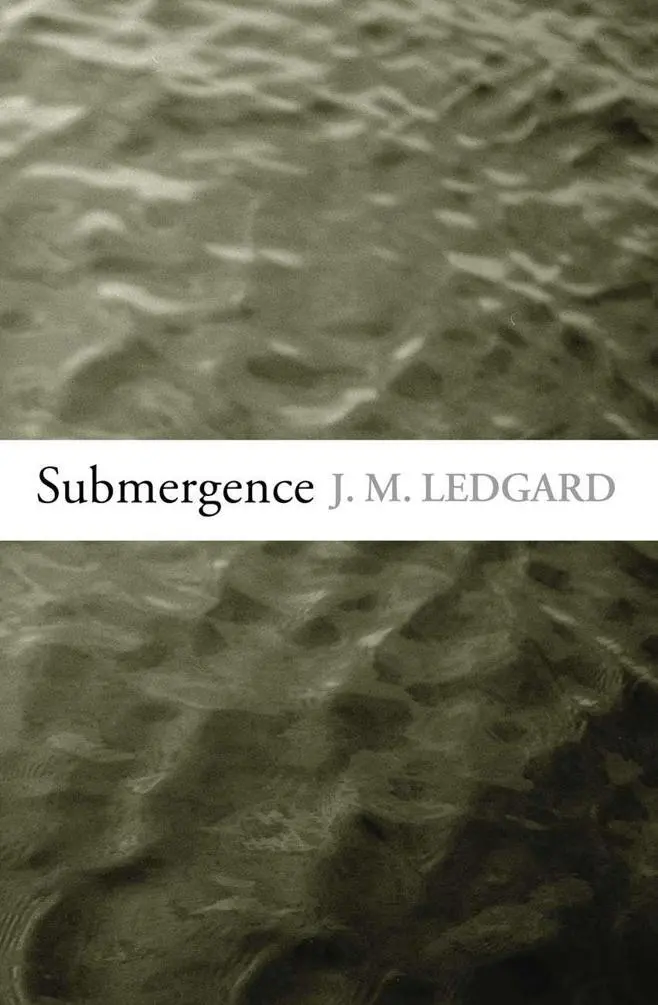
- Название:Submergence
- Автор:
- Издательство:Random House UK
- Жанр:
- Год:2011
- ISBN:9781446496831
- Рейтинг книги:5 / 5. Голосов: 1
-
Избранное:Добавить в избранное
- Отзывы:
-
Ваша оценка:
Submergence: краткое содержание, описание и аннотация
Предлагаем к чтению аннотацию, описание, краткое содержание или предисловие (зависит от того, что написал сам автор книги «Submergence»). Если вы не нашли необходимую информацию о книге — напишите в комментариях, мы постараемся отыскать её.
Both are drawn back to the previous Christmas, and to a French hotel on the Atlantic coast, where a chance encounter on the beach led to an intense and enduring romance. For James, his mind escapes to utopias both imagined and remembered. Danny is drawn back to beginnings: to mythical and scientific origins, and to her own. It is to each other and to the ocean that they most frequently return: magnetic and otherworldly, a comfort and a threat.
Submergence — читать онлайн бесплатно полную книгу (весь текст) целиком
Ниже представлен текст книги, разбитый по страницам. Система сохранения места последней прочитанной страницы, позволяет с удобством читать онлайн бесплатно книгу «Submergence», без необходимости каждый раз заново искать на чём Вы остановились. Поставьте закладку, и сможете в любой момент перейти на страницу, на которой закончили чтение.
Интервал:
Закладка:
Under the floor of the Grand Mosque in Mecca, where the Kaaba stands, is a honeycomb of lava caves. It was into those caves that the religious radicals who seized the Grand Mosque in 1979 retreated. These men were convinced that the Mahdi had come to rule the last days of the world. They were fighting for him.
The caves are deep in places, with, on the walls, films of the microbial life we shall arrive at. The Mahdis put up a determined fight, broken only when the Saudi government converted French commandos to Islam. These Frenchmen oversaw the pumping in of poison gas, grenades, gunfire and flares into the caves. The Mahdi women hidden directly below the floor of the Kaaba cut the faces off their men to confound identification. Many of the Mahdis fought to the death. Those who surrendered were secretly tried and publicly beheaded in four different Saudi cities.

Being in the dark, in the heat, being so often sick, bitten by insects and rodents, with visitations of light, made his mind unsteady. There was an uncertainty in him which held that the executions by axe in Tudor England and the executions with curved swords in Saudi Arabia and with a dagger in the face in Somalia resembled one another and that the blood spilled by each of them was commingled.
It was a solitary confinement. He spoke Arabic, but had no interpreter for Somali. They had not allowed him a phone call. There was no talk of a ransom. His captors were nothing like the pirate gangs in Haradheere and Hobyo, or the Taliban factions he had worked with and against in Afghanistan who would sell any captive for money.
He ran on the spot. He performed headstands. He made a list of the books he would load onto his electronic tablet when he was freed. His name was James More and he was a descendant of Thomas More and he supposed he would read Utopia again. He put together all that he had learned or surmised about the group holding him, with the goal of delivering it in person at a debriefing at the Secret Intelligence Service building in London. Legoland. In this work his mind was not at all troubled. He memorised the faces of the fighters who were not Somalis, their skills and the Arabic they spoke, one to the other.
In some hostages the memory of their life before goes away, or else there is a sense of suspension, as there is during a severe hospitalisation. For him, it was as if some faces were safer than others, and some memories more important. Many intimate details he could not dwell on, yet others were insistent. His subconscious was trying to make sense of a whole that was turning and guttering and shedding itself like a planet in its infancy. There were passages of thought about things he had never paid attention to, such as companies who used to advertise widely and had since disappeared. What had happened to Agfa, for example?
He wondered why it was that street kiosks in Africa had not created their own product lines. Why could you not buy a compliment from a vendor in a slum the way you bought a stick of gum or a cigarette? The smallest coin might buy a folded piece of paper with a handwritten note: you are gentle, you are gorgeous , or, your future achievements will overshadow your past achievements .
At other times, he set his mind the task of playing back the sound and images it had stored. It helped to be patient. He put himself again in the winter forest, breathed out, and looked up. Snowflakes drifted down. Slowly, music came to him. Pop, punk, fragments of symphonies and jazz sessions. Finally, there were films and television shows, sports events; a match point, a rugby try. He became his own multimedia player, although there was nothing automated about it; it was biological, twitchings in red mud, with stanzas missing; moving pictures were fragile, they flickered, and then were gone.
The sunbeam from the water pipe hole moved across the wall during the day. He followed it. He could see it strike the wall only if he turned to face it. If he did that, he could not see it coming in. It bothered him. Every human being faced forwards. Walked forwards. Ran forwards. Looked out through socketed eyes. Time ran forwards. One day added to another. Addition and subtraction. Danny said that subtraction was the least part of mathematics because it was the taking away of what was. He banged the back of his head against the wall. Just hair. Skin on bone. He averted his eyes from the mosquitoes dancing in the light. He adjusted the cardboard. He said to himself, because of charity and love you should never allow death to rule your thoughts.
He crouched in a corner and came to terms with the volume of the room. Before, he had seen every room by the furniture and decorations in it, and by the light coming in through the windows or from electric bulbs. Here, hollowness gaped all around. The air was fouled, oily, beaded; he was sunk to the bottom, on a floor of excrement, and the ceiling was the underside of the surface of a strange sea.
Pieter Bruegel the Elder’s painting The Fall of the Rebel Angels shows us there really is a force to subtraction: you subtract from an angel until you end up with a demon. If you download an image of the painting onto your computer, or better yet see it hanging in the Royal Museum of Arts in Antwerp, you will notice how the rebel angels fall from heaven at the top left of the canvas to hell at the bottom right. Their wings are at first subtracted for the lesser wings of bats and dragons. Towards the earth they are reduced to moths, frogs and other soft things. They are driven together by the golden angels of heaven armed with effulgent discs, lances and swords, whose task it is to sanitise our world. You will see how the rebel angels continue to change their forms as they are driven into a sea, whose opening is an obscure drainpipe. They lose their legs, wings, all hope of surfacing and become fish, squid, spawn and seeds of trees never to be planted. Underwater they continue to be subtracted from their former selves until they are at last incorporeal and see-through at the bottom.
It would be interesting to show a print of this painting to a jihadist fighter, who may never have known anything so visually imaginative, and see if he would stand aghast or applaud the angels, who spear and prick the swollen creatures.
She took a TGV from Paris and changed at a country town for a single-carriage train which rattled over seemingly narrowing tracks, and not unpleasantly — indeed, rattled in such a way that she could no longer work on her laptop, and so closed it deciding that her holiday had begun. She glanced at her fellow passengers, typecast fishermen’s wives and farmer’s children of a ruddy complexion, and stared out at the land. This part of France was coming to a standstill. It was the week before Christmas, the time of hard Gothic frosts and the first snow that stayed. The leaves were all blown off the trees, the streams and rills covered in thin ice and the ditch water beside the tracks frozen thick with air pockets on the underside, as though beaten out by the paws and mittens of panicked animals within. She saw the austere beauty in all of this, and the mathematics also. Suddenly, the sea presented itself between two smooth breast-shaped hills. She smiled: she was always returning to it.
Her stop was more of a halt than a station. She helped a pensioner off, then went back and took down her bag. The platform was of the kind that sloped away at both ends. In the centre was a plastic shelter like a bus stop. She stood in it out of the wind. A timetable was pasted up: there was a notice from the church, another from the cycling club, and a handwritten offer for goose liver. Graffiti had been sprayed on one side, four tags in a single colour. It was uncomplicated, but she was grateful to be standing there in the calm, not in London in the noise.
Читать дальшеИнтервал:
Закладка:
Похожие книги на «Submergence»
Представляем Вашему вниманию похожие книги на «Submergence» списком для выбора. Мы отобрали схожую по названию и смыслу литературу в надежде предоставить читателям больше вариантов отыскать новые, интересные, ещё непрочитанные произведения.


Обсуждение, отзывы о книге «Submergence» и просто собственные мнения читателей. Оставьте ваши комментарии, напишите, что Вы думаете о произведении, его смысле или главных героях. Укажите что конкретно понравилось, а что нет, и почему Вы так считаете.