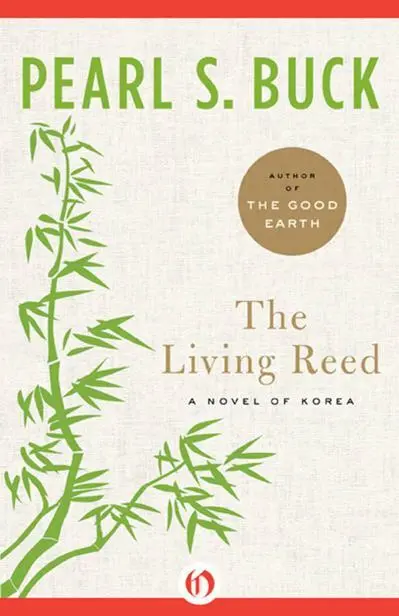
Pearl Buck - The Living Reed
Здесь есть возможность читать онлайн «Pearl Buck - The Living Reed» весь текст электронной книги совершенно бесплатно (целиком полную версию без сокращений). В некоторых случаях можно слушать аудио, скачать через торрент в формате fb2 и присутствует краткое содержание. Год выпуска: 2012, Издательство: Open Road Media, Жанр: Современная проза, на английском языке. Описание произведения, (предисловие) а так же отзывы посетителей доступны на портале библиотеки ЛибКат.
- Название:The Living Reed
- Автор:
- Издательство:Open Road Media
- Жанр:
- Год:2012
- ISBN:нет данных
- Рейтинг книги:4 / 5. Голосов: 1
-
Избранное:Добавить в избранное
- Отзывы:
-
Ваша оценка:
The Living Reed: краткое содержание, описание и аннотация
Предлагаем к чтению аннотацию, описание, краткое содержание или предисловие (зависит от того, что написал сам автор книги «The Living Reed»). Если вы не нашли необходимую информацию о книге — напишите в комментариях, мы постараемся отыскать её.
, Pearl S. Buck’s epic historical novel about four generations of one aristocratic family in Korea. Through the story of the Kims, Buck traces the country’s journey from the late nineteenth century through the end of the Second World War. The chronicle begins as the Kims live comfortably as advisors to the Korean royal family. That world is torn apart with the Japanese invasion, when the queen is killed and the Kims are thrust into hiding. Regarded by Buck as “the best among my Asian books,”
is a gripping account of a nation’s fight for survival, and a detailed portrait of one family’s entanglement in the ebb and flow of history.
The Living Reed — читать онлайн бесплатно полную книгу (весь текст) целиком
Ниже представлен текст книги, разбитый по страницам. Система сохранения места последней прочитанной страницы, позволяет с удобством читать онлайн бесплатно книгу «The Living Reed», без необходимости каждый раз заново искать на чём Вы остановились. Поставьте закладку, и сможете в любой момент перейти на страницу, на которой закончили чтение.
Интервал:
Закладка:
The physician by this time was aged, and his hands trembled. Yet he examined the ear and then he called his assistant, a young Korean whom he had taught during the years.
“Your hand is better at this than mine,” he told the man. “I will stand beside you and help you, but you must hold the knife.”
Il-han stood watching. First they put his son to sleep, holding some liquid-soaked cotton to his nostrils as he lay on a table. Then when he was asleep, while Il-han was uneasy for the sleep was too much like death, the young doctor, his hands encased in thin rubber gloves such as Il-han had never seen before, took a small thin knife from a tray held by a woman aide, and he cut the boy’s ear lobe and split it cleverly. Next with a needle and thread he sewed it into shape and attached it to the head. When all was finished, he tied on a bandage.
“Come back after a few days,” the old American doctor said, “and in ten days or so, you will see your son’s ear as like the other as his two eyes are alike.”
Sunia made much ado when Il-han brought the boy home again, for he had not told her, knowing she would be fearful and forbid it. But the ear healed well, and then the boy was perfect. Il-han was glad, except that he thought the elder son was colder to him than ever after the younger son was made perfect.
So much for his sons. The second accomplishment was a book that Il-han had been writing all these years. In it he put down, day after day, every wrong deed he heard done in the capital or in the nation. Friends visited him, though not often, and always in secret, and unknown men came to tell him stories of their sufferings, and again and again unknown members of the Tonghak came to his house and he received them because of Choi Sung-ho, but Sung-ho himself never returned, and when Il-han asked a Tonghak where he was, that man shook his head or shrugged his shoulders and none seemed to know who he was or if any knew him, they did not know where he was.
From whatever he learned from such persons and from every other source possible to him now, Il-han wrote in his book. He wrote down what every yangban spent on bribes and trickeries, and what every soban connived. When new governors were appointed for the provinces, he found out what time they left and when they arrived, how much they spent on the way, what women they took with them, or slept with as they went, who was bribed for what, and who welcomed them when they came to their new places, and who paid for the feasts and the dancing girls, and whether Japanese spies talked with them, and whether they met in secret with Japanese or Chinese or Russians, and if they traveled and where and how long they stayed away from their posts and who were their hosts and what favors were asked and if they were granted. When each such evil was known and written down in his book, and he saw how corruption weighed more heavily year by year upon the miserable landfolk, Il-han then wrote pages of what he believed should happen and how righteousness and justice could still be saved.
In the long evenings Sunia, her day’s work done, sat listening while he read aloud to her what he had written. Sometimes she was so weary with her household cares that when he paused to ask what she thought, he saw she slept. He never waked her, for he saw, too, in her sleeping face how much she had aged. The youthful beauty was gone, the lines of middle-age were clear, the same lines that he saw in his own face in the mirror in his bedroom. Seeing her, he only sighed and closed the book softly and let her sleep.
Yet there were other times when she did not sleep and when she listened, admiring, yearning for the world he wrote of in contrast to what was. On one such night he saw her weeping when he looked up to ask her if he wrote well.
“Now, Sunia,” he said, “have I written something wrong?”
She shook the tears from her eyes and tried to smile. “No, you have written all too well. But — but — oh, why can you not be heard? Will anyone ever read this book? I cannot bear to think your life is wasted here under this grass roof.”
He did not answer. Her question was the one he asked himself many times. Was his life wasted? Perhaps for his times and for his people, but not for himself. He had set the task of knowing what he was — he, a Korean. Now he knew. He closed the book.
“It is time to sleep,” he said. “The night grows dark and there is no moon.”
In the early evening of a certain night a messenger came on foot to the gate of Il-han’s grass roof home. Since he was a stranger, the gatekeeper would not admit him until he had himself inspected the man’s appearance. When he had looked at the man from head to foot, he let him in, but held him in the gatehouse under the guard of three other servants until he went to find his master and report the presence and the appearance of this stranger.
Il-han had finished his evening reading of the Confucian classics with his sons. In the mornings now their studies were in mathematics and history, in the afternoons their studies were in literature, and in the evening before they were sent to bed, Il-han read aloud to them the Book of Poetry or the Book of Changes , expounding in simple words the meaning of the sonorous, ancient words. Each learning period was short for he knew how easily the thoughts of the young wander afield, yet he believed that by this thrice-repeated period each day, his sons’ minds would be permeated with learning and with knowledge of the good, and he dreamed that though his life might be useless, in the lives of his sons his own might continue with benefit to his people.
In the calm of such comfort, then, he had bid his sons sleep well while he settled himself to his own studies, Sunia being absent at the moment and in the kitchen supervising the brew of a ginseng tea which he found soothing to his inner organs at the end of the day. At this moment the gatekeeper was announced by a servant and Il-han nodded his head for the man to enter. The gatekeeper came in and standing near the door in respect he bowed and then spoke.
“Master, there has come a stranger to our gate. I did not let him enter until I had looked at him well. He is a foreigner.”
Il-han let his pen fall from his hand. “Is he wearing foreign dress?”
“No,” the man replied. “He is in proper dress like yours, master. But his face is not our face.”
“Did he give his name?” Il-han asked.
“He said that you would know him if you saw him.”
“How could you understand a foreigner’s language?” Il-han inquired.
“He speaks our language,” the gatekeeper replied.
They looked at each other, master and man. One thought was in each mind. Was this a ruse in order perhaps to stab Il-han? Of all those whom the King had sent to America on the mission, only Il-han remained free in his own house. Min Yong-ik, when he had recovered from his wounds, lived in exile, hiding here and hiding there, rejected even by the Chinese whom he had tried to serve. Hong Yong-sik, who had chosen not to flee with the Japanese when the Chinese soldiers entered the palace, had been cut to pieces before the King’s eyes. So Kwang-pom escaped to Japan and had lived there in exile these ten years, and here in his own country he was now called a traitor. Others were in prison, or in exile in unknown distant villages and farms.
“Master,” the gatekeeper said in a low voice, “I will put my knife through this stranger, and throw his body in the pond.”
For a moment Il-han was frightened, but at himself, because he was tempted. It would be easy — a thing he would never do but if a gatekeeper, faithful to the family — who would know, or if knowing, blame the master? The next moment he recalled what he was and was ashamed. What — had the evil of the times permeated him, too, and to the soul? Because men were killed everywhere in treachery and in secret, was he to stoop to murder? Thus he inquired of himself, and the answer was no, and no again. He took his pen and fitted it into the silver cap and he closed his book and got to his feet.
Читать дальшеИнтервал:
Закладка:
Похожие книги на «The Living Reed»
Представляем Вашему вниманию похожие книги на «The Living Reed» списком для выбора. Мы отобрали схожую по названию и смыслу литературу в надежде предоставить читателям больше вариантов отыскать новые, интересные, ещё непрочитанные произведения.


Обсуждение, отзывы о книге «The Living Reed» и просто собственные мнения читателей. Оставьте ваши комментарии, напишите, что Вы думаете о произведении, его смысле или главных героях. Укажите что конкретно понравилось, а что нет, и почему Вы так считаете.