Pearl Buck - The Living Reed
Здесь есть возможность читать онлайн «Pearl Buck - The Living Reed» весь текст электронной книги совершенно бесплатно (целиком полную версию без сокращений). В некоторых случаях можно слушать аудио, скачать через торрент в формате fb2 и присутствует краткое содержание. Год выпуска: 2012, Издательство: Open Road Media, Жанр: Современная проза, на английском языке. Описание произведения, (предисловие) а так же отзывы посетителей доступны на портале библиотеки ЛибКат.
- Название:The Living Reed
- Автор:
- Издательство:Open Road Media
- Жанр:
- Год:2012
- ISBN:нет данных
- Рейтинг книги:4 / 5. Голосов: 1
-
Избранное:Добавить в избранное
- Отзывы:
-
Ваша оценка:
The Living Reed: краткое содержание, описание и аннотация
Предлагаем к чтению аннотацию, описание, краткое содержание или предисловие (зависит от того, что написал сам автор книги «The Living Reed»). Если вы не нашли необходимую информацию о книге — напишите в комментариях, мы постараемся отыскать её.
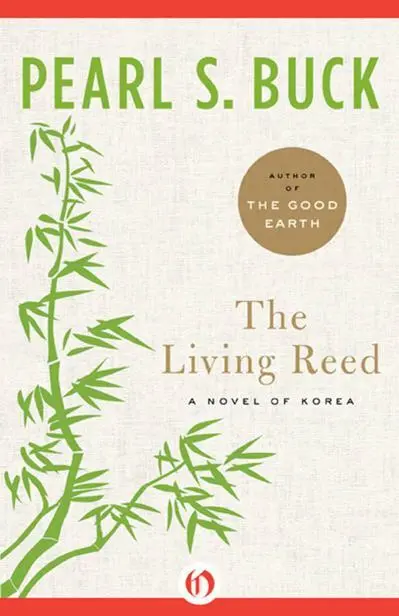
, Pearl S. Buck’s epic historical novel about four generations of one aristocratic family in Korea. Through the story of the Kims, Buck traces the country’s journey from the late nineteenth century through the end of the Second World War. The chronicle begins as the Kims live comfortably as advisors to the Korean royal family. That world is torn apart with the Japanese invasion, when the queen is killed and the Kims are thrust into hiding. Regarded by Buck as “the best among my Asian books,”
is a gripping account of a nation’s fight for survival, and a detailed portrait of one family’s entanglement in the ebb and flow of history.
The Living Reed — читать онлайн бесплатно полную книгу (весь текст) целиком
Ниже представлен текст книги, разбитый по страницам. Система сохранения места последней прочитанной страницы, позволяет с удобством читать онлайн бесплатно книгу «The Living Reed», без необходимости каждый раз заново искать на чём Вы остановились. Поставьте закладку, и сможете в любой момент перейти на страницу, на которой закончили чтение.
Интервал:
Закладка:
“How have you saved me?” he demanded.
“I saved you as my father saved your father,” the tutor replied. “When angry people were about to kill your father in his time, my father persuaded them to let him retire to this grass roof.”
“My father was a good man,” Il-han said.
The tutor was relentless. “A good man, but he did not lift his voice when others were evil. And you too, you are a good man, but you do not lift your voice. You have access to the King and to the Queen but you have not raised your voice for your people.”
Il-han returned look for look. “What would you have me say?”
For the first time the man’s black eyes wavered. “I do not know.”
He waited a moment, biting his lip. Then he lifted his eyes again to Il-han’s eyes. “For that, too, I blame you. It is you who should know, and because you should know, because you must know, I have saved your life and the lives of your family. Today, in the congress of the Tonghak, I stood up and declared that among those who are to die you must not be killed. You — you are not to die! But I swore by my own life that you would be brave enough, when you knew, to speak against the corruption of the government, and against the taxes heavy as death, and the pushing men from Japan who are bringing their cheap goods here for our folk to buy because there are no other goods. And above all, you must speak bravely against the Japanese tricksters who by one means and another are buying land from the landowners because the landfolk can no longer pay even the taxes on their harvests.”
These words fell upon Il-han like blows from an iron cleaver. For a while he could not reply, and indeed for so long that the tutor could not endure the silence and he cried out again.
“I tell you, it is only for this that I have saved you and your sons!”
To which Il-han again after a long silence could only answer with deep sighs and few words.
“Tonight I must rest,” he said.
“But tomorrow?” the tutor insisted.
“Tomorrow I will think,” Il-han promised.
The tutor rose then and bowed and went away, and suddenly Il-han was so weary that he could only look at Sunia, begging for her help.
“You need not speak a word,” she said. “Your bath is hot, your supper is waiting and then you must sleep.”
He rose. “You who understand—” He felt her hand slip into his and hand in hand they went toward the rooms she had prepared for their life.
“What shall I call you?” he asked the tutor.
It was noon of the next day when he summoned the man to come to him alone. He had not yet seen his sons, and he had told Sunia that he would not until he had spoken again with the tutor. His older son was old enough to have been shaped by his tutor beyond knowledge, and he must know not only what the tutor had to say further but also what he was. It seemed to him, after his sleepless night, that all his years until now had been meaningless. He had lived at the beck of the Queen and the call of the King, conceiving this to be his duty. Even his long journeys into his own country and then into the foreign countries had been in service of the truebone royal house, rather than for the sake of the people. Was it indeed true that people and rulers must be separate? When he served one, must it mean that he did not serve the other?
“I can no longer think of you as my son’s tutor,” Il-han said when the tutor came again into his presence. “You are someone I do not know. Your surname is Choi but what is your name?”
“Sung-ho,” the man replied. He smiled half ruefully. “I wish I could call myself after the great Ta-san of the past, but I am not worthy. I must continue merely to use the name my father raised for me when I went to school.”
“Perhaps you will make a great name of it,” Il-han said.
Sung-ho only smiled again.
“I have a question to ask,” Il-han went on.
“Ask what you will,” Sung-ho replied.
Il-han saw how confident the man was, how bright his look, how straight his carriage. He sat on his cushion without diffidence, eager and ready.
“Is it you who have shaped my elder son so that he prefers to live here in the country under this grass roof rather than in the city?”
“Inevitably I have shaped him,” Sung-ho replied. “At first it was only that the city was hot in summer while here it is always cool. But as I shaped him, I shaped myself. Had I not spent summers here with your father under this grass roof I might never have come to know the landfolk.”
“Are the people on my land Tonghak?” Il-han asked.
“They are,” Sung-ho replied. “At least all who are young.”
Il-han smiled wryly. “Does this mean that you will all rise up in the middle of some night and behead me?”
“No,” Sung-ho said sturdily. “It means that we look to you to speak for us.”
Il-han was somewhat confounded at this. Was he then in duress? He poured two bowls of tea, so that he could have time to think, and he handed one to Sung-ho, but not with both hands as he would to an equal. To his surprise, Sung-ho also took the bowl with one hand, and not with both hands as he must from his superior.
Il-han went on. “Tonghak is a dumping pot for all sorts of rascals and rebels, debtors who will not pay their debts, thieves who will not pay their taxes.”
Sung-ho did not yield one whit. “You know very well how common people insist upon tricks and conjurings from those whom they love and admire, and who they think can protect them, and is it just to demand that every Tonghak be free from corruption when the yangban themselves are corrupt?”
It was Il-han who must yield. “I cannot deny it,” he said.
At this Sung-ho softened his voice. “I exempt you always from the corruption of your kind. I know you to be an honest man, and I swore this in order to save your life.”
Il-han laughed. “You will not allow me to forget that I owe you my life!”
“I will not allow you to forget,” Sung-ho agreed, and he did not laugh.
Before Il-han could proceed, he heard the voices of his two sons, one shouting in anger, the other wailing in pain. Both he and Sung-ho leaped to their feet, but the door burst open and Il-han saw his elder son walking toward him and dragging something behind him. This something was nothing else than his sobbing younger son, bound hand and foot with rope. In his right hand the elder son held a dagger-shaped stick of bamboo.
“What are you doing?” Il-han shouted and seized his elder son while Sung-ho lifted the younger child to his feet and pulled away the rope. Without stopping to inquire why his elder son had been so cruel, Il-han lifted his hand and slapped him first on one cheek and then on the other, and this so hard that the boy’s head turned left and right and left and right. Now it was the elder one who began to roar loud sobs.
“You!” Il-han said between set teeth. “You, who are a savage!”
“No,” the child sobbed. “I am Tonghak, and he is a yangban who takes money—”
The younger child was loosed by now and Il-han clasped him and lifted him to his shoulder. The two men exchanged looks.
“You have made my elder son into a criminal,” Il-han declared.
Sung-ho returned his hard look with another as hard.
“Forgive me,” he said. “I do not belong in your house.”
With these words, he disappeared and from that time on Il-han saw him no more, nor did he know where he went or whether he would ever return.
Here Il-han was, then, left with the two children, both crying, and a servant ran to tell Sunia, and in a moment or two she was there. The child she comforted was the elder one, Il-han observed, and he protested.
“Do not comfort that one,” he exclaimed. “He would kill his brother if he could.”
Читать дальшеИнтервал:
Закладка:
Похожие книги на «The Living Reed»
Представляем Вашему вниманию похожие книги на «The Living Reed» списком для выбора. Мы отобрали схожую по названию и смыслу литературу в надежде предоставить читателям больше вариантов отыскать новые, интересные, ещё непрочитанные произведения.

Обсуждение, отзывы о книге «The Living Reed» и просто собственные мнения читателей. Оставьте ваши комментарии, напишите, что Вы думаете о произведении, его смысле или главных героях. Укажите что конкретно понравилось, а что нет, и почему Вы так считаете.