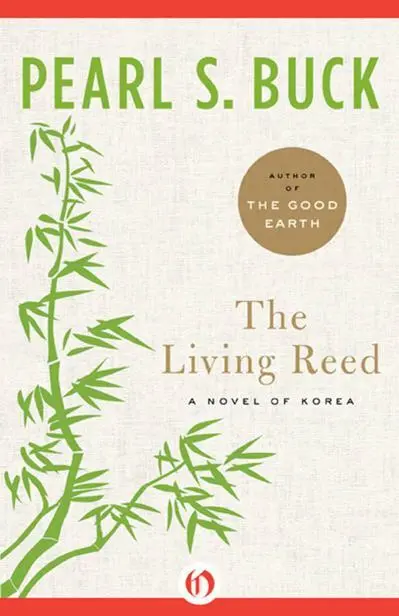
Pearl Buck - The Living Reed
Здесь есть возможность читать онлайн «Pearl Buck - The Living Reed» весь текст электронной книги совершенно бесплатно (целиком полную версию без сокращений). В некоторых случаях можно слушать аудио, скачать через торрент в формате fb2 и присутствует краткое содержание. Год выпуска: 2012, Издательство: Open Road Media, Жанр: Современная проза, на английском языке. Описание произведения, (предисловие) а так же отзывы посетителей доступны на портале библиотеки ЛибКат.
- Название:The Living Reed
- Автор:
- Издательство:Open Road Media
- Жанр:
- Год:2012
- ISBN:нет данных
- Рейтинг книги:4 / 5. Голосов: 1
-
Избранное:Добавить в избранное
- Отзывы:
-
Ваша оценка:
The Living Reed: краткое содержание, описание и аннотация
Предлагаем к чтению аннотацию, описание, краткое содержание или предисловие (зависит от того, что написал сам автор книги «The Living Reed»). Если вы не нашли необходимую информацию о книге — напишите в комментариях, мы постараемся отыскать её.
, Pearl S. Buck’s epic historical novel about four generations of one aristocratic family in Korea. Through the story of the Kims, Buck traces the country’s journey from the late nineteenth century through the end of the Second World War. The chronicle begins as the Kims live comfortably as advisors to the Korean royal family. That world is torn apart with the Japanese invasion, when the queen is killed and the Kims are thrust into hiding. Regarded by Buck as “the best among my Asian books,”
is a gripping account of a nation’s fight for survival, and a detailed portrait of one family’s entanglement in the ebb and flow of history.
The Living Reed — читать онлайн бесплатно полную книгу (весь текст) целиком
Ниже представлен текст книги, разбитый по страницам. Система сохранения места последней прочитанной страницы, позволяет с удобством читать онлайн бесплатно книгу «The Living Reed», без необходимости каждый раз заново искать на чём Вы остановились. Поставьте закладку, и сможете в любой момент перейти на страницу, на которой закончили чтение.
Интервал:
Закладка:
“Today,” he began, “I will tell you the story of Ta-san. Listen carefully, for when I have finished I will be able to tell whether you have understood, and I shall be angry if you show me that you have not listened.”
“Is the story true?” his elder son asked.
“True,” he said, “and full of meaning for us nowadays, although Ta-san lived before you were born or even I was born. But my father, your grandfather, knew him and learned much from him.”
He then told the story of Ta-san, concerning whom he had found many notes written by his father. He would not confess to himself that it was the tutor’s mention of Ta-san that had rekindled Il-han’s interest and sent him searching among his father’s notes.
“You must know,” he told his sons, “that our country, Korea, was the first in the world to make the printed word — that is, with movable type.”
Here Il-han paused. He paused to see if his elder son would ask what movable type was, but he did not. Il-han then went on without explanation, for he believed that to answer a child’s question before it is asked is to destroy natural curiosity.
“There were many books when Ta-san lived and he read them. In this he was fortunate, for though our people have for a long time had books, common folk could not read them, first because they did not know their letters and second because they were not permitted to share knowledge. Our rulers controlled all learning. But Ta-san could read and he read not only the books in his father’s house but also the books in the King’s palace, because he had passed his examinations with such high honor that even the King noticed him, yet he did not read all day. As he grew older, the King asked him to do many great tasks. One of them, for example, was to build the second capital at Suwon, where the King could retreat if the capital itself were attacked by enemies, and while Ta-san made plans for the second capital, he also devised a way whereby big stones and trunks of trees could be lifted by a rope put through a pulley, and how a machine, called a crane, could be used. He made many such inventions.
“One day he found some books that told of what other countries did. Until now Ta-san had thought that all knowledge was in our country and in China, but in these new books he found such new thoughts that there was even a new god. Oh, but this made his enemies happy, for it was forbidden to read such books, and now they said Ta-san was a traitor and he had to leave his fine city house and move to a house in the country, far away. There he sat reading and reading and writing great books and speaking his mind—”
“Like you, Father,” his younger son put in.
Il-han had been thinking that his son had not listened and when the child said this with such intelligence and understanding, Il-han looked at him with a scrutiny he had never before given him.
“Like me,” he agreed, “and in some ways Ta-san was more useful to his country and our country than he had ever been before. True, the Noron were then in power, and he was a Namin, as our ancestors were, and so he could only write his books and keep them. But the day came when he was free again, and then the books he wrote could be read by all who could read. Some day you will read them, too, as I did, and as I am doing now.”
“Why?” This came from the literal mind of his elder son.
“Because he did not sit in idleness,” Il-han said. “Because he roamed the earth and went among its peoples, while his body was confined to his own house and gardens. He made beautiful gardens, too, and he even built a waterfall.”
“Then we will build a waterfall,” his elder son declared.
The notion seized upon both children and they were on their feet in a moment and making for the door.
“Wait,” Il-han called after them, “wait! I will come with you. We will do it together.”
They halted, astonished that he could consider such play, and he reproached himself that he had not shared their life but forced them always into his. So he took a hand of each and they went into the garden, far from the kitchen court where the kimchee was being made, and Il-han spent that whole day with his sons, choosing a place in the brook where the water could be debouched into another channel to make a pool fed by the waterfall. This work took days to complete, and Il-han found the key to the teaching of his sons. First they must sit and learn for an hour or so much more as he felt they could bear, and then they went to the building of the waterfall and the pool. He saw to it that the work went slowly and so the months passed toward winter.
To Il-han’s own surprise, this life with his sons deepened his own life. No longer was learning apart from life. When he studied Ta-san’s plan for the community ownership of land he considered how he could apply it to his own tenant farmers, who maintained this farm he had inherited from his ancestors. Ta-san had declared that farmers should work collectively, each pooling his land into the general community ownerships. The harvests, he said, were to be allotted, after taxes, to the farmers in proportion to the labor they had given.
Il-han could not approve the plan as a whole, yet he was amazed that within the stern controls of the Yi dynasty, so long ago Ta-san could conceive such changes, even though they were never used. And he pondered long upon the question of how his own tenants could be justly rewarded for their labor on his land. Here he sat inside his comfortable grass roof, shaded from the summer sun and warmed in winter by the ondul floors, and he drew in the money they earned for him, while they toiled in his fields and lived in crowded huts and ate coarse food. Wrong, wrong, his heart told him, and dangerous, his mind told him, but where could one man begin? Moreover, he had not the power that even Ta-san had, though in exile. He assuaged his heart then by calling in his tenants that year after the harvest, and he met them on the threshing floor before the gate.
They stood in the late sunshine, a ragged crew of sun-browned men, their horny hands hanging while they bowed to him. None spoke, and all were anxious, for why should a landlord speak to his tenants except to tell them that the rent was raised?
He perceived their anxiety and made haste to allay it.
“I greet you,” he said, “to thank you for the harvests, which are good beyond the average. This I take it is at least partly because you have done your work well. For the rest, we must thank Heaven for rain and sun in proportion to the need.”
They still looked at him with sullen eyes, doubting his intent, and suddenly he was afraid of them. The distance between him and them was very far and there was no bridge.
“I will not keep you,” he said. “I wish only to tell you that your share of the harvests will be doubled this year.”
They could not believe him. They still gazed at him in fear mixed with doubt. Whoever heard of a landlord who doubled the share of the tenant? Such good fortune was too rare.
As for Il-han, he saw their doubt and he was angry at their ingratitude. No one spoke. He waited and when he saw that they had no intent to speak, he felt his heart grow cold and hard.
“This is all I have to say,” he told them, and he turned and strode into his house and barred the gate behind him.
Yet when he had time to think over their brief meeting, he blamed himself for his anger. Why should they feel gratitude? For years they had toiled only to receive a meager share of the harvest. Even to double that share was not enough. The injustice of their lives was the injustice of centuries. It could not be mended in a day by one man on one farm.
On one cold New Year’s Eve several years later, Il-han reckoned that all he had done and thought and felt, added together, showed only two accomplishments. One was that his sons grew well and he had developed their minds beyond expectation. They were passing from babyhood to boyhood, the elder edging into his youth, although at thirteen he was still turbulent and impatient and argumentative, and he chose to make many quarrels with his brother, who in defense drew apart from him and became solitary. In a way this was a comfort to Il-han, for his younger son sometimes sought his company alone, partly for protection against the elder brother, but also because he and his father were much alike in loving books and writing poetry. This younger son had besides a tender love of music and he learned to play upon the kono harp so well that this became a cause of jealousy in the older brother. The elder was the more handsome of the two, however, and a very handsome lad he was, tall and strong, his eyes bright and bold, his nose straight, his lips thin, and he made fun of his younger brother’s light build. When he was angry, he even taunted the younger one for the imperfection of the lobe of his ear until one day Il-han, himself in rage, took his younger son to the American physician who had saved Min Yong-ik’s life, and he asked him to make the ear right again.
Читать дальшеИнтервал:
Закладка:
Похожие книги на «The Living Reed»
Представляем Вашему вниманию похожие книги на «The Living Reed» списком для выбора. Мы отобрали схожую по названию и смыслу литературу в надежде предоставить читателям больше вариантов отыскать новые, интересные, ещё непрочитанные произведения.




Обсуждение, отзывы о книге «The Living Reed» и просто собственные мнения читателей. Оставьте ваши комментарии, напишите, что Вы думаете о произведении, его смысле или главных героях. Укажите что конкретно понравилось, а что нет, и почему Вы так считаете.