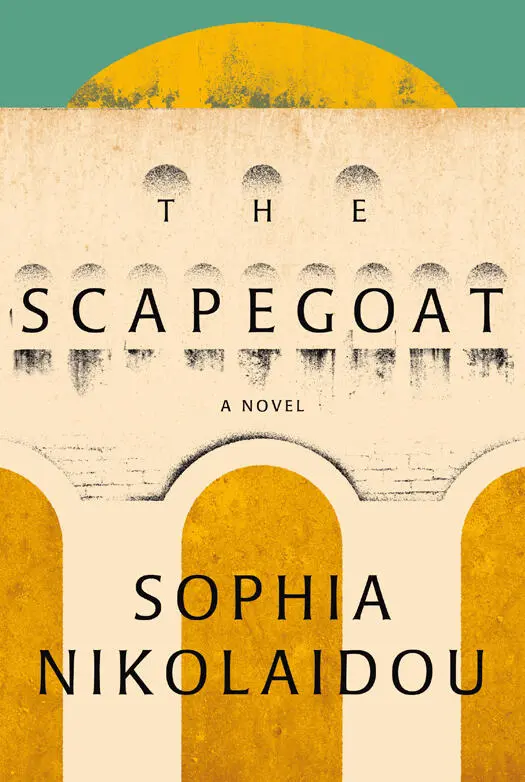
Sophia Nikolaidou - The Scapegoat
Здесь есть возможность читать онлайн «Sophia Nikolaidou - The Scapegoat» весь текст электронной книги совершенно бесплатно (целиком полную версию без сокращений). В некоторых случаях можно слушать аудио, скачать через торрент в формате fb2 и присутствует краткое содержание. Год выпуска: 2015, Издательство: Melville House, Жанр: Современная проза, на английском языке. Описание произведения, (предисловие) а так же отзывы посетителей доступны на портале библиотеки ЛибКат.
- Название:The Scapegoat
- Автор:
- Издательство:Melville House
- Жанр:
- Год:2015
- ISBN:нет данных
- Рейтинг книги:5 / 5. Голосов: 1
-
Избранное:Добавить в избранное
- Отзывы:
-
Ваша оценка:
The Scapegoat: краткое содержание, описание и аннотация
Предлагаем к чтению аннотацию, описание, краткое содержание или предисловие (зависит от того, что написал сам автор книги «The Scapegoat»). Если вы не нашли необходимую информацию о книге — напишите в комментариях, мы постараемся отыскать её.
Flash forward to modern day Greece, where a young, disaffected high school student is given an assignment for a school project: find the truth.
Based on the real story of famed CBS reporter George Polk — journalism’s prestigious Polk Awards were named after him — who was investigating embezzlement of U.S. aid by the right-wing Greek government, Nikolaidou’s novel is a sweeping saga that brings together the Greece of the post-war period with the current era, where the country finds itself facing turbulent political times once again.
Told by key players in the story — the dashing journalist’s Greek widow; the mother and sisters of the convicted man; the brutal Thessaloniki Chief of Police; a U.S. Foreign Office investigator — it is the modern-day student who is most affecting of them all, as he questions truth, justice and sacrifice. . and how the past is always with us.
The Scapegoat — читать онлайн бесплатно полную книгу (весь текст) целиком
Ниже представлен текст книги, разбитый по страницам. Система сохранения места последней прочитанной страницы, позволяет с удобством читать онлайн бесплатно книгу «The Scapegoat», без необходимости каждый раз заново искать на чём Вы остановились. Поставьте закладку, и сможете в любой момент перейти на страницу, на которой закончили чтение.
Интервал:
Закладка:
He had no words left, or hopes, or friends.
Georgiou felt ashamed. Ashamed of himself, of the luxury of his worries, which only moments earlier had seemed to be piled mountain-high, and of his cowardice. He watched but didn’t move any closer. People were passing by, others were watching the scene, smoking, chewing tiropitas. One little kid started to run toward Fendi, but his mother grabbed him by the coat — that was not a sight for a child, so she pulled him back and they continued on their way.
Georgiou took a step forward, then stopped. It seemed wrong, offensive somehow, for him to touch Fendi on the shoulder — after all, he had nothing to say, all the words in his head rang false. Better for him to just keep walking. But that didn’t seem right, either, that’s not the kind of person he was, he’d fought for so many things in his life, written articles full of fire, taken part in fierce protests. He stood for a moment, unable to decide. Then he walked over, left a twenty-euro bill on the sidewalk at Fendi’s knees, and quickly walked away.
But he was dogged by that deep sense of shame. Shame for having too few words and too much money, shame that he couldn’t reach out to touch the man, shame, shame, shame.
He turned into Pavlos Melas Street to seek shelter. He remembered going out for a walk years ago with Minas, who couldn’t have been more than three at the time. They were headed down Agia Sophia Street. Minas was walking ahead, refusing to let his father hold his hand, and gazing in amazement at everything around him. Everything seemed entirely new: the bitter orange trees, the cars, bottle caps on the ground. A gypsy woman lying on a piece of cardboard mumbled prayers mixed with curses. She’d pulled up her skirts and her dark thighs were there for all to see, rotten flesh, crooked legs, turned-in ankles, a hard, yellow crust over her toenails. A little farther on a blind man was sitting on a plastic bag, playing a pipe. Minas froze, staring.
— What do they want, Dad? he asked.
— Money, Georgiou answered, but that didn’t satisfy his son.
— You have money, why don’t you give them some?
The question was logical enough. He tried to explain his reasoning patiently and calmly, as he’d seen Teta do any number of times when Minas barraged her with questions. He quickly realized that his explanations were confusing the child even more — how could they not, since he was only stringing phrases together? In the end he gave up. They might be lying , he heard himself say, they might have even more money than we do , and Minas finally stopped asking.
When Minas was little, he used to observe the adults around him with an unblinking eye. He listened in on everything they said behind closed doors. He played alone in his room, with Playmobil and Legos, knights, dragons, and pirates. He would leave notes on the fridge for his mother to read and answer in writing — it had to be in writing, in a box he would draw in the bottom right corner of the page, with the heading Mom’s Answer in careful letters.
Teta was endlessly proud of her only child, whom she raised according to the rules she herself had learned as a child. She was constantly worrying, she always found something to agonize over: how Minas would drift off into a world of his own, lost in thought, and she couldn’t tell if those thoughts were happy or sad. Or how he avoided kids his own age and sought out the company of adults, in whose presence he was particularly eloquent and outgoing.
— Don’t make mountains out of molehills, was Evthalia’s steady advice. The child is fine, it’s your own head that needs examining.
But now that Minas had raised his banner of revolution, the ground had fallen away from beneath Teta’s feet. Apparently her obedient son wasn’t quite so obedient after all.
— Don’t fight him, Evthalia advised.
That’s when Teta exploded.
— Sure, she shot back, that’s easy for you to say. We both know I was raised on prohibitions, by a mother who always had to get her way.
Evthalia refused to discuss old wounds; she had no intention of revisiting decisions she had made decades earlier. But she didn’t protest: at her age she had learned to give way, to not waste energy on useless conflict but rather try and find a solution. This situation, though, seemed to have reached an impasse. Minas had dug in his heels and all Teta could do was tug at the leash.
Recently Teta had begun to resign herself. You can’t live your son’s life for him, and you can’t make his decisions , her therapist admonished.
Of course Teta thought Minas was the one who should be seeing a therapist, but he refused even to discuss anything “stupid,” a category that included therapists and their theories. Tasos and Evthalia both agreed with the boy’s evaluation, but since they didn’t have anything better to suggest, they kept their mouths shut.
Minas lived barricaded in his room. He rarely went out at night, rarely talked on the phone. He was plugged in at all times. Teta searched the Internet history on his computer a few times, but never discovered anything worth worrying about. An interview with Jacques Derrida about the instability of meaning and the tyranny of the easy answer (good lord), poems and paintings by Nikos Engonopoulos (lovely, but useless for a graduating senior who should be preparing for his exams), a virtual tour of Prague (poor thing, he’d been planning for that trip), and a statue of Justice dressed like a rock star, with hair extensions, a sword, and a dog collar (perish the thought).
Teta didn’t feel great about spying on her son, but she also believed she was doing the right thing. Her therapist disagreed. What you did was wrong , he admonished, human relationships are built on trust, and trust is hard to regain once it’s lost . Teta didn’t take his chiding too seriously. The therapist based his judgments on books, while Teta based hers on experience. He had no children of his own, so who was he to tell her how to manage her son? She still went to see him regularly, and sought his advice about all kinds of things, but in the end she acted as she saw fit. Theories about mutual respect were all well and good, but she needed to know what she was up against.
When she finally went to Minas’s school she was past seeking advice; what she needed was an oracle. But most of his teachers felt that there was nothing they could do, no matter how sympathetic they were to her son. No one who teaches the senior class has time to babysit parents. Teta knew that, of course — or rather, she imagined it: she may not have been a teacher herself, but after so many years as a mother she knew a thing or two about schools.
It had been hard for Evthalia to accept her daughter’s decision not to become a teacher, a decision suddenly communicated to Evthalia together with the news of Teta’s pregnancy. Tasos and Teta knew that Evthalia wouldn’t lose her temper in front of a pregnant daughter. And indeed, Evthalia, as fierce as knives when it came to issues of professional dignity and financial independence, accepted the blow without a single comment and held out her arms to the couple. Later, of course, when the dust had settled, she took her daughter aside.
Yes, she understood that Tasos’s job was a demanding one, with no set schedule or real days off, and yes, he made enough for them to raise a child on, particularly since they weren’t the type to indulge in useless luxuries — but, Teta, honey , Evthalia said sweetly, though she was fuming on the inside, is that why I sent you to university, so you could shut yourself up in the house and raise a child? She wanted to say his child, but at the last minute she held back, a fact for which she silently congratulated herself. Evthalia might not have been the sort of feminist who went around with hairy legs and sensible shoes, and she certainly hadn’t burned any bras, but she made no bones about raising her voice and giving people a piece of her mind when the situation called for it. She hadn’t quit her job to raise Teta, though her husband had tried to insist on it. Back in those days women were homemakers, each confined to her own tiny realm. Evthalia, however, wanted a salary of her own, so she wouldn’t have to ask for money to have a dress made. And when her husband died young and she received his first miserable pension check in the mail, she went to his grave, and instead of crying like all the other widows dressed head to toe in black, she told him, See, if I’d listened to you, I’d be begging in the streets , and washed his gravestone with a deep sense of vindication.
Читать дальшеИнтервал:
Закладка:
Похожие книги на «The Scapegoat»
Представляем Вашему вниманию похожие книги на «The Scapegoat» списком для выбора. Мы отобрали схожую по названию и смыслу литературу в надежде предоставить читателям больше вариантов отыскать новые, интересные, ещё непрочитанные произведения.











Обсуждение, отзывы о книге «The Scapegoat» и просто собственные мнения читателей. Оставьте ваши комментарии, напишите, что Вы думаете о произведении, его смысле или главных героях. Укажите что конкретно понравилось, а что нет, и почему Вы так считаете.