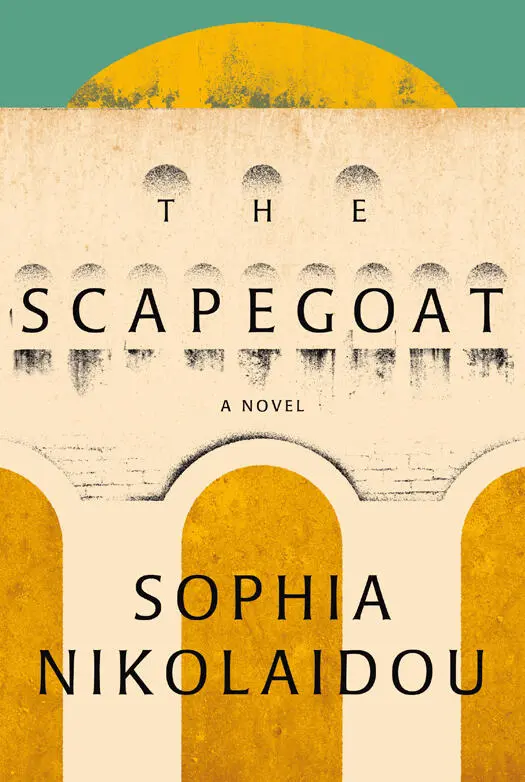
Sophia Nikolaidou - The Scapegoat
Здесь есть возможность читать онлайн «Sophia Nikolaidou - The Scapegoat» весь текст электронной книги совершенно бесплатно (целиком полную версию без сокращений). В некоторых случаях можно слушать аудио, скачать через торрент в формате fb2 и присутствует краткое содержание. Год выпуска: 2015, Издательство: Melville House, Жанр: Современная проза, на английском языке. Описание произведения, (предисловие) а так же отзывы посетителей доступны на портале библиотеки ЛибКат.
- Название:The Scapegoat
- Автор:
- Издательство:Melville House
- Жанр:
- Год:2015
- ISBN:нет данных
- Рейтинг книги:5 / 5. Голосов: 1
-
Избранное:Добавить в избранное
- Отзывы:
-
Ваша оценка:
The Scapegoat: краткое содержание, описание и аннотация
Предлагаем к чтению аннотацию, описание, краткое содержание или предисловие (зависит от того, что написал сам автор книги «The Scapegoat»). Если вы не нашли необходимую информацию о книге — напишите в комментариях, мы постараемся отыскать её.
Flash forward to modern day Greece, where a young, disaffected high school student is given an assignment for a school project: find the truth.
Based on the real story of famed CBS reporter George Polk — journalism’s prestigious Polk Awards were named after him — who was investigating embezzlement of U.S. aid by the right-wing Greek government, Nikolaidou’s novel is a sweeping saga that brings together the Greece of the post-war period with the current era, where the country finds itself facing turbulent political times once again.
Told by key players in the story — the dashing journalist’s Greek widow; the mother and sisters of the convicted man; the brutal Thessaloniki Chief of Police; a U.S. Foreign Office investigator — it is the modern-day student who is most affecting of them all, as he questions truth, justice and sacrifice. . and how the past is always with us.
The Scapegoat — читать онлайн бесплатно полную книгу (весь текст) целиком
Ниже представлен текст книги, разбитый по страницам. Система сохранения места последней прочитанной страницы, позволяет с удобством читать онлайн бесплатно книгу «The Scapegoat», без необходимости каждый раз заново искать на чём Вы остановились. Поставьте закладку, и сможете в любой момент перейти на страницу, на которой закончили чтение.
Интервал:
Закладка:
— Sir, I said again.
— Listen, Georgiou. How long have we known one another?
— Six years.
He nodded in agreement.
— Six years, yes. Now tell me, in those six years, have I ever given you the mistaken impression that I follow democratic processes in my classroom? Did I ever submit any issue pertaining to our class to a vote?
— No, sir.
— I’m glad I haven’t created any misunderstanding, Souk said, putting an end to the conversation.
I stood up to leave.
— Georgiou, he called as I was walking out the door, and waved me back in. Listen, I know you’re at sea. But you’re going to have to work on your own. Study the sources, decide which you trust and which you don’t, form your own opinion. Here’s a book that might help you figure out how to conduct historical research. Just read the introduction and the opening chapter. That should be plenty.
That’s how Souk is. He’d probably been carrying that book around in his bag for a week. He believes in the theory that you shouldn’t protect kids from difficult things. That they learn from falling down and getting hurt. Learning through suffering. I don’t know if it’s a great pedagogical method, but it works.
Freedom is a sneaky thing. You think it’s actually free, but sometimes it turns out to be pretty pricey.
I’m an idiot.
I’ve been reading for ages and I don’t understand anything. After the first few hours I started to take notes, the way Grandma taught me. With arrows and diagrams and page numbers in parentheses. I don’t know how I’m ever going to get anywhere, and that methodology book Souk gave me just confused me even more.
I’ve got all the events down, with dates. But I can’t figure out how they’re connected. Reasons, causes, effects, it’s all one huge knot. Brits, Americans, Greeks, I can’t keep the names straight or remember who did what. Dad insists that I need to read the newspapers from back then. He says that’s the only way I’ll get my finger on the pulse of the time. I have to view events through a reporter’s lens, for him that’s a given.
Yesterday he brought me a CD with scans of the front pages and reporting from 1949, when Gris was on trial. The newspaper was digitized ages ago, someone at the office did it. So now I’ve got new material, when I can’t even manage what I already had.
I feel like an idiot.
Like that time Souk taught us a surrealist poem called “The Forest Boat,” by Nikos Engonopoulos, in our first year of middle school. He handed out photocopies and most kids thought it made no sense, but no one dared comment out loud. I didn’t understand a word, and was terrified he might call on me and realize once and for all how stupid I was.
It’s something I’ve always worried about. What a clever child, and so special, he’s sure to go far , my teachers all used to tell my mom. I liked hearing their praise, but it terrified me, too. I was sure someone would eventually figure out that I’m not special at all. I’ve got a mediocre mind, it only tricks you if you don’t look too close.
The day Souk brought that Engonopoulos poem into class, he read it out loud in his usual cold voice. I had no idea what it was about. But I felt like there was something happening on the page, something important.
I was having fun.
So much fun that I forgot everyone around me. I forgot the classes, the fight I’d had with Mom that morning, the spinach rice waiting for me when I got home. And when Evelina raised her hand and started in on the poem, trying to unpack the “hidden meaning” of every single line, I felt like shoving her. What she was actually doing was changing the words of the poem one by one, so as to make it comprehensible. To explain it to us imbeciles.
— A poem has handles, Souk said, trying to guide us. Try to identify them and pick it up that way. Poetry doesn’t speak only to the heart, true emotion also passes through the brain; that’s what makes it so strong.
Evelina raised her hand again. She tried a second time to dissect the poem and explain it in her own words. Souk looked at her for a moment, perhaps trying to make up his mind whether or not to say what he was thinking.
— That’s your poem. If Engonopoulos had wanted to say all that, he would’ve used other words. Poetry is a precise art.
Evelina didn’t let out a peep. The others were all grateful that she had explained the incomprehensible, so they could answer the questions Souk would give us for homework. I, meanwhile, was furious at her for ruining the poem with her interpretation.
What I’m trying to do with these sources reminds me of Evelina reading that poem. I’m not studying the events, I’m looking for easy connections between them, to get it over with. I’m not letting them speak, I’m trying to speak for them. If Dad had ears to hear, I’d tell him that journalism does exactly the same thing, even if it doesn’t like to think so. It takes events and wraps them up in its own voice. I already know what his objections would be. In our conversations he steamrolls me every time. He knows how to argue. I always think of what I want to say too late, when he’s already left the room.
I don’t know what Souk got me mixed up in, or if I’ll ever figure it out. I’ve stuck Post-its with the names of the major players all over the walls of my room, and a photograph of Gris over my bed. Tall and pale on the first day of the trial.
— Who’s that scarecrow you’ve got on your wall? Mom asked when she came in to clean. When I told her who it was and what happened to him, her response was:
— They burned his youth in a single night.
THROUGH OTHER EYES
THEN THERE WERE TANKS ,
NOW THERE ARE BANKS
Tasos Georgiou glanced at the slogan on the wall and smiled. For days he’d been walking into the newspaper building without noticing anything, he, a man who always claimed that nothing escaped him, not even a blink of his colleagues’ eyes. It had been a month since he’d joked around with the others, he just went straight to his office, shut the door, and started making calls.
— It’s a tough time for the boss, said the staff reporters, his “guys,” who’d learned most of what they knew from him, on the job.
They’d heard the rumors, they knew how bad the numbers were, and they were all riddled with worry. Whispered conversations in the halls centered around furloughs and salary reductions, and no one had a comforting word to say to anyone. The atmosphere at work was poisonous. No more goofing around, or workplace flirtations, or smiles for no reason. Every now and then someone would groan, it just slipped out before they could choke it back.
No one felt like doing anything. The uncertainty dragged on for days, until the days became weeks. The rumors infected everything, and none of them were ever confirmed. The girls in accounting stopped buying new lipstick. They used sample moisturizers from department stores and waited for the bomb to drop.
Georgiou wasn’t sleeping well and suffered relentless headaches. Conversations with his superiors were excruciating. He was constantly weighing and calculating, trying to figure out which would be the smallest sacrifice.
— Ask your staff, suggested a veteran editor he knew in Athens who was an expert at spreading strife and breaking up alliances. They might prefer if you fired some of them. That way the rest would get to keep their jobs.
He wouldn’t hear of it. He knew them all by their first names, knew their wives and children. Sure, there were some lazy guys who got away with murder, who spent all day on the phone or taking cigarette breaks, but he couldn’t just send them packing. He wouldn’t take responsibility for that crime.
Читать дальшеИнтервал:
Закладка:
Похожие книги на «The Scapegoat»
Представляем Вашему вниманию похожие книги на «The Scapegoat» списком для выбора. Мы отобрали схожую по названию и смыслу литературу в надежде предоставить читателям больше вариантов отыскать новые, интересные, ещё непрочитанные произведения.








Обсуждение, отзывы о книге «The Scapegoat» и просто собственные мнения читателей. Оставьте ваши комментарии, напишите, что Вы думаете о произведении, его смысле или главных героях. Укажите что конкретно понравилось, а что нет, и почему Вы так считаете.