Alberto Moravia - Two Friends
Здесь есть возможность читать онлайн «Alberto Moravia - Two Friends» весь текст электронной книги совершенно бесплатно (целиком полную версию без сокращений). В некоторых случаях можно слушать аудио, скачать через торрент в формате fb2 и присутствует краткое содержание. Год выпуска: 2011, Издательство: Other Press, Жанр: Современная проза, на английском языке. Описание произведения, (предисловие) а так же отзывы посетителей доступны на портале библиотеки ЛибКат.
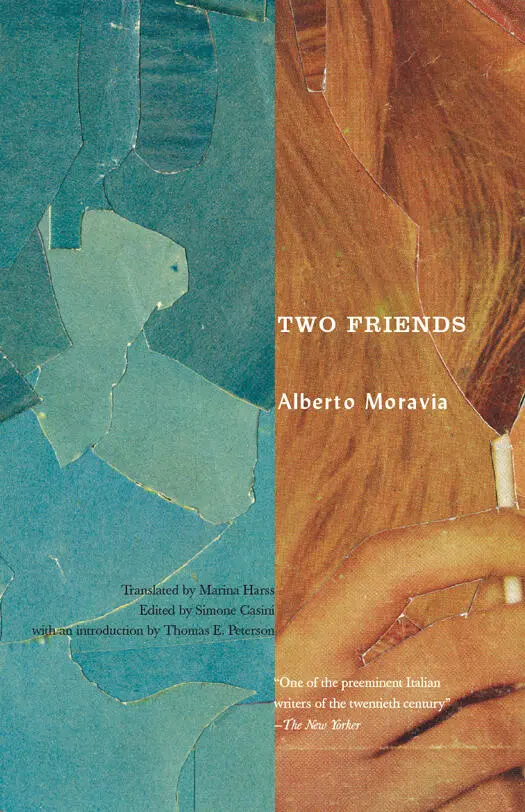
- Название:Two Friends
- Автор:
- Издательство:Other Press
- Жанр:
- Год:2011
- ISBN:нет данных
- Рейтинг книги:3 / 5. Голосов: 1
-
Избранное:Добавить в избранное
- Отзывы:
-
Ваша оценка:
Two Friends: краткое содержание, описание и аннотация
Предлагаем к чтению аннотацию, описание, краткое содержание или предисловие (зависит от того, что написал сам автор книги «Two Friends»). Если вы не нашли необходимую информацию о книге — напишите в комментариях, мы постараемся отыскать её.
Anyone interested in literature will relish the opportunity to watch Moravia at work, tinkering with his story and working at it from three unique perspectives.
Two Friends — читать онлайн бесплатно полную книгу (весь текст) целиком
Ниже представлен текст книги, разбитый по страницам. Система сохранения места последней прочитанной страницы, позволяет с удобством читать онлайн бесплатно книгу «Two Friends», без необходимости каждый раз заново искать на чём Вы остановились. Поставьте закладку, и сможете в любой момент перейти на страницу, на которой закончили чтение.
Интервал:
Закладка:
NOTE ON THE TEXT
I. MATERIALS
The typescript pages of the three unpublished drafts of Sergio and Maurizio’s story are in the archives of the Fondo Alberto Moravia in Rome. They consist of 258 typescript pages, on Fabriano Extra Strong paper measuring approximately 28 × 22 centimeters (11 × 8½ inches), unnumbered by the author. The numeration, provided by the archive, reflects the order in which the pages were discovered. Many pages had been damaged over the years and were recently restored.
A REDISCOVERED SUITCASE
The pages were found in a suitcase which was discovered, in poor condition, in the spring of 1996. According to Moravia’s heirs and the directors of the Fondo, it was in the basement of Moravia’s home on the Lungotevere della Vittoria. Another suitcase — which can be seen in photographs taken by Serafino Amato in the special edition of the Quaderni del Fondo Moravia (journal of the Fondo Moravia) dedicated to the exhibit Moravia and Rome (November 2003, pp. 2–3, 201–203), had been discovered, in better condition, a few months earlier, in September 1995. The two suitcases contained various pages written by the author, including materials relating to several novels, such as La ciociara ( Two Women ) , La noia ( Boredom ), and L’attenzione ( Attention ), as well as stories which were later included in Racconti romani ( Roman Tales ) , Nuovi racconti romani ( New Roman Tales ), and L’automa ( The Fetish ). Thus all of these papers date from the fifties and early sixties, and certainly before 1963, the year Moravia moved out of his home on the Via dell’Oca and into his new home on the Lungotevere. It is possible that the writer, or someone else, filled the suitcases during the move in a somewhat disorderly fashion, packing recent and relevant texts and documents, not to be confused with material Moravia was actively working on at the time. It is also possible that these papers remained in the suitcases, untouched, from 1963 until they were discovered thirty years later.
This may explain their survival. As has been noted by several sources, the writer was known to destroy his preparatory materials once a book had been published. We recall the account of Sebastian Schadhauser (a German sculptor and friend of Moravia’s), transcribed from a video at the Fondo Moravia. Schadhauser accompanied Moravia on several trips during the seventies and eighties, and assisted him during his convalescence from a hernia:
During that period I often lit the fireplace in order to burn manuscripts. When [Moravia] finished writing something, he was in the habit of burning the manuscripts. He didn’t keep manuscripts, he burned them. Also the corrected proofs. When he received proofs from a newspaper, he would correct them, and then when they came back from the editor, he would burn them. There is a fireplace in the corner of his house on the Lungotevere della Vittoria. It’s set at a diagonal, like this. He would light a fire there and burn papers. During that period, I did it because he couldn’t get up. But he burned all of his manuscripts. I don’t think there are many manuscripts in circulation. He had this habit. For him, the finished work was the published work. The rest, he burned.
Up to the present, no other drafts or notes related to Moravia’s novels from before the seventies have been found; there are only a few clean proofs, kept by his editor, which reflect the final version of the work (there is one typescript of La romana ( The Woman of Rome ) and one of La noia ). The situation with the more recent novels is somewhat different; the Fondo Moravia has several drafts that survived in the writer’s home. Of course, it is possible that in the future other lost typescripts or manuscripts will be found, especially if they were given by the author to friends, relatives, or editors, as in the case of a typescript of Il disprezzo ( Contempt ), that was discovered in 2002. This was an almost final draft of the novel, and it is now in the collection of the Fondo Moravia. But until now the only texts that have survived from the writer’s office are those discovered in the suitcase at the house on Lungotevere della Vittoria, which escaped the flames thanks to the vicissitudes of the move.
In order to understand the dimensions of Moravia’s directive and to evaluate the typescript pages that have survived, we must pause to reflect on the very small number of pages that have been discovered.
It is of course impossible to quantify the total number of typescript pages produced by the author over the course of preparing a novel, but based on the meager resources — letters and interviews — to be found in the “Notes on the Texts” in Bompiani’s Classici edition of Opere complete di Alberto Moravia ( Complete Works ), volumes 1–4, we could estimate the number to be around one thousand pages, over two thousand in the case of the longer novels. For example, the typescript pages relating to the composition of La ciociara, La noia , and L’attenzione found in the two suitcases represent only a small fraction of the total preparatory materials relating to those works (about a fifth). This would mean that the 258 pages relating to the three versions of this unpublished novel would have been only one small part of the complete preparatory work. If they represent early versions of the novel, that would mean that there was still much work to be done before the completion of the final version.
The pages found in the two suitcases were immediately handed over to the Fondo Alberto Moravia, which was new at the time. The Fondo, in turn, passed them on to the Gabinetto Vieusseux in Florence (directed by Enzo Siciliano) in September of 1995 and April 1996. There, they were numbered, indexed, and partially restored. In April 1999 they were returned to the Fondo Moravia, where they still reside, and where we were able to refer to them during the preparation of the multivolume “Classici Bompiani” edition.
Even if further study of these pages relating to the story of Sergio and Maurizio might have suggested the possibility of an alternative order, we decided to keep the original numeration provided by the archive because it documents the order in which the pages were originally found (in the suitcase). If in fact this order was determined by Moravia himself, we can derive useful information from it, as we will see, in the task of identifying the texts.
THE “DUE AMICI” TYPESCRIPTS
Among the pages found in the first, more battered, suitcase were those related to an unfinished project. In the absence of a title, they are identified in the Fondo Moravia under the heading “Sergio Maurizio.” For this edition, we decided to use the title I due amici (Two friends). These pages date from the period 1951–1952 and are the oldest example we now have of Moravia’s compositional methods. The aforementioned typescript for La romana ( The Woman of Rome ), in the collection of the late Valentino Bompiani, is different: it is in a completed draft, ready to be be sent out to readers.
Before reconstructing the biographical and narrative context, we must describe these texts carefully, pointing out the details which are most useful for dating them and determining their internal order.
VERSION A
The first group of pages, which we have called Version A, consists of sixty-two typescript pages, unnumbered and unmarked by the author, plus nine more abandoned, rewritten, or substituted by him. According to the current numeration in the archive, this corresponds to pages 162–225 and 231–37 in Dossier 6 (Incartamento 6). Many pages, now restored, had deteriorated over time and include lacunae, especially near the margins.
Читать дальшеИнтервал:
Закладка:
Похожие книги на «Two Friends»
Представляем Вашему вниманию похожие книги на «Two Friends» списком для выбора. Мы отобрали схожую по названию и смыслу литературу в надежде предоставить читателям больше вариантов отыскать новые, интересные, ещё непрочитанные произведения.


Обсуждение, отзывы о книге «Two Friends» и просто собственные мнения читателей. Оставьте ваши комментарии, напишите, что Вы думаете о произведении, его смысле или главных героях. Укажите что конкретно понравилось, а что нет, и почему Вы так считаете.