Joshua Cohen - Witz
Здесь есть возможность читать онлайн «Joshua Cohen - Witz» весь текст электронной книги совершенно бесплатно (целиком полную версию без сокращений). В некоторых случаях можно слушать аудио, скачать через торрент в формате fb2 и присутствует краткое содержание. Год выпуска: 2010, Издательство: Dalkey Archive Press, Жанр: Современная проза, на английском языке. Описание произведения, (предисловие) а так же отзывы посетителей доступны на портале библиотеки ЛибКат.
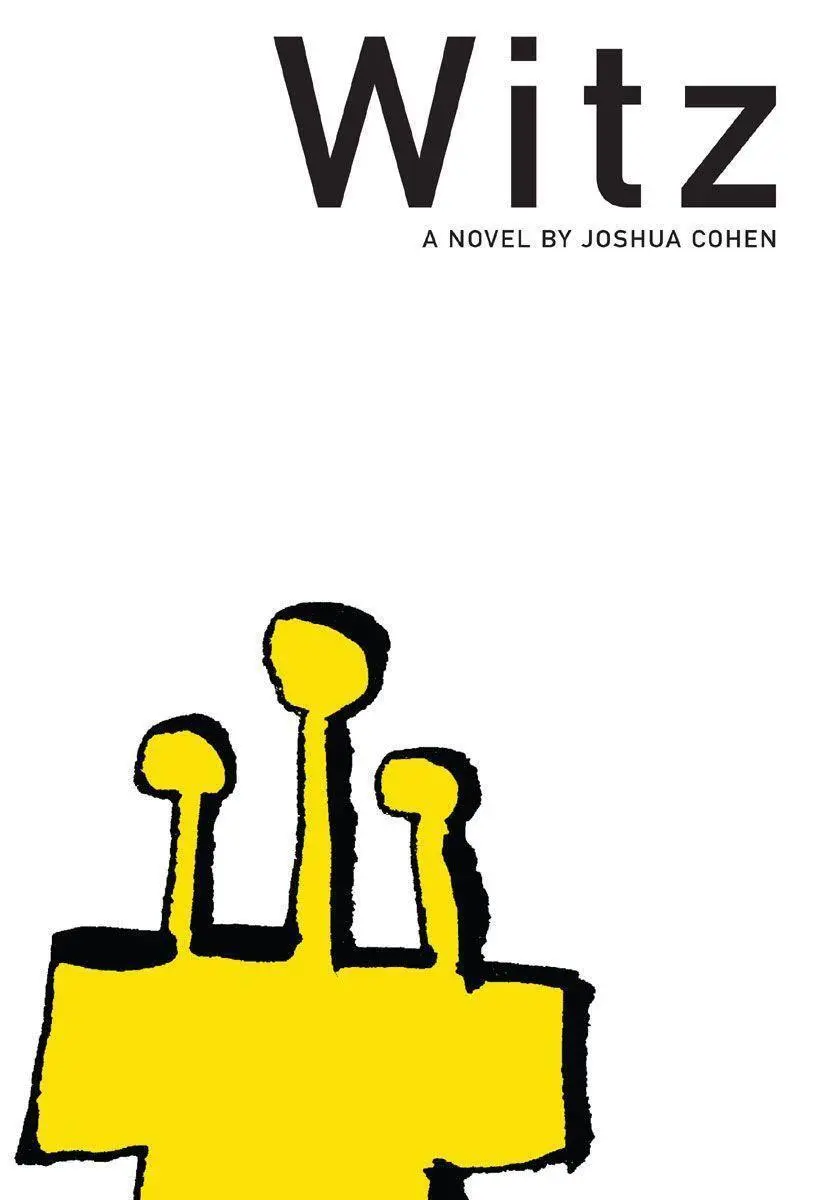
- Название:Witz
- Автор:
- Издательство:Dalkey Archive Press
- Жанр:
- Год:2010
- ISBN:нет данных
- Рейтинг книги:3 / 5. Голосов: 1
-
Избранное:Добавить в избранное
- Отзывы:
-
Ваша оценка:
Witz: краткое содержание, описание и аннотация
Предлагаем к чтению аннотацию, описание, краткое содержание или предисловие (зависит от того, что написал сам автор книги «Witz»). Если вы не нашли необходимую информацию о книге — напишите в комментариях, мы постараемся отыскать её.
Meanwhile, in the not-too-distant future of our own, “real” world, another last Jew — the last living Holocaust survivor — sits alone in a snowbound Manhattan, providing a final melancholy witness to his experiences in the form of the punch lines to half-remembered jokes.
Witz — читать онлайн бесплатно полную книгу (весь текст) целиком
Ниже представлен текст книги, разбитый по страницам. Система сохранения места последней прочитанной страницы, позволяет с удобством читать онлайн бесплатно книгу «Witz», без необходимости каждый раз заново искать на чём Вы остановились. Поставьте закладку, и сможете в любой момент перейти на страницу, на которой закончили чтение.
Интервал:
Закладка:
MALKA ( queen ),
MAVA ( pleasant ),
MIRI ( bitter ),
------------------ MENACHEMA
( consolation )???
MIRIAM, ( rebellious );
this, the degeneration of the degenerations of one Benjamin BLANK, as provisionally assembled from an extensive trove of scholarly materials only last quarter discovered amid collections charred, basemented, of Siburban attics both sacred, profane — both previously classified and heretofore outright outclassed: Rabbi Doctor Karol Hushner PhD’s estimable summary of the entire Nachlass of Doctor Elisha Abuya ( Ethica Semitica ), comprising a small, eminently portable volume whose covers — as do its Subjects — branch themselves out into innumerably leafy later editions, supplanted in terms of comprehensiveness if not in that of readability by the multiedited, multiauthored, multivolume (7) opus Tractatus Neohebraicus , representing the unrivaled summation of all Affiliated thought (indeed, the acknowledged precursor to all future scholarship in the field, it’s suggested in passim), with emphasis placed on parallels manifest between religious ritual and trends within then contemporary culture (invaluable Notes & Postface provided by one Rav Yossi Letushkin). Also might we mention to you our vast selection of surviving incanabula — for esoteric, press #1, for exoteric, press #2—which we are only now prepared to make available in handsome reproduction for the edification of the general public (lacunæ not included, pericope upon request): the Steinstein Agrapha fragments, Poxy 48a, and the Q documents, GMy1, 2, and the Rubina Pseudoepigraphia, this remaining Oxyrhynchiana going on sale now and for the lowlow price of only 99.99 NS (New Shekels; note: B Notes no longer accepted), supplies are limited, operators are standing by the banks of the Jordan reclaimed. And these are the degenerations of the degenerations of the degenerations of one Mister Benjamin Blank: witness the destruction ignobly ordered of the entire Garden Archive, whose hold had been rumored to include a Rothschild’s richesse of firsthand accounts, along with a Warburgian wealth of secondary source documentation, an Oppenheimerian fortune of footage: thousands of hours of recorded interview with many of the Subject’s intimates, culled from hundreds of appearances in tens of media outlets; at the heart of this estimable body of record since lost, once lying in reels that would seem the tombs of instantly resurrectable corpus — pull the blinds, flick the breath, it’s alive — at least threehundred sixtyfive (365) films dealing with the unspeakable Subject Itself, including: Israel’s Home Movies (Beta II, Beta III, VHS, DVD, SPECIFY FORMAT), professionally recorded simchas shredded, Garden surveillance torched…and an excellent selection of those legendarily forgotten Holywood epics, never to be screened for our patience again: The Making of a Messiah (5760), Live in Los Siegeles (5760), The Making of the Making of a Messiah (5760), Pope for a Year (5760), Joysey Girl (5760)…
But we haven’t mentioned her much, have we — allow us to rectify. Her name was Rubina, and she was the true Israelien firstborn, though a girl, a woman almost, the guardian of their blood and its cause. As if Him developed in opposite, His other half…the mirror that was once in the hall that was then moved into her room to be her mirror while a new mirror was bought for the hall: she was reflective, was it…slim, tall, and silent (reedy, it could be said, but should anyone resemble a reed?), in appearance as neat and orderly as her room, which for those eight days during which they shared the earth together and its house thereupon was B’s obsession. A room fluffed of all pillow, or so it’d felt — hers the one room topside He’d avoid in His house removed to the Garden as if a reflection of the basement below: any sleep there was troubled, nightmares whoever remembered anything but their fright, tumblingly tear the sheets from the bed, highly threadcounted to lull and then…held taut, a white that was tight and yet soft, welcoming to fall asleep and yet, a terror to dream: that wasn’t for Him, the room was too virginally pure, as if carpeted by snow underfoot so undisturbed He wants to fly out the window she’d gaze through toward the tree in the yard, not step down to stay and admire its shade. And she, too, was soft, that once she held Him on the recline of that eighth day home from the hospital with Hanna asleep upstairs-upstairs, them in the kitchen, Him gathered hulkingly into her lap, the folds of her skirt, as if cleavage Himself, or a still bumptious pregnancy — but she was still a virgin, wasn’t she, never known…her hips in motherly sit becoming her waist becoming her breasts two of them both severe and knifelike, He’d cried when they wouldn’t milk, pricked His lips, then how she let go, too heavy, too huge — then went to gather Him up again, tried to but couldn’t, pale, unforgiving: the cries she ignored as she felt hers were ignored always and still, leaving Him alone on the floor for her room. Of the wrong sex for inheritance, birthed carelessly to the wrong, engendered only to lose…Rubina would pass with the rest, to the sleep she so desperately needed. Hanna, jealous of her youth. As for Israel, he wouldn’t touch her anymore. Years since menarche. That and the three of them hardly talked ever since she got her license for her own car, too, with her college acceptance, Dear Rubina Israelien, We are pleased to inform you that …she was to leave soon enough, the house, the hearth if they’d had one that worked; the pillows, stuffed full with room. Freedom, she thought. Real life…not to be.
As for her name, Sarah, Rebecca, Rachel or Leah — they’d decided early on Rubina, and so beginning the cycle of resurrecting the dead, as if a Messiah’s remaking: her named after Reuben, though his name was Reuven, her mother’s side her greatuncle, never knew him, you never do if you have their name’s how it is, how they always die before you’re ever born to their calling. She has his lips, too (erogenously rued); it’s awful, you give someone a name after another, suddenly that someone has another’s lips and eyes (hyperthyroidal, exophthalmic), her nose, or hair. How that last Shabbos’ night she’s left alone if still, distantly, ghostingly, mothered at the table already emptied and even sponged in the diningroom, the tableroom, the we sit and eat and drink here and be a family sustaining ourselves altogether here room, sitting at the place at which she always sat, facing Hanna now resting herself upstairs to the left of her father gone, too. Then the boy, Benjamin’s His name’s what she knows not His namesake. All’s cleared, except her bowl of soup, lentil, taken with a large dose of salt. The warmth had left, her and the soup unspooned. Upstairs-upstairs, the pillows were waiting, holding her form.
Eat your soup! Hanna’d said, you eat nothing, I want you to eat up, I need you to do it for me…two spoonfuls, at least one or a half, you’re old enough for me not to have to — should I heat it up?
And how Rubina a little late to mature begins crying again, seasoning the soup already, I’m sorry, she’s not, just a pinch overseasoned, doubledipped, too, with a lapse of the pepper when Hanna was called to the phone.
Israel again — again late.
You, you’re as thin as a snake…I’m asking you to eatup, please, a something, just a little something, for me I’m your mother, but nothing. As if too tired to hold even her spoon’s silver, its bowl weighed down by only the light it scoops from a far sconce, she’s exhausted, with no expression of response, then, thrusting the white of her wrists out, her pure upturned hands, she rises from the table, walks to the hall, seemingly somnambulant (her face fine and un-lined, slenderwaisted nose, greatuncle lips though that mensch, he was actively sensuous, loved him his women and girls and his food and drink, and her introverted ringlets of hair, corkscrewy enough to take up a tangle of it with which to open a bottle of wine), up the stairs to her room, which she enters with feathersteps, then lies down: enters not through her door, as there’s no door to her room, it’s just curtained, and the old curtain from the shower downstairs the stronger defense, against what — Israel having hung it in punishment after Josephine had found her inhaling inside, smoking what; her form as if gusted, through the hallway and into the sheer, and then through it, oneirically, in a gauzy meld (at least that’s how it’s been filmed, softfocus, soundtracked with an orchestra of strings divided more than could be any family, tribe, or her nation), disappears into sleep, fade to black: despite or perhaps thanks to such state, which is medicated to numb — generically zaleplon, with zolpidem occasionally mixed — to share her angels as if these halved wingless pills offered in return for fast friendship with Lilith, the Mother of Night, to hold wild heavens of sleepovers, gossiping over junk manna until dawn upon the winds of the harp. Rubina had had it all, had possessed the stuff in the veins, the life and its generational furtherance — all the living branches of our bodied tree, veined out from her heart to the tips of her fingers and the pleasurable bud between her thighs and her toes: it’s that she could’ve engendered, barring the effects of an unfortunate endometriosis — and maybe that’s why she slept so much, always tired…that’s what the doctors decided, not depression or smoking or drugs or the college degrees her car required or whatever else the shrinks shrank from her, the pulse always in her protuberant eyes and the burnt broken wing of her mouth — but sensing that she was of no use, perhaps knowing this only on her last night as if it were a void just discovered within her in bed and about to sleep for her last, found deep in her womb as a hunger, a lower thirst, having hidden to maturity in a hollow, the death grown bare, her barren. Ours will be the world of the bloodless. Ours is the world of no claim.
Читать дальшеИнтервал:
Закладка:
Похожие книги на «Witz»
Представляем Вашему вниманию похожие книги на «Witz» списком для выбора. Мы отобрали схожую по названию и смыслу литературу в надежде предоставить читателям больше вариантов отыскать новые, интересные, ещё непрочитанные произведения.









Обсуждение, отзывы о книге «Witz» и просто собственные мнения читателей. Оставьте ваши комментарии, напишите, что Вы думаете о произведении, его смысле или главных героях. Укажите что конкретно понравилось, а что нет, и почему Вы так считаете.