Shashi Tharoor - Show Business
Здесь есть возможность читать онлайн «Shashi Tharoor - Show Business» весь текст электронной книги совершенно бесплатно (целиком полную версию без сокращений). В некоторых случаях можно слушать аудио, скачать через торрент в формате fb2 и присутствует краткое содержание. Год выпуска: 2011, Издательство: Arcade Publishing, Жанр: Современная проза, на английском языке. Описание произведения, (предисловие) а так же отзывы посетителей доступны на портале библиотеки ЛибКат.
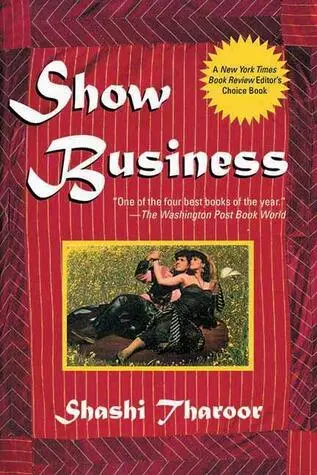
- Название:Show Business
- Автор:
- Издательство:Arcade Publishing
- Жанр:
- Год:2011
- ISBN:нет данных
- Рейтинг книги:3 / 5. Голосов: 1
-
Избранное:Добавить в избранное
- Отзывы:
-
Ваша оценка:
Show Business: краткое содержание, описание и аннотация
Предлагаем к чтению аннотацию, описание, краткое содержание или предисловие (зависит от того, что написал сам автор книги «Show Business»). Если вы не нашли необходимую информацию о книге — напишите в комментариях, мы постараемся отыскать её.
Show Business — читать онлайн бесплатно полную книгу (весь текст) целиком
Ниже представлен текст книги, разбитый по страницам. Система сохранения места последней прочитанной страницы, позволяет с удобством читать онлайн бесплатно книгу «Show Business», без необходимости каждый раз заново искать на чём Вы остановились. Поставьте закладку, и сможете в любой момент перейти на страницу, на которой закончили чтение.
Интервал:
Закладка:
Scene: Godambo with Mehnaz Elahi. “I enjoyed your performance at the Cultural Evening last night,” he says gutturally. “I would like to engage you for a very special occasion.”
Mehnaz is shrewdly obliging.
“You see, my daughter is getting married,” Godambo goes on. “And we are celebrating it in a big way, as befits an alliance involving one of the city’s biggest families. I would like to have an entertainment show worthy of the occasion. And I would like you to dance at the wedding. Especially since the bridegroom is an associate of yours.”
“An associate?” Mehnaz clearly hasn’t heard about Ashok’s plans.
“Ashok Banjara,” Godambo says with pride. “Why, hasn’t he told you?”
“There is a lot,” Mehnaz replies with a set expression, “that Ashok doesn’t tell me.”
“Well,” Godambo says, looking uncomfortable, “will you perform at the occasion anyway?”
“Of course.” Mehnaz’s tone is dull.
“Good. So you will come for the event? Three weeks from now. I hope you are free.”
“Oh — three weeks from today.” Mehnaz is quick to make the most of a bad job. “I am afraid I cannot accept your invitation, Sethji. You see, I have a prior commitment in Bombay. Of course, I could try to change it….”
“You must,” Godambo insists, “or I would be most disappointed. And,” he says, looking at her with the eye of an experienced businessman, “I would of course be happy to double your fee on this happy occasion.”
“In that case,” says Mehnaz happily, “how can I let you down for such an important event?”
And so to the wedding. As the ceremony progresses, complete with demure bride dripping with gold, catered food dripping with ghee, and overladen bar dripping with Scotch, Mehnaz, gazing wistfully at the bridegroom, dances for her supper as a temporary accompanist sings a variant of Ashok’s song:
Where are you, my love?
I wait for light from the neon above.
You have taken my heart
And hid it from view,
Now the marriage mart
Has deprived me of you.
Wh-e-e-re are you, my love?
But this time there is no answer.
It is some years later. Maya is seated on a dhurrie on the floor, taking music lessons from a maestro with a harmonium. “Very good,” says the maestro, Asrani, an actor more usually seen in the role of stock comedian. “Now once again: sa-ri-ga-ma-pa-da-ni-sa.” He tosses his head back with a tonal flourish as he runs through the scale. “Now you.
Maya dutifully echoes her guru: “Sa-ri-ga-ma-pa-da-ni-sa.”
“Not bad,” says the maestro. “But there is something missing.” He taps his belly, producing a percussion note like the glug of a drowning diver, and resumes. “Sa-ri-ga-ma-pa-da-ni-sa.”
Maya smiles prettily and in turn tosses her head. “Sa-ri-ga-ma-pa-da-ni-sa.”
“You’re getting it,” says the maestro. “See, it’s simple:
Sa, salary, monthly cash flow,
Ri, receipt for getting same;
Ga, garment, when bank is working slow,
Ma, materialism’s no shame;
Pa, paupers can’t teach a thing,
Da, daal-bhat costs a lot,
Ni, needs are what make me sing —
and that brings us back to sa — something you forgot?”
Maya’s brow unfurrows in comprehension. “You haven’t been paid,” she says in contrition. “I’m so sorry, Panditji.”
“An able pupil,” exclaims the maestro. “Music may be the riches of the soul, but the soul of music requires riches. Or at least a humble pittance.”
As Maya hurries to her safe to pay her teacher, the maestro remarks on how good she has become. “Very good indeed,” he pronounces, nodding in satisfaction at the notes she is deferentially offering him. “What made you want to take up singing?”
The camera lingers in close-up on Maya’s poignantly inexpressive face. “I used to take lessons, years ago,” she says, a faraway gaze in her eyes. “That’s how I met my husband. I gave up singing when I married him. But now, my husband spends more and more time on his music. When he leaves, I feel he is taking the music out of my life. I decided the only thing I could do was to learn it myself so that I could join his world.”
“ Wah, wah,” responds Asrani heartily. It is not clear whether his appreciation is for the sentiment or the money he has just finished counting.
There follow a couple of scenes that establish Ashok in affectionate domesticity: scenes involving his beautiful wife and dutiful children. Intercut with these are scenes of his professional relationship with Mehnaz: he sings as she dances, her sighs in his direction completely unrequited.
Scene: Maya is about to give her first public performance as a singer. And she is introduced fulsomely to a large audience by none other than her own father, Seth Godambo.
“As you know, my son-in-law is a very good singer,” Godambo orates. “And in this domain he is now joined by the not inconsiderable talents of his wife, my daughter, Maya.” (Applause.) “She is a good wife, but what is not so widely known is that she also has a musical soul. And she has kindly agreed today, under the able guidance and instruction of Pandit Asrani” — the maestro, his mouth full of paan, takes an affable bow — “to sing for you today, all in the cause of charity, of course.” Godambo nods, but even without this cue the extras in their seats applaud the winsome debutant with rare enthusiasm.
Her aesthetic inclinations thus rendered socially respectable, Maya launches into song:
All I want is to sing for you
Because, you know, I’ve this thing for you,
That throbs in every note;
All I want is to be with you
Because, you know, I can’t be free with you,
If music sticks in my throat.
Her diffidence slips away with every verse, and at the end the audience is on its feet, applauding, all except Mehnaz, who gets up from her seat at the back of the hall, her mouth set in a thin line of resentment, and slips out.
Maya goes from success to success. In a series of quick cuts, she is shown performing in overflowing halls to standing ovations, receiving prizes and awards, and being featured on posters and in neon lights. Meanwhile, Ashok’s career fades. He and Mehnaz are seen in nondescript theaters before dwindling crowds, his name set in increasingly smaller print on shabby notices, while Maya’s name and face glow in every newspaper. His expression becomes increasingly lugubrious as Maya continues to receive accolades. And after one performance, as everyone else claps, Ashok is seen turning away and walking out of the hall.
“Depressing, isn’t it?” Mehnaz, her curves enhanced by a slinky dress, is by his side in a nearby garden; she is carrying a snakeskin handbag. “To see all this adulation, when true talent like yours goes unrecognized?”
Ashok sees no hint of sarcasm in the question. “I’m happy for Maya,” he says, sounding far from it. “But sometimes…”
“Sometimes you wish this hobby of hers would leave some room for the professionals like us,” Mehnaz says shrewdly, her pectorals heaving in sympathy. “People don’t applaud her singing, Ashok. They’re in love with her, the simple girl-next-door with the looks and manners of a housewife, a woman who looks as if she’d sooner offer you a cup of tea than charge you admission to hear her sing. The crowds love it: they go and sit there, and they look at her, and it doesn’t matter how well she sings or how much better we — I mean you — do. Style and glamour are passé, Ashok.” Mehnaz undulates with regret as she turns toward him. “No one wants excitement any more. Simplicity is in.”
Читать дальшеИнтервал:
Закладка:
Похожие книги на «Show Business»
Представляем Вашему вниманию похожие книги на «Show Business» списком для выбора. Мы отобрали схожую по названию и смыслу литературу в надежде предоставить читателям больше вариантов отыскать новые, интересные, ещё непрочитанные произведения.









Обсуждение, отзывы о книге «Show Business» и просто собственные мнения читателей. Оставьте ваши комментарии, напишите, что Вы думаете о произведении, его смысле или главных героях. Укажите что конкретно понравилось, а что нет, и почему Вы так считаете.