Shashi Tharoor - Show Business
Здесь есть возможность читать онлайн «Shashi Tharoor - Show Business» весь текст электронной книги совершенно бесплатно (целиком полную версию без сокращений). В некоторых случаях можно слушать аудио, скачать через торрент в формате fb2 и присутствует краткое содержание. Год выпуска: 2011, Издательство: Arcade Publishing, Жанр: Современная проза, на английском языке. Описание произведения, (предисловие) а так же отзывы посетителей доступны на портале библиотеки ЛибКат.
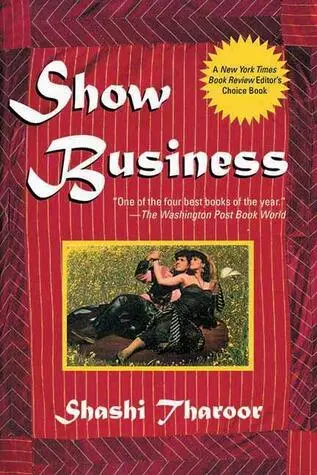
- Название:Show Business
- Автор:
- Издательство:Arcade Publishing
- Жанр:
- Год:2011
- ISBN:нет данных
- Рейтинг книги:3 / 5. Голосов: 1
-
Избранное:Добавить в избранное
- Отзывы:
-
Ваша оценка:
Show Business: краткое содержание, описание и аннотация
Предлагаем к чтению аннотацию, описание, краткое содержание или предисловие (зависит от того, что написал сам автор книги «Show Business»). Если вы не нашли необходимую информацию о книге — напишите в комментариях, мы постараемся отыскать её.
Show Business — читать онлайн бесплатно полную книгу (весь текст) целиком
Ниже представлен текст книги, разбитый по страницам. Система сохранения места последней прочитанной страницы, позволяет с удобством читать онлайн бесплатно книгу «Show Business», без необходимости каждый раз заново искать на чём Вы остановились. Поставьте закладку, и сможете в любой момент перейти на страницу, на которой закончили чтение.
Интервал:
Закладка:
“You! What are you doing here?”
“Ijust thought I’d come and watch you sing,” she says softly. “Do you mind?”
“Mind? Of course not. It’s just that — you haven’t done this in a long time.” Their eyes meet, and it is obvious even to the villagers in the twenty-five-paisa seats that nothing has changed between them.
“Why did you leave me that night, without even a word?” she asks intensely.
“Because I didn’t think you cared whether I stayed or not,” Ashok says miserably. “I wanted — oh, I don’t know, attention, perhaps.”
Attention is just what he’s going to get, for Pranay suddenly appears, his eyes bloodshot, his feet unsteady. He is carrying a gun, which he points directly at Ashok.
Maya turns, sees him, and throws herself on the assailant. But she can only deflect the shot. Pranay fires — once, twice, the bark of the revolver punctuating the music and bringing the sound track to a screeching halt. Maya screams. Ashok collapses, bleeding profusely in Eastman color.
Scene: a hospital. Ashok lies swathed in an improbable array of bandages that carefully leave his face made-up and visible. Bottles drip assorted fluids into his veins. A worried Dr. Iftikhar tells Ashok’s parents, “I am sorry, but the situation is serious. We cannot save your son without a rare type of blood. And yours,” he tells the stricken Ramkumar, “does not match.”
“But I have the same blood type as my husband’s,” Maya exclaims. “Please take whatever is necessary to save my dharampati’s life.” Cymbals clash on the sound track as symbols flash on the screen.
“Shabash,” says Dr. Iftikhar. (He has been waiting a long time to say it.)
After a few quick cuts (both cinematic and surgical), Ashok and Maya lie on adjoining cots, smiling wanly at each other. The precious red fluid drips into him from a large bottle suspended above his bed.
“You saved my life,” Ashok declaims. She smiles in satisfied response.
Ashok, remarkably restored, goes on. “Oh, Maya, I’ve done a terrible thing. I’ve been untrue to you and to myself. I’m miserable, Maya. Won’t you forgive me?”
“There is nothing to forgive, Ashok,” Maya says, rising from her bed to embrace her husband and placing her head against his chest. “I want to tell you something. I have decided to give up singing.”
“What?” In his astonishment Ashok almost sits up, but he is drawn short by his tubes. “Give up singing! But why?”
“I only took it up to become closer to you, my husband,” says Maya, as treacly notes drip through the sound track. “Instead it has only driven us apart. I don’t need it. You give me all the music I need in my life.”
“You’re doing this for me,” Ashok says in wonder. “What a noble woman you are, Maya! How could I ever have dreamed of betraying you?”
They look at each other in wordless communion.
A knock sounds at the door. It is Mehnaz. “I am leaving town, Ashok,” she announces, to catcalls from the audience. She says to Maya, “I took something I had no right to. I must now return it to its true owner.” And she drops a chain into Maya’s palm. The medallion of the dancing goddess shines back at him as the dancing godless turns on her heel and walks out of their lives.
Scene: another Ashok performance, but this time there is no Mehnaz, no dance to accompany. Ashok is on center stage himself, having taken over the spot of the woman who now sits in the front row smiling adoringly at him, as he dedicates his impassioned and familiar melody to her:
My heart beats for you,
I’d perform feats for you,
You are the mistress of my soul;
My eyes light for you,
I’d gladly fight for you,
Without you I don’t feel whole.
At the end of the song, as the rapturous audience exclaims their admiration, Ashok steps to the front of the stage. “As you know, I am singing to you today because my wife, Maya, has announced her decision to give up the stage,” he declares. The crowd expresses its disappointment. “But I too do not wish her to abandon something that gives so many of you so much pleasure.” Shouts of enthusiasm from the crowd. “Maya is determined not to pursue a single career. So today I am proud to announce the birth of a new singing duo — Maya and Ashok!”
The crowd erupts. Maya, taken aback, blushes bashfully in her seat. Then, urged on by the crowd and by her own husband, she walks up to the stage to stand by Ashok’s side. Together, smiling, they sing:
ASHOK:
Where are you, my love?
Of you I can’t have enough.
You have taken my heart
And kept it with you,
Now no one can start
To part me from you.
Whe-e-e-re are you, my love?
MAYA:
Where are you, my love?
You shelter me like the roof above.
You have taken my heart
And made my life new,
We shan’t ever part.
I’ll always give you your due.
Whe-e-e-re are you, my love?
As they sing, Ashok’s arm wound protectively around his wife, Pranay smiling fraternally in the wings, the camera moves back, taking a long shot of them, the stage, the crowd. The long notes of “Where are you, my love?” fill the sound track, and on the now-distant image of the happy couple appear the words
THE BEGINNING.
Monolog Lie: Day
MEHNAZ ELAH1
They wouldn’t let me in, would you believe that? “Sorry, moddom,” that lousy little Bong at the entrance to the intensive care unit said, “strict instructions. Doctor’s orders.” Doctor’s orders my foot. I bet it was that shrewish little wife of yours. Honestly, what you saw in that woman is beyond me. I know, I know, I shouldn’t be saying these things against your wonderful, saintly Maya. But as long as you’re going to lie there and not tell me what I can and can’t say, I’m going to say what I think. And what I think is that that precious Maya of yours is an absolutely insufferable little prig. There’s nothing she wouldn’t do to put me down, to humiliate me. Me! The only woman who’s been a real woman to you.
“You mean you won’t let me see Him?” I asked incredulously, and the Bong shivered, in this Bombay heat he shivered, I tell you. “If you don’t let me through,” I said, “I’ll kick up such a fuss that this hospital will find itself torn to shreds in every film magazine in the country.” Do you know how many film journalists are waiting outside? I’m asking you, Ashokji, not the Bong. At least twenty-five, I swear. “Do you want your name in all the papers, Mr. Bannerji, for being the banner-ji who banned Mehnaz Elahi from visiting her own husband?” That really shook him up, I can tell you. He looked around nervously, up and down the antiseptic corridors, and whispered through his crooked teeth. “Family all gone to lunch, moddom,” he admitted. “You go in quickly now.” So here I am.
I suppose I shouldn’t have used the husband bit, since you seem to hate it so much now. But you didn’t once, did you? When you took me to that temple and put a garland of marigolds around my neck and gave me your ring and said, “In the eyes of God we’re man and wife”? Oh, I was so moved then, Ashokji. I thought you really meant it. Only afterward Salma said to me, “In the eyes of which God, hanh? If he really wanted to marry you, why did he take you to a temple, instead of converting to Islam and marrying you proper?” And I had no answer. I mean, I never expected you to leave your prissy little malnourished wife, but if you were a Muslim you could legally have two wives, know what I mean? Instead of doing this temple thing like all those other actors just to make the woman feel respectable while knowing full well that it hasn’t any validity in anybody’s eyes but God’s. If He’s looking. “Maybe his God was, but Allah certainly wasn’t,” Salma sniffed. OK, so I know she was just trying to make me feel bad, no film star is going to marry poor pimply Salma even as a third wife, poor thing, so she has to get her own back. But even then, I’ve got to admit she has a point, hasn’t she? Go on, tell me, hasn’t she?
Читать дальшеИнтервал:
Закладка:
Похожие книги на «Show Business»
Представляем Вашему вниманию похожие книги на «Show Business» списком для выбора. Мы отобрали схожую по названию и смыслу литературу в надежде предоставить читателям больше вариантов отыскать новые, интересные, ещё непрочитанные произведения.








Обсуждение, отзывы о книге «Show Business» и просто собственные мнения читателей. Оставьте ваши комментарии, напишите, что Вы думаете о произведении, его смысле или главных героях. Укажите что конкретно понравилось, а что нет, и почему Вы так считаете.