Mary Keane - Fever
Здесь есть возможность читать онлайн «Mary Keane - Fever» весь текст электронной книги совершенно бесплатно (целиком полную версию без сокращений). В некоторых случаях можно слушать аудио, скачать через торрент в формате fb2 и присутствует краткое содержание. Год выпуска: 2013, Издательство: Scribner, Жанр: Современная проза, на английском языке. Описание произведения, (предисловие) а так же отзывы посетителей доступны на портале библиотеки ЛибКат.
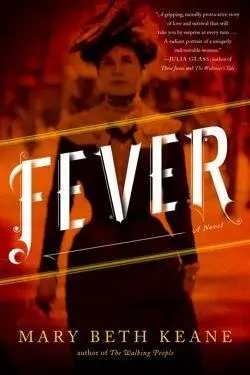
- Название:Fever
- Автор:
- Издательство:Scribner
- Жанр:
- Год:2013
- ISBN:нет данных
- Рейтинг книги:3 / 5. Голосов: 1
-
Избранное:Добавить в избранное
- Отзывы:
-
Ваша оценка:
Fever: краткое содержание, описание и аннотация
Предлагаем к чтению аннотацию, описание, краткое содержание или предисловие (зависит от того, что написал сам автор книги «Fever»). Если вы не нашли необходимую информацию о книге — напишите в комментариях, мы постараемся отыскать её.
In order to keep New York’s citizens safe from Mallon, the Department of Health sent her to North Brother Island where she was kept in isolation from 1907–1910. She was released under the condition that she never work as a cook again. Yet for Mary — spoiled by her status and income and genuinely passionate about cooking — most domestic and factory jobs were heinous. She defied the edict.
Bringing early twentieth-century New York alive — the neighborhoods, the bars, the park being carved out of upper Manhattan, the emerging skyscrapers, the boat traffic — Fever is as fiercely compelling as Typhoid Mary herself, an ambitious retelling of a forgotten life. In the hands of Mary Beth Keane, Mary Mallon becomes an extraordinarily dramatic, vexing, sympathetic, uncompromising, and unforgettable character.
Fever — читать онлайн бесплатно полную книгу (весь текст) целиком
Ниже представлен текст книги, разбитый по страницам. Система сохранения места последней прочитанной страницы, позволяет с удобством читать онлайн бесплатно книгу «Fever», без необходимости каждый раз заново искать на чём Вы остановились. Поставьте закладку, и сможете в любой момент перейти на страницу, на которой закончили чтение.
Интервал:
Закладка:
NINE
There were times, over on North Brother, with John Cane staring at the way she spread jam over a piece of toast and bit off the corner, when Mary felt like none of it was real. Even two years on, the doctors still spoke to her like she was a child, and she tried to find new ways of reminding them that she’d served food to people who once dined with the president of the United States of America. And after tasting what she’d prepared, they looked up from their plates to study her more closely, knowing she was not entirely what she seemed. Beneath the plain attire and the cook’s hands, behind the thick Irish accent and the working-class posture of exhaustion, they saw something else: a level of taste, an understanding of what those seated at the table were really after — a challenge to the palate, a meal to be enjoyed and not just consumed.
Mary wanted Mr. O’Neill to know that there were some doctors who had an unhealthy obsession with her bathroom habits, far beyond the scope of the case. “They’d watch me go, if I let them,” she told him. Two years earlier she wouldn’t even have been able to say that much, wouldn’t have even been able to make a glancing reference to “going.” They could make all the insinuations and comments they wanted about Alfred, and the rooms they shared, why they weren’t married, what kind of woman this made her. None of it bothered her as much as the discussion of her bathroom habits. Shortly before Mary met Mr. O’Neill, one of the nurses who came to collect her samples joked that she envied Mary. “You’ve got your cottage on the water, free rein of the island, no balance to be paid to the grocer, no child hanging off you, no husband to face at night, no younger brothers to put through school. There’s more than a few who’d trade with you.” The nurse said this as Mary placed on the floor the usual glass canister that contained her sample, mixed in a solution that looked like water. The nurse handed her a second canister for her urine. Mary usually tried to shroud the contents of the canisters with paper or a napkin, wrapping them separately at first and then together, like a package that needed a bow, and doing so allowed her to pretend for a moment that what was happening was not really happening. But that day, because of the nurse’s comment, Mary shoved the jars in the other woman’s direction without wrapping them, pushed them into her hands so roughly that the nurse fumbled, almost dropped them. The contents sloshed inside.
“Careful, Miss,” the woman said.
“I’d say the same to you,” Mary answered.
The doctors admitted that more than a third of the time Mary’s samples came back showing no Typhoid bacilli whatsoever. And her urine came back negative 100 percent of the time. When Mr. O’Neill asked about past pressure they’d put on Mary to submit to gallbladder surgery, they conceded that they no longer believed her gallbladder was to blame. Her intestines, perhaps. Her stomach. They weren’t sure.
“Good thing you were stubborn about surgery,” Mr. O’Neill said to Mary later. “It would have been for nothing.” Mary had occasionally wondered why no one had mentioned her gallbladder in a long time, and now she wanted to go up to the hospital and demand an apology. They were animals. They would have risked her life for sport.
“Let it go,” Mr. O’Neill said. “We’ll address all of it at the right time.”
He said that it was essential that they humanize her at the hearing. “Make me into a human?” Mary asked, confused.
“Well, yes. What I mean is, we have to paint your story so that anyone, no matter what their station, will sympathize. And better yet, make them afraid that they could end up like you.”
“So in acting for me they’re really acting for themselves.”
“Exactly. So. What were your feelings when you were told you were being brought to North Brother? Were you aware of the Tuberculosis hospital here?”
“My feelings?”
“Were you afraid? Did you even know of North Brother? Where exactly it was, for example?”
“Of course,” Mary said, looking at him steadily. “Of course I knew where it was. Doesn’t every person in this city know?”
Mr. O’Neill seemed about to say something but changed his mind.
“You think I don’t follow a newspaper, Mr. O’Neill? Even the illiterate in this city know exactly where North Brother is. There’s more to getting news than reading it in the paper. There’s talking, too, isn’t there? Or did you assume we don’t talk about the same topics you talk about? Wasn’t the General Slocum disaster only five years ago?”
She did not admit to Mr. O’Neill that she’d never heard of North Brother before June 1904, when the General Slocum burned. But forever after, she thought of those people whenever an errand brought her near Kleindeutschland , little Germany, where most of the people on the General Slocum that day were from. More than one thousand people had burned to death or drowned, and Mary thought of that number when she looked out over the East River now — men, women, children all bobbing in the rough water, pushed back and forth and under. A story went around in the weeks after the tragedy that the manufacturer of the life preservers had slipped in iron bars to make the weight minimums, that the captain and crew had abandoned the ship and its passengers and taken a tug from North Brother back to Manhattan, refusing to look at those in the water who cried out for their help. Inmates from the House of Refuge on Rikers swam into the water to help people, and then swam back to their prison that night.
Mary often went down to the spot where survivors had stumbled ashore, sometimes imagining that she’d been on board, that she’d been one of the women who jumped into the river and made it to North Brother, and when she wasn’t looking — occupied, perhaps, by the sound of her own breathing, distracted by her gratitude for her life, her back turned, her ears closed — she’d been left behind and forgotten.
• • •
The hearing would not be a quick one; that much was clear within an hour. As the sun rose higher and heated the odors of the room, Mary felt weaker. She watched sweat run down the sides of Mr. O’Neill’s face. Judge Erlinger’s eyes had begun to close. One doctor, instead of answering anything specific about her case, lectured exclusively on the bleeding of horses, and how it was no longer necessary to bleed a horse to death in order to obtain the maximum amount of serum to make vaccines. “Take Diphtheria, for example,” he went on. “There have been several cases where the horse’s reaction is so strong that death came too quickly, and the glass cannulae used to collect the blood were broken in the horse’s fall and destroyed.”
A murmur went up among the other doctors. Mary leaned over and asked Mr. O’Neill why they were talking about horses.
“The best thing,” the man went on, “is to always bleed from the carotid vein, and not the jugular. The jugular will weaken the horse too quickly, and in most cases results in less blood collected. But even more important, the use of supports must”—he banged his fist on the chair for emphasis—“become standard practice across the labs. A large male horse can be suspended with two stout ropes, one passing behind the forelegs and one in front of the hind legs. Once the support is in place, the cannula should be inserted into the artery. By this method it’s possible to obtain five usable gallons from a single horse.”
“And where do you stand on the Mallon case?” the DOH lawyer urged the doctor.
“In terms of Typhoid, I think the answer lies in widespread milk pasteurization, cleaner water, better education on personal hygiene. Typhoid is entirely preventable.”
Читать дальшеИнтервал:
Закладка:
Похожие книги на «Fever»
Представляем Вашему вниманию похожие книги на «Fever» списком для выбора. Мы отобрали схожую по названию и смыслу литературу в надежде предоставить читателям больше вариантов отыскать новые, интересные, ещё непрочитанные произведения.












Обсуждение, отзывы о книге «Fever» и просто собственные мнения читателей. Оставьте ваши комментарии, напишите, что Вы думаете о произведении, его смысле или главных героях. Укажите что конкретно понравилось, а что нет, и почему Вы так считаете.