Evan Hunter - Streets of Gold
Здесь есть возможность читать онлайн «Evan Hunter - Streets of Gold» весь текст электронной книги совершенно бесплатно (целиком полную версию без сокращений). В некоторых случаях можно слушать аудио, скачать через торрент в формате fb2 и присутствует краткое содержание. Город: New York, Год выпуска: 1975, ISBN: 1975, Издательство: Ballantine Books, Жанр: Современная проза, на английском языке. Описание произведения, (предисловие) а так же отзывы посетителей доступны на портале библиотеки ЛибКат.
- Название:Streets of Gold
- Автор:
- Издательство:Ballantine Books
- Жанр:
- Год:1975
- Город:New York
- ISBN:978-0-345-24631-8
- Рейтинг книги:4 / 5. Голосов: 1
-
Избранное:Добавить в избранное
- Отзывы:
-
Ваша оценка:
Streets of Gold: краткое содержание, описание и аннотация
Предлагаем к чтению аннотацию, описание, краткое содержание или предисловие (зависит от того, что написал сам автор книги «Streets of Gold»). Если вы не нашли необходимую информацию о книге — напишите в комментариях, мы постараемся отыскать её.
Streets of Gold — читать онлайн бесплатно полную книгу (весь текст) целиком
Ниже представлен текст книги, разбитый по страницам. Система сохранения места последней прочитанной страницы, позволяет с удобством читать онлайн бесплатно книгу «Streets of Gold», без необходимости каждый раз заново искать на чём Вы остановились. Поставьте закладку, и сможете в любой момент перейти на страницу, на которой закончили чтение.
Интервал:
Закладка:
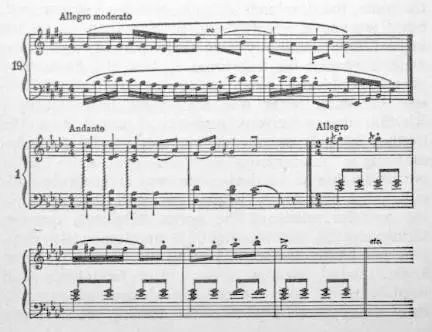
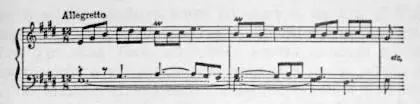
I’ve been told by sighted people who are not musicians that those sixteenth notes in the bass clef of the first and second measures look forbidding, as do the triplets in the treble clef of the last two measures. But believe me, this is a very simple exercise. Well, here’s that same passage as it would look (or, more correctly, feel ) in Braille:
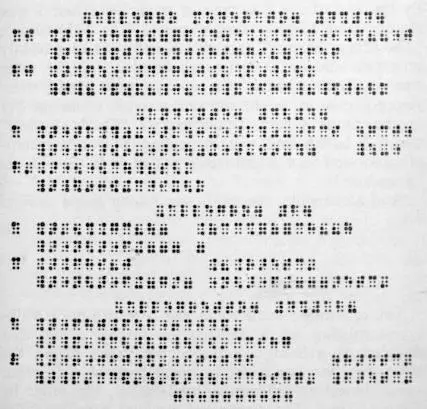
Try, then, to imagine the Braille notation for a beast like the “Hammerklavier.” The mind boggles. And mine did . In fact, I still find Braille music confusing at times, even though I studied it for the better part of ten years. Space is a problem in music for the blind, and very often the same symbols are used to mean different things. Imagine being a blind musician for a moment (thank God, you don’t have to) and running across a symbol that stands for a whole note as well as an eighth note. Rampant bewilderment? I tell you . Or stumble across a shorthand musical direction that says, “Count back twelve measures and repeat the first four of them.” Dandy, huh?
Patiently, Miss Goodbody taught me to read. I memorized the keyboard, I memorized the chords, I memorized pieces in Braille, feeling the raised dots with one hand while I played the notes with the other, and then reversing the process with the other hand. By the end of my first year of study with her, I was reading and playing simple pieces like Schumann’s “The Merry Farmer” (which I heard sung as a bawdy tune years later, the lyrics proclaiming: “There once was an Indian maid/who always was afraid/some young buckaroo/would slip her a screw/while she lay in the shade”) and Tchaikovsky’s “Doll’s Burial,” which I hated, and was struggling with more complicated stuff like Beethoven’s Sonatina in G and his “Ecossaise.”
And meanwhile, the myth was taking shape around me.
The apartment we lived in was a fourth-floor walk-up, consisting of a kitchen, a dining room that doubled as a living room because that’s where the radio was, and two bedrooms next door to each other — one shared by my mother and father, the other by Tony and me. The apartment was not a railroad flat in the strictest sense. That is, the rooms were not stretched out in a single straight line, like train tracks. But it was a railroad flat in that there were no interior corridors, and to get to one room you had to pass through another. My parents must have made love very tiptoe carefully, lest Tony or I, on the way to the bathroom in the dead of night, stumble upon their ecstasy. The kitchen was tiny, with the icebox, the gas range, and the sink lined up against one wall, a wooden table with an oilcloth cover (I loved the feel and the smell of that oilcloth) against the opposite wall. A window opened onto the backyard clotheslines, and also onto the windows of countless neighbors with whom, like an Italian (excuse me — American) Molly Goldberg, my mother held many shouted conversations as she hung out the laundry.
Molly Goldberg was part of the growing myth.
We needed that myth in the thirties. We needed it because we were desperate. I used to think my mother was a lousy cook. I used to think her menus were unimaginative. I can still recite the entire menu for any given week from 1933 through 1937, because they didn’t change an iota until my father was appointed a regular and we moved to the Bronx. We began eating a little better then. But in those years when he was bringing home his twelve dollars a week from the post office (plus eight cents a letter for special delivery mail), the menus were unvaried. I knew, for example, that Monday night meant soup. The soup was made with what my mother called “soup meat,” and which I now realize was the cheapest cut of beef available, stringy and tasteless, and boiled in a big pot with soup greens and carrots. On Tuesday and Thursday nights, pasta was served with a meatless sauce, spiced and herbed, accompanied by salad and bread. On Wednesday night, we ate scrambled eggs with bacon. Eggs cost twenty-nine cents a dozen in those days, but my mother used only eight of them with a pound of bacon (at twenty-two cents a pound) and could serve a dinner for four, including Italian bread and an oil-and-vinegar salad, for about fifty-two cents. Friday night was fish, of course. On Saturday night, we ate breaded veal cutlets. Veal cost sixteen cents a pound as opposed to twenty cents a pound for pork or twenty-six cents a pound for round steak. On Sunday, we went to my grandfather’s house for the weekly feast. We were not starving. I don’t mean to suggest we were even hungry. I’m only saying that we (not me, not Tony, but certainly my parents) were aware of our plight, and further aware that millions of other Americans were hungry and were starving.
In 1932, the wife of President Hoover had said, “If all who just happened not to suffer this year would just be friendly and neighborly with all those who just happened to have bad luck, we’d all get along better.” Maybe she started the myth, who the hell knows? Or maybe it was Hoover’s Secretary of Labor who, again in 1932, while people were aimlessly wandering the nation in boxcars and eating roots in barren fields, said, “The worst is over without a doubt, and it has been a disciplinary, and in some ways, a constructive experience.” Well, by 1933, the worst was still far from being over without a doubt, and everyone in the country knew that whereas some people had it slightly better than other people, everybody had it bad. We’d been riding high on those fat years following World War I, and suddenly, literally overnight, we’d fallen into an abyss so deep it appeared bottomless. We rushed to elect Roosevelt in 1932, not because we thought he’d miraculously pull us up into the clear blue yonder, but only because we thought he might somehow arrest our downward plunge before we hit the jagged rocks below. And now it was 1933, and FDR and the NRA and the CCC and the PWA and the WPA and the AAA had given us a whole lot of alphabets, but still not much soup to put them in. “Hard times” was still the common denominator; without that specter of hunger constantly leering in the background, the myth would never have come into being.
If Hoover’s woman had naively stated one element essential to the creation of any myth in any time (a cultural ideal), and if Hoover’s man had optimistically stated another (a commonly felt emotion or experience), it was Franklin Delano Roosevelt who became the first of literally thousands of thirties’ heroes (or villains) without which the myth could not have functioned. Everybody either hated him or loved him. There was no in between. You never heard anyone saying, I can take the man or leave him alone. He was “ That Man,” and there was no possible way of remaining indifferent to him or his programs. But if love and hate are opposite sides of the same coin, and you spin the coin often enough and fast enough, the emotions become blurred and all you know is that something’s spinning on the table there, and it’s got two sides to it, and you can’t remember anymore which side was love and which was hate. Hating Roosevelt or loving Roosevelt became almost identical emotions. But more important, in terms of the myth, they became commonly shared emotions. Love him or hate him, he was ours. Deliverer or nemesis, he was ours. Thinking about him one way or the other, or both ways, or now one way and then the other, became part of what it meant to be American. We were becoming American, you see. Not the way my grandfather had (he still wasn’t in 1933, as a matter of fact) or the way my mother had, but in a way that was entirely new and unexpected and naive and exciting and sometimes deliriously exhilarating. We were beginning to claim people and things as our own , establishing tradition where earlier there had been only history to hold us together. The building blocks of the burgeoning myth were Buck Rogers guns and Charlie McCarthy insults, Busby Berkeley spectaculars and John Dillinger stickups, “Life Is Just a Bowl of Cherries,” Shirley Temple dolls, “Happy Days Are Here Again.” They were here again. For the first time. Because however superficial it may seem now, the myth had been conceived innocently and in desperation, and it is no accident that people today look back upon those terrible years of the 1930s with a sense of keen nostalgia. It was then that we became a family.
Читать дальшеИнтервал:
Закладка:
Похожие книги на «Streets of Gold»
Представляем Вашему вниманию похожие книги на «Streets of Gold» списком для выбора. Мы отобрали схожую по названию и смыслу литературу в надежде предоставить читателям больше вариантов отыскать новые, интересные, ещё непрочитанные произведения.


Обсуждение, отзывы о книге «Streets of Gold» и просто собственные мнения читателей. Оставьте ваши комментарии, напишите, что Вы думаете о произведении, его смысле или главных героях. Укажите что конкретно понравилось, а что нет, и почему Вы так считаете.