Evan Hunter - Streets of Gold
Здесь есть возможность читать онлайн «Evan Hunter - Streets of Gold» весь текст электронной книги совершенно бесплатно (целиком полную версию без сокращений). В некоторых случаях можно слушать аудио, скачать через торрент в формате fb2 и присутствует краткое содержание. Город: New York, Год выпуска: 1975, ISBN: 1975, Издательство: Ballantine Books, Жанр: Современная проза, на английском языке. Описание произведения, (предисловие) а так же отзывы посетителей доступны на портале библиотеки ЛибКат.
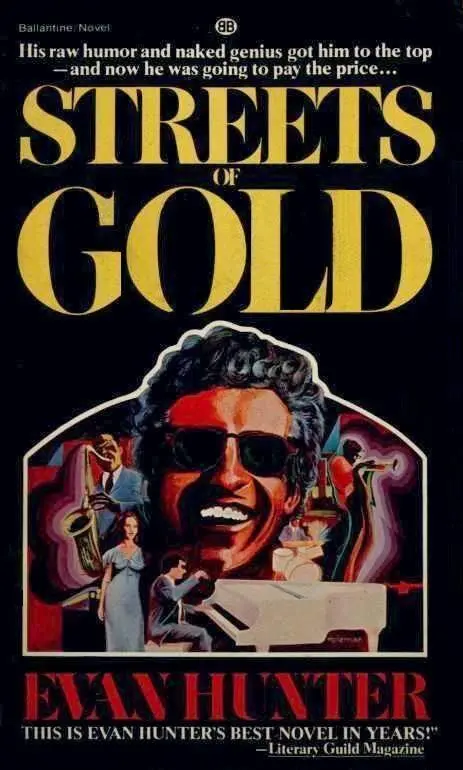
- Название:Streets of Gold
- Автор:
- Издательство:Ballantine Books
- Жанр:
- Год:1975
- Город:New York
- ISBN:978-0-345-24631-8
- Рейтинг книги:4 / 5. Голосов: 1
-
Избранное:Добавить в избранное
- Отзывы:
-
Ваша оценка:
Streets of Gold: краткое содержание, описание и аннотация
Предлагаем к чтению аннотацию, описание, краткое содержание или предисловие (зависит от того, что написал сам автор книги «Streets of Gold»). Если вы не нашли необходимую информацию о книге — напишите в комментариях, мы постараемся отыскать её.
Streets of Gold — читать онлайн бесплатно полную книгу (весь текст) целиком
Ниже представлен текст книги, разбитый по страницам. Система сохранения места последней прочитанной страницы, позволяет с удобством читать онлайн бесплатно книгу «Streets of Gold», без необходимости каждый раз заново искать на чём Вы остановились. Поставьте закладку, и сможете в любой момент перейти на страницу, на которой закончили чтение.
Интервал:
Закладка:
“I think we’re gonna have to march, too,” my father said. “If we can’t get a decent living wage, Stella, we have to march.”
“How can government employees march?” my mother asked.
“It won’t be the same as a strike. It’s just a way of letting them know we’re alive.”
“You know what Grandpa told me this afternoon?” I said.
“What did Grandpa tell you?”
“That Mussolini is right about Ethiopia. It does belong to the Italian people.”
“Sure, your grandfather’s a greaseball,” my mother said. “What do you expect him to say?”
“He’s not a greaseball no more,” Tony said. “He’s been here more than thirty years already.”
“Can he run for president?” my mother asked.
“No, but...”
“Then he’s still a greaseball,” she said flatly.
“ I can run for president,” I said. “And Tony can, too.”
“Why don’t you run together?” my mother said, not without a touch of sarcasm. “President and vice-president.”
“Would it be any worse than Roosevelt and Garner?” my father asked, and then said, “How come fish again?”
“It’s Friday,” my mother said.
“I hate fish,” my father said.
“So do I,” Tony said.
“Me, too,” I said.
“That’s right, teach them to be heathens,” my mother said.
“Miss Goodbody says Mussolini is a bad man,” I said.
“Is she a Jew?” my father asked.
“I don’t know. Why?”
“Because the Jews are for Ethiopia.”
“Grandpa says Roosevelt is a Jew,” Tony said.
“Another one of his greaseball ideas,” my mother said. “I get sick and tired of hearing him talk about the other side all the time. If he likes it so much there, why the hell doesn’t he go back?”
“He is going back,” I said. “And I’m going with him.”
“Here’s your hat, what’s your hurry?” my mother said.
“The streets are so clean in Fiormonte, you could eat right off them,” Tony said.
“Try eating off your plate right here, why don’t you?”
“In Fiormonte, everybody’s poor but happy,” I said.
“Sure, that’s why your grandfather came here. Because everybody was so happy in Fiormonte.”
“He came here to make his fortune,” Tony said.
“So he made it. So tell him to shut up about the other side.”
“Vinny the Mutt hit the numbers for five hundred bucks the other day,” my father said. “Now that’s a fortune.”
“Miss Goodbody says the numbers is a racket,” I said. “What time is it?”
“Seven o’clock.”
“ ‘Amos ’n’ Andy’!” I yelled, and shoved back my chair, and ran into the dining room. “She says it supports prostitution.”
Radio was the best entertainment medium ever devised for humanity. I am one day going to form a blind men’s marching society, and we are going to begin screaming at the tops of our lungs outside movie theaters and television studios, demanding the abolition of any form of entertainment that requires the use of eyes. If you yourself are blind and reading this in Braille (fat chance) or having it read aloud to you by someone who will undoubtedly distort its tonal quality, please consider seriously the possibility of joining this lonely voice, and forming (in the tried-and-true American way) a group that will demand something vitally important in its own tiny, selfish way — the return of the radio as something more than a conduit for bad music and bad news. We will be the only true minority group on these shores; the smallest one, anyway.
Calling ourselves the Consolidated Organization to Correct Kinescopic Excesses, Yelling to Eliminate Discrimination to the Sightless, we will become known in brief (and again in keeping with the American way of reducing long titles to acronyms) as the COCK-EYEDS. And having a title, and a shorthand word representing that title, we will then be able to take our place alongside all those other organizations shouting for separateness and apartness instead of solidarity-proud, worthy, and righteous conclaves like the Brotherhood of Abortion Banners Insisting on Egg Survival; or the Regional Independent Federation of Lovers of Egret Shooting; or the American Readiness Association Clamoring to Halt the Nasty and Intolerable Destruction of Spiders; or, finally, the Committee Against Virtually Everything Stalagmitic. And one day, all of us will happen to meet in the middle of Fifth Avenue, marching in all directions, and we will shout, “Brother!” together at the same instant, mistaking this for a cry of unity instead of an echo in a closed, locked, windowless room. On that day, we will finally discover we’d all been blind. I should only live to see it.
The radio was a blessing, and whereas in those days I felt it had been invented exclusively for the sake of the blind, I now realize it was a necessary ingredient in the mortar that held the myth together — one part radio, one part movies, and equal parts of ballyhoo and hullabaloo. Being the cheapest form of entertainment around, the radio was perfectly suited to the times. But more important, it provided us with hundreds of fictitious families who in turn were incorporated into the larger American family, the myth endlessly reflecting itself in a series of mirrors that threw back images of images. The Goldbergs, the Barbours, Easy Aces, Vic and Sade were all families in the strictest sense of the word, but if a family consists of any group of people whose idiosyncrasies, affectations, speech patterns, and personalities are intimately known, why then Jack Benny’s gang was a family, and the Lone Ranger and Tonto were a family, and so were The Green Hornet and Kato, and Major Bowes and all his amateurs, and the super-intellects on “Information, Please,” and the nuts in Allen’s Alley — Senator Claghorn and Mrs. Nussbaum, and boisterous Ajax Cassidy, and Titus Moody saying, “Howdy, bub,” each and every time. We were surrounded by families within families, and not all of them were suffering like the people who came to Mr. Anthony for radio advice each week. (“No names, please,” he always cautioned, and this was picked up at once and made an inside family joke on other radio shows, and then it filtered its way into the streets so that whenever anyone said, “Hello, Louie,” or “Hello, Jim,” the response was invariably, “No names, please.”)
Each week, we waited breathlessly for that Monday-night radio voice to tell us, “This is Cecil B. De Mille coming to you from Holllllywood.” We wondered along with Bob Hope just who Yehudi was, and fell off our chairs when Jerry Colonna replied, “Ask Yehudi’s cutie.” And when Hope said, “Who’s Yehudi’s cutie?” Colonna answered, “Ask Yehudi,” bringing the expected, “Yes, but who’s Yehudi?” — the whole hilarious nonsensical round delighting us. We knew George Burns would end his show with, “Say good night, Grade,” and we knew Baron Munchausen would say, “Vas you dere, Sharlie?” and yes, I vas dere, Sharlie, and I loved every minute of it. I had relatives all over Harlem, and all over the airwaves, and by extension all over the United States, because I knew we were all listening to that little box and, somehow, the sound waves miraculously being carried into all our homes were transforming the entire nation into a single giant living room.
In 1933, at seven o’clock every weekday night, the family thirty million Americans listened to was “Amos ’n’ Andy.” During the ensuing fifteen minutes of air time, telephone traffic dropped by fifty percent, movie theaters called off their scheduled performances and tuned their loudspeaker systems into NBC’s Red Network, and the nation’s more urgent business stopped dead while a pair of white men named Freeman Gosden and Charles Correll portrayed a gallery of Negro characters they themselves had invented — Amos, Andy, the Kingfish, Lightnin’, Brother Crawford, and the whole marvelous crowd at the Fresh Air Taxicab Company. “Those niggers are hot stuff,” my mother would say, and indeed they % were. I would go around the house after each show, quoting dialogue I had just heard and partially memorized, causing Tony to roll on the floor in laughter all over again.
Читать дальшеИнтервал:
Закладка:
Похожие книги на «Streets of Gold»
Представляем Вашему вниманию похожие книги на «Streets of Gold» списком для выбора. Мы отобрали схожую по названию и смыслу литературу в надежде предоставить читателям больше вариантов отыскать новые, интересные, ещё непрочитанные произведения.
Обсуждение, отзывы о книге «Streets of Gold» и просто собственные мнения читателей. Оставьте ваши комментарии, напишите, что Вы думаете о произведении, его смысле или главных героях. Укажите что конкретно понравилось, а что нет, и почему Вы так считаете.