Evan Hunter - Streets of Gold
Здесь есть возможность читать онлайн «Evan Hunter - Streets of Gold» весь текст электронной книги совершенно бесплатно (целиком полную версию без сокращений). В некоторых случаях можно слушать аудио, скачать через торрент в формате fb2 и присутствует краткое содержание. Город: New York, Год выпуска: 1975, ISBN: 1975, Издательство: Ballantine Books, Жанр: Современная проза, на английском языке. Описание произведения, (предисловие) а так же отзывы посетителей доступны на портале библиотеки ЛибКат.
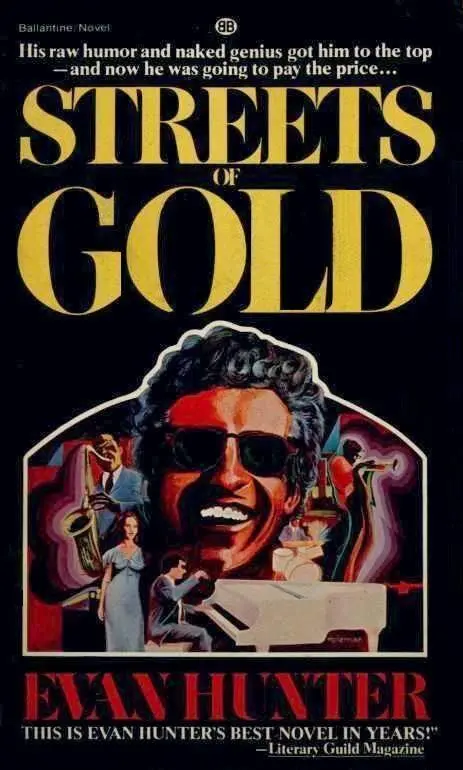
- Название:Streets of Gold
- Автор:
- Издательство:Ballantine Books
- Жанр:
- Год:1975
- Город:New York
- ISBN:978-0-345-24631-8
- Рейтинг книги:4 / 5. Голосов: 1
-
Избранное:Добавить в избранное
- Отзывы:
-
Ваша оценка:
Streets of Gold: краткое содержание, описание и аннотация
Предлагаем к чтению аннотацию, описание, краткое содержание или предисловие (зависит от того, что написал сам автор книги «Streets of Gold»). Если вы не нашли необходимую информацию о книге — напишите в комментариях, мы постараемся отыскать её.
Streets of Gold — читать онлайн бесплатно полную книгу (весь текст) целиком
Ниже представлен текст книги, разбитый по страницам. Система сохранения места последней прочитанной страницы, позволяет с удобством читать онлайн бесплатно книгу «Streets of Gold», без необходимости каждый раз заново искать на чём Вы остановились. Поставьте закладку, и сможете в любой момент перейти на страницу, на которой закончили чтение.
Интервал:
Закладка:
“Say, s’cuse me for protrudin’, stranger,” I would say in Andy’s voice, “but ain’t you got a hold of my watch chain?”
“Your watch chain?” I would answer as the Kingfish. “Well, so I does. How you like dat? One of dese solid gold cuff links of mine musta hooked on your watch chain dere.”
Ah, yes.
In the thirties, we were well on the way to becoming one big happy family.
On the day they stole Dominick’s college ring and Luke’s watch (not to mention their trousers), I was in the tailor shop on First Avenue with my grandfather and Pino. It was November, and the streets outside were cold and deserted. The shop, as my grandfather described it to me, had a plate-glass window fronting on First Avenue, the legend F. Di Lorenzo, Tailor lettered on it in curving gold leaf. The wooden flooring of the shop window served as a seat for visitors to the shop (seven-year-old me, on this occasion), as well as a repository for a clutter of badly designed and poorly colored posters of men and women wearing the fashionable clothes of 1933, advertising “Dry Cleaning” and “Custom Tailoring” and “Expert Alterations.” There were also cardboard movie posters for most of the theaters in the neighborhood, the Cosmo, the Grand, the RKO Proctor’s, and even the Palace — familiarly called the Dump by everyone in the ghetto. And, in one corner of the window, the NRA-member poster, with its blue eagle clutching lightning bolts in one claw, and a gear wheel in the other, and the red-lettered legend WE DO OUR PART.
There was a bell over the door of the shop, and it tinkled whenever anyone came in. The numerals 2319 were lettered onto the glass of the entrance door in the same gold leaf that spelled out my grandfather’s name and occupation. A sewing machine was just inside this front door, to the left as you came in, facing the long counter upon which my grandfather cut cloth and behind which he did most of his hand stitching. Running at a right angle to the counter was a double tier of clothing rods upon which were hung suits, trousers, dresses, skirts, overcoats, sweaters, all the garments left to be repaired or cleaned or pressed, each bearing a paper ticket pinned to the sleeve or the hem. A flowered curtain behind the counter covered the doorway to the back room, where my Uncle Luke ran the pressing machine. Whenever he was pressing, great billowing clouds of steam poured from between the padded jaws of the machine and seeped into the front of the shop. There was always the smell of steam in that shop. In the wintertime, it was particularly reassuring.
My mother has told me that my grandfather’s hair was already white in 1933, entirely white, giving him an older look than his fifty-three years. He was undoubtedly wearing thick-lensed eyeglasses with black frames, and his customary work costume — black trousers and white shirt, over which he wore an unbuttoned, chalk-dusted, black cardigan sweater, a tape measure draped over his shoulders. The big cutting shears that were almost an extension of his right hand were surely on the countertop within easy reach. Pino was sitting at the sewing machine, putting buttons on Salvation Army uniforms. He had lost his job shortly after the Crash, and now worked alongside my grandfather in the shop which was largely sustained by the Salvation Army uniform orders he himself had first brought to his friend. In 1933, he was described to me as a dapper little man with a neatly cropped black mustache, customarily and meticulously dressed in a pin-striped suit, an anachronistic celluloid collar on his shirt, an emerald stickpin holding his tie to his shirt.
The only sounds in the shop were the ticking of the big, brass-pendulumed clock on the wall opposite the clothing racks, and the clanging of the radiators, and the incessant clicking of Pino’s thimble and needle. The smells were those of the twisted De Nobili cigars both men were smoking, and the individual human scents (which I knew by heart) of my grandfather and Pino, and a subtler aroma that is difficult to describe unless you have spent a considerable amount of time in a tailor shop. It is the elusive aroma of clothes. A lot of clothes. Clothes of different fabrics and different textures and different weights, but nonetheless giving off a different collective aroma at different times of the year. In November, with the wind rattling the plate-glass window of the shop, the clothes gave off the scent of hidden corners. I sniffed in the aromas, I listened to the sounds.
“Grandpa,” I said, because this had become a running gag between us, and I never tired of it, “why do you smoke those guinea stinkers?”
“Who says they’re guinea stinkers?” my grandfather said.
“Everybody.”
“Che ha detto?” Pino asked.
My grandfather said, “ Ha chiamato questi ‘guinea stinkers.’ ”
“Ma perchè?”
“Why do you call them guinea stinkers?” my grandfather asked me.
“Because they stink.”
“What?” Pino said. “You’re wrong, Ignazio. It does not stink. It smells nice.”
“That’s no guinea stinker,” my grandfather said expectedly, delighting me. “That’s a good see-gah.” He puffed on it deliberately and ceremoniously, raising a giant smelly cloud of smoke. “This suit is for you,” he said, and rustled a paper pattern. “On Christmas Day, you’ll be the best-dressed kid in Harlem.”
“I know,” I said, and grinned.
“In Fiormonte, on Christmas... Pino, do you remember il Natale a Fiormonte ?”
“Sì, certo,” Pino said.
“Some one of these days, Ignazio,” my grandfather said, “I’m gonna take you home to the other side. I’ll show you my home, okay? You want to come to Fiormonte with Grandpa?”
“Sure.”
“È vero, Pino? Non è bella, Fiormonte?”
“È veramente bellissima.”
“From where I lived, Ignazio, you could see the river, no? And before la fillossera .”
The front door of the shop flew open, the bell tinkled. I smelled my Uncle Luke’s aftershave and my Uncle Dominick’s b.o.
“What’s the matter?” my grandfather said immediately.
“They took our pants!” Luke shouted.
“What?”
“Our pants!” Dominick said.
“ Who took your pants?”
“They came in the club, Pop,” Luke said in a rush, “and they took all our rings and watches, and then they made us take off our pants so we couldn’t chase them.”
“ Who took your pants?” my grandfather said patiently.
“They took my class ring ,” Dominick said. “Why are you so worried about my pants ?”
“Who?”
“Some gangsters.”
“What gangsters?”
“We don’t know. They had guns.”
“From la vicinanza ?”
“I don’t know,” Luke said. “I never seen them before, did you, Doc?” he asked his brother.
He had begun calling him “Doc” as soon as Dominick entered Fordham University, from which he’d been graduated in June of 1929, shortly before the Crash. In 1933, when I was seven years old, Dominick had just begun his third year of law school. Years later, when my parents first took Tony and me to the World’s Fair, my mother spotted the trylon and perisphere and immediately said, “There’s Luke and Dominick.” She never called him “Doc.” In fact, no one in the family ever did, except Luke.
“You got some pants for us, Pop?” he asked.
“Where am I going to get pants for you?”
“This is a tailor shop,” Luke said. “You mean to tell me you ain’t got pants for us?”
“In the back,” my grandfather said. “The ones near the sink. The ones I use for patches. Don’t touch no customer’s clothes!” he shouted to them as they went through the curtain. “ Che pensa?” he asked Pino.
Читать дальшеИнтервал:
Закладка:
Похожие книги на «Streets of Gold»
Представляем Вашему вниманию похожие книги на «Streets of Gold» списком для выбора. Мы отобрали схожую по названию и смыслу литературу в надежде предоставить читателям больше вариантов отыскать новые, интересные, ещё непрочитанные произведения.




Обсуждение, отзывы о книге «Streets of Gold» и просто собственные мнения читателей. Оставьте ваши комментарии, напишите, что Вы думаете о произведении, его смысле или главных героях. Укажите что конкретно понравилось, а что нет, и почему Вы так считаете.