Evan Hunter - Streets of Gold
Здесь есть возможность читать онлайн «Evan Hunter - Streets of Gold» весь текст электронной книги совершенно бесплатно (целиком полную версию без сокращений). В некоторых случаях можно слушать аудио, скачать через торрент в формате fb2 и присутствует краткое содержание. Город: New York, Год выпуска: 1975, ISBN: 1975, Издательство: Ballantine Books, Жанр: Современная проза, на английском языке. Описание произведения, (предисловие) а так же отзывы посетителей доступны на портале библиотеки ЛибКат.
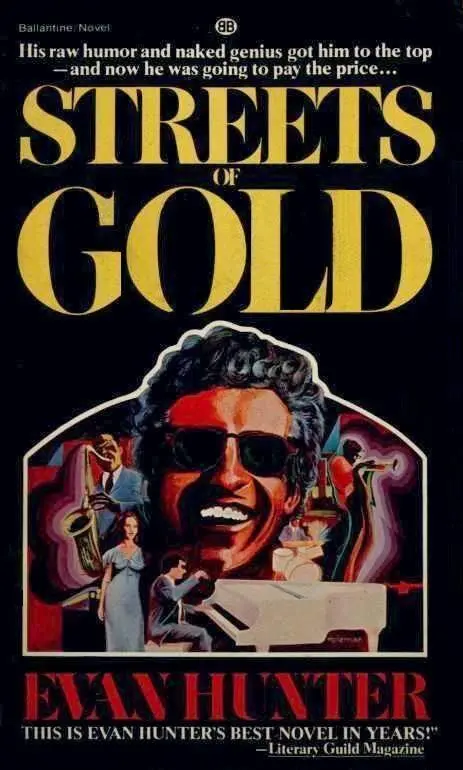
- Название:Streets of Gold
- Автор:
- Издательство:Ballantine Books
- Жанр:
- Год:1975
- Город:New York
- ISBN:978-0-345-24631-8
- Рейтинг книги:4 / 5. Голосов: 1
-
Избранное:Добавить в избранное
- Отзывы:
-
Ваша оценка:
Streets of Gold: краткое содержание, описание и аннотация
Предлагаем к чтению аннотацию, описание, краткое содержание или предисловие (зависит от того, что написал сам автор книги «Streets of Gold»). Если вы не нашли необходимую информацию о книге — напишите в комментариях, мы постараемся отыскать её.
Streets of Gold — читать онлайн бесплатно полную книгу (весь текст) целиком
Ниже представлен текст книги, разбитый по страницам. Система сохранения места последней прочитанной страницы, позволяет с удобством читать онлайн бесплатно книгу «Streets of Gold», без необходимости каждый раз заново искать на чём Вы остановились. Поставьте закладку, и сможете в любой момент перейти на страницу, на которой закончили чтение.
Интервал:
Закладка:
“Oh, yes, I picked up a little French when I was over there.”
“In the war, do you mean?”
“Yes, I was with the 107th Infantry Regiment, 27th Division, and I picked up a little French.”
“We must have a talk sometimes,” Stella said.
“Comme vous voulez,” Jimmy said, which he had picked up from a little French hooker he had picked up. “Are you sure there’s no request you’d like to hear? We can play almost anything.”
“I don’t suppose you know my favorite song,” Stella said.
“What song is that, Stella?”
“It’s ‘The Sheik of Araby.’ ”
“Oh, yes,” Jimmy said, “we can play that. My piano player has the sheet music. Lots of people think that that particular song was written for Valentino, for the piano players to play in the movie houses, you know, when they’re showing the picture. But that’s not true, Stella. Actually, it’s from a Broadway show. There was a show last year called Make It Snappy . That’s what The Sheik of Araby’ is from. It’s printed right on the sheet music.”
“I didn’t know that,” Stella said.
“Yes, it’s true.”
“I do love the song, though.”
“We’ll play it for you in the next set.”
“That’ll be the berries,” she said.
“I do a lot of cymbal work in it, makes it sound more like the desert. Stella?” he said.
“Yes?”
“I don’t know whether we’ll be playing overtime or not, that hasn’t been worked out yet, Matty’s still talking it over with your father. But even if we do play overtime, we’ll probably be finished along around one o’clock, maybe one-fifteen by the time I get the drums packed and pay the guys...”
“Yes?”
“I was wondering, I know it’ll be kind of late, but I thought you might like to take a ride over to the West Side, there’s some nice jazz clubs there with nigger musicians, it’s a lot of fun and perfectly safe, otherwise I wouldn’t even be asking you.”
“Oh, do you have a car?” she asked casually.
“No, but my trumpet player has one, and him and his girl’ll be running over there afterwards — she’s the little blond girl sitting there near the bandstand, the one with the green beaded dress, do you see her?”
“Yes, she seems very nice,” Stella said.
“Oh, she is, a very nice girl, they’re keeping steady company, they expect to get married sometime next year. We made that dress for her.”
“What do you mean? Who did?”
“Me and my mother. We have this crochet beading and embroidery business, I make all the designs, and we’ve got these girls for us who do the work. That’s a very spiffy dress you’re wearing yourself, Stella, I meant to compliment you on it.”
“It was in Vanity Fair .”
“I’m sure of that, it’s very swanky.”
“Though it’s just a copy.”
“It’s a very good copy, though. And the color is beautiful with your eyes and hair. You have very pretty eyes, Stella.”
“And you’ve got a very pretty line,” she said, and smiled.
“No, that’s no line. I saw those eyes and I couldn’t believe you were an Italian girl, I’ve never seen eyes like that on any Italian girl I know.”
“Well, I’m American, don’t forget,” Stella said, bridling for just an instant.
“Oh, naturally, can’t I tell that? I’m only saying those are really beautiful eyes, and I’m not trying to be fresh, I honestly mean it.”
“Well, thank you,” Stella said, and didn’t know what to do with her suddenly really beautiful eyes, so she lowered them.
“So what do you think? Would you like to come along with us when we go over there?”
“Well, I would have to ask my father,” Stella said, and glanced at Francesco, who was sitting at a table with Pino, his head on his folded arms. Pino was singing “ Pesce Fritt’ e Baccalà” at the top of his lungs. His eight-year-old son, Tommy sat stiffly beside his father, looking terribly embarrassed. “Or my mother, ” Stella amended.
“Well, could you ask her? We’ll only stay an hour or so. You could ask your sister and Matty to come along, too, if you like. There’s plenty of room in the car, it’s a Pierce-Arrow.”
“A Pierce-Arrow,” Stella said, “I’m sure my mother will say okay.”
“ Au ’voir, then,” Jimmy said, and went back to the bandstand.
As the Phantom Five played “The Sheik of Araby,” which had not been written for Rudolph Valentino, but instead for a Broadway show called Make It Snappy , and as Pino Battatore sang another chorus of the song they had learned together in Fiormonte, Francesco sat at the table with his head on his folded arms and tried to understand why he’d been crying just a short while ago. He had cried when news of his father’s death first reached him, and he had cried again when his mother died, and again when his sister Emilia had written to tell him of Maria’s illness and subsequent death; he had thought he’d cried for all of them when it was necessary to cry, and appropriate to cry, and timely to cry. But tonight, at his daughter’s engagement party, his darling angel Cristina, who was to marry a fine and handsome boy, he had cried again, and he could not understand why. And so he listened to Pino’s rasping off-key voice beside him, and heard Tommy pleading with his father to be still, and off at the other end of the room the Phantom Five went into another chorus of “The Sheik of Araby,” with Jimmy Palmer doing a lot of cymbal work to simulate the mood of the desert — and suddenly Francesco knew.
“But my family will be here ,” Pino had said to him long ago, and he remembered those words now, and realized that his family, the family of Francesco Di Lorenzo, was here. There was no family in Fiormonte; his mother and father were dead, Maria was dead, Emilia had left for Torino with her husband, who hoped to find work in the steel mills. The family was here. He had a beautiful, gentle wife whom he loved and cherished, and for whom he would work hard all the days of his life; he had a seventeen-year-old daughter who was engaged to be married; and a twenty-year-old daughter who was sure to marry soon herself, once she found the right boy, she was fussy, Stella, he liked that about her, she was not easy to please, his Stella, his star; and Domenico, such a smart boy, studying so hard at a very difficult high school in the Bronx, a ninety average, that was very good, they said, a ninety; and Luca, so tall, so gentle, who played the violin and piano beautifully, just like his cousin Rodolfo in Fiormonte... But no, Rodolfo had been killed in the war, Rodolfo was dead. The family was here.
Fiormonte had been the family, but now the family was here.
He sat up and looked at Pino, and Pino abruptly stopped singing.
“È qui,” he said to his friend. “ La famiglia è qui.”
“Cosa?” Pino asked.
Francesco watched his daughter as she went to the bandstand and began talking to the drummer, who kept playing all the while she chatted and smiled at him. On the dance floor, his other daughter, his angel Cristina, danced in the arms of a man who not ten minutes before had called him “Papa.” Francesco was forty-two years old. For the longest time he had been twenty-four, and had dreamed of going home. He was now forty-two, and knew he would never go home again, never return to Italy, never.
The family was here. He was the head of the family, and the family was here. Home was here.
He suddenly covered Pino’s hand with his own and squeezed it very hard.
II
They stood on line outside the free employment agency, four thousand men every day of the week, six thousand on Mondays, when presumably the chances of finding work were higher. There was not much talking on the line. Most of the men knew they would not get a job, but they were still trying, their hopelessness was not yet total. They waited in the bitter cold for two hours, sometimes three, and then a thousand of them were led inside, following each other up the long flight of steps to the huge open room with desks and telephones and men with megaphones. They filled out forms — name, address, age, education, religion, color. And then they waited for the phones to ring. A ringing phone meant a job offer. One of the megaphone men would answer a phone, and then call out a job — “Man needed to shovel snow, forty cents an hour” — and there would be a rush to the desk, and the job-seekers would be warned again to stay in line behind the rope, and another phone would ring, and a megaphone man would announce, “Skilled mechanic, seventy-five cents an hour, might be a full day’s work,” and another rush to the desk, and another warning. Each of the men knew if he didn’t get a job in the hour allotted to him upstairs, he would have to leave and come back the next day, and fill out the form again, and wait another sixty minutes for that phone to ring. If nothing came during that length of time, they would all be herded out of the big room again, and another thousand men who’d been waiting on line outside the building would be led upstairs to listen for those ringing telephones that meant someone had a job offer for them. Two hundred, three hundred men found temporary work each day. Most found nothing. They would wander over to the park afterward, and sit on benches and stare at their shoes. It was better than going home.
Читать дальшеИнтервал:
Закладка:
Похожие книги на «Streets of Gold»
Представляем Вашему вниманию похожие книги на «Streets of Gold» списком для выбора. Мы отобрали схожую по названию и смыслу литературу в надежде предоставить читателям больше вариантов отыскать новые, интересные, ещё непрочитанные произведения.


Обсуждение, отзывы о книге «Streets of Gold» и просто собственные мнения читателей. Оставьте ваши комментарии, напишите, что Вы думаете о произведении, его смысле или главных героях. Укажите что конкретно понравилось, а что нет, и почему Вы так считаете.