Evan Hunter - Streets of Gold
Здесь есть возможность читать онлайн «Evan Hunter - Streets of Gold» весь текст электронной книги совершенно бесплатно (целиком полную версию без сокращений). В некоторых случаях можно слушать аудио, скачать через торрент в формате fb2 и присутствует краткое содержание. Город: New York, Год выпуска: 1975, ISBN: 1975, Издательство: Ballantine Books, Жанр: Современная проза, на английском языке. Описание произведения, (предисловие) а так же отзывы посетителей доступны на портале библиотеки ЛибКат.
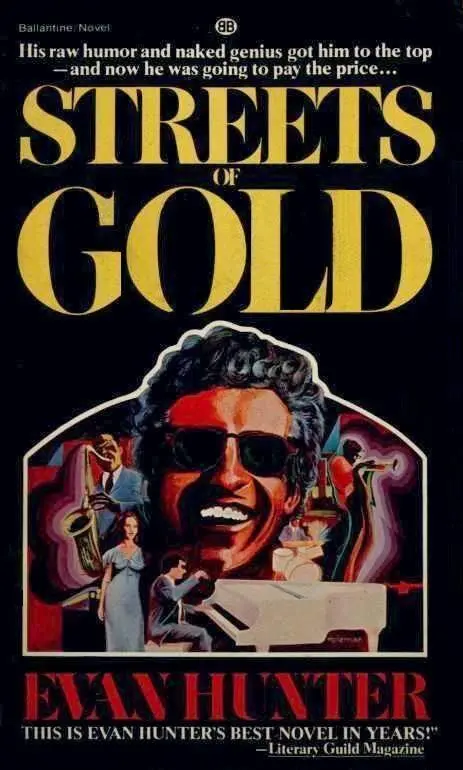
- Название:Streets of Gold
- Автор:
- Издательство:Ballantine Books
- Жанр:
- Год:1975
- Город:New York
- ISBN:978-0-345-24631-8
- Рейтинг книги:4 / 5. Голосов: 1
-
Избранное:Добавить в избранное
- Отзывы:
-
Ваша оценка:
Streets of Gold: краткое содержание, описание и аннотация
Предлагаем к чтению аннотацию, описание, краткое содержание или предисловие (зависит от того, что написал сам автор книги «Streets of Gold»). Если вы не нашли необходимую информацию о книге — напишите в комментариях, мы постараемся отыскать её.
Streets of Gold — читать онлайн бесплатно полную книгу (весь текст) целиком
Ниже представлен текст книги, разбитый по страницам. Система сохранения места последней прочитанной страницы, позволяет с удобством читать онлайн бесплатно книгу «Streets of Gold», без необходимости каждый раз заново искать на чём Вы остановились. Поставьте закладку, и сможете в любой момент перейти на страницу, на которой закончили чтение.
Интервал:
Закладка:
God knows what music he was playing in those days, or how he could possibly concentrate on it while simultaneously watching Stella through the holes in his hood. He was not to form his own Dixieland band until 1924, following an already well-established trend. But jazz had found its way from New Orleans to Chicago in 1917, and men like King Oliver, Louis Armstrong, and Jelly Roll Morton were beginning to be imitated in black Harlem and elsewhere in New York as well. Chances are, though, that my father’s band was more influenced by Paul Whiteman, who called himself the King of Jazz, but who played the sort of music I don’t even like to think about, much less dwell upon. The Phantom Five undoubtedly played a great many fox trots, tangos, and two-steps, the craze for such lunatic dances as the bunny hug, the turkey trot, the kangaroo, the snake, the grizzly bear, the crab, and a veritable zooful of others having all but vanished during the war. And possibly, just possibly, one or another of his musicians might occasionally have tried a lick in emulation of what they considered to be real nigger funk, but their stuff was mired, man, it had to be. I heard many of my father’s subsequent bands when I was growing up, and I would say that Stella’s assessment of the Phantom Five in 1922 was probably accurate: they were lousy. (My father claims, however, that Mike Riley, the trumpet player who coauthored “The Music Goes ‘Round and ‘Round,” a resounding hit that all but smothered the airwaves in 1935, had played in one of his early bands. I guess it’s true. My father has a way of hitching his wagon to any passing star. He claims, for example, that James Cagney grew up in his neighborhood. “Oh sure, I knew Jimmy when we were kids.” I am his most recently passing star.) Whatever he was playing in that hot and smelly hall on 116th Street, he played it without benefit of sheet music; my father never learned to read a note of music, and could not tell a single paradiddle from a double.
He made his move during a ten-minute break. Munching a ham and cheese sandwich on a soggy roll, his hood tucked into the white cord sash at his waist, he two-stepped over to Matty Diamond, who was said to have connections and who had recommended the Phantom Five to the girl’s father. Matty was standing at the makeshift bar, wooden planks set up on horses and covered with a long white tablecloth, in deep and serious conversation with his future father-in-law. Both men were pissed to the gills. Francesco had a glass of red wine in his hand. Through a pair of twisted straws, Matty was sipping homemade gin from a soda pop bottle.
“How’s it going, Matt?” Jimmy asked.
“Fine, who’s that?” Matty said, and turned away from the bar.
“Me. Jimmy Palmer. Music okay?”
“Beautiful,” Matty said, and put his arm around Jimmy. “That is some beautiful music you fellows are making. Where’d you learn to play that way, huh?”
“Oh, I been playing drums a long time now.”
“Well, it certainly shows, the way you play them things,” Matty said. “Papa,” he said, and turned to Francesco, “I want you to meet Jimmy Palmer, he’s the leader of the band there.”
“Piacere,” Francesco said, and held out his hand. The ensuing handshake was a bit awkward in that the hand Francesco extended was the one holding the glass of wine.
“Nice to meet you,” Jimmy said.
“Conosce ‘La Tarantella’?” Francesco asked.
“Oh, sure, would you like to hear that?” Jimmy said.
“He likes all that greaseball music,” Matty whispered.
“Well, we like to play to suit everybody,” Jimmy said. “Say, who’s the...?”
“Why do you fellows wear them things, them costumes?” Matty asked.
“Just an idea,” Jimmy said, and smiled.
“It’s a good idea,” Matty said. “It makes you look very good, them costumes.”
“Thank you. Matty, I was wondering if you knew...”
“Listen, I think maybe you ought to figure on overtime,” Matty said. “Papa, I think maybe the band ought to stay past twelve, don’t you think?”
“Cosa?” Francesco said, and belched.
“How much you fellows charge for overtime?” Matty said.
“Well, overtime’s more expensive,” Jimmy said.
“Sure, how much, don’t worry about it.”
“We get six dollars a man for overtime.”
“That’s an hour? Six dollars an hour?”
“That’s right.”
“What does that come to for all of you fellows?”
“Thirty dollars. It’d cost you more with a union band.”
“Oh, sure. Papa, they want thirty dollars more if they play after midnight.”
“Cosa?” Francesco said.
“It’s okay,” Matty said. “Don’t worry about it, Jimmy.”
“Who’s the girl in the red dress, would you know?” Jimmy asked.
“Who?”
“Over there.”
“What girl?”
“In the red dress.”
“The girl in the red dress?”
“Over there. The beaded dress.”
“Oh, yes,” Matty said.
“Who is she, would you know?”
“Oh, yes.”
“Well, who?”
“That’s my sister-in-law. My future sister-in-law. Stella.”
“What’sa matta my Stella?” Francesco asked.
“Nothing, Papa. This man here wanted to know her name.”
“Stella,” Francesco said, and nodded in agreement. Stella was most certainly his daughter’s name.
“Well, I’ll see you around, huh?” Jimmy said, and put on his hood, and walked over to where Stella was talking to her sister. “Hi, Stella,” he said. “How do you like the music?”
Stella turned to look at him. She had green eyes. He did not know any girls with green eyes.
“The music is absolutely the cat’s meow,” she said sarcastically, but her tone was lost on him. He was drowning in her eyes.
“Glad you like it,” he said. “I’m Jimmy Palmer. It’s my band.”
“You’ve got some band there, Jimmy Palmer,” Stella said. “All you need now is some horses, and you could go out burning crosses on niggers’ lawns.”
“Oh, yeah,” Jimmy said, missing the allusion to Birth of a Nation , which Stella had seen four times. “You know any horses can play saxophone?”
Stella laughed and looked at him more closely. Or, rather, looked at this hooded and sheeted person, brown eyes showing in the holes of the hood, some two or three inches taller than she was, a nice voice, he seemed to speak English very good. “Jimmy Palmer,” she said. “Is that an Italian name?”
“That’s the name I use,” he said.
“Use for what?”
“For when I’m playing. We play all over the city,” he said.
“What’s your real name?”
“Jimmy Di Palermo.”
“Are you from the other side, or were you born here?”
“Here,” he said. “On a Hun’ Third Street.”
“I was born here, too,” Stella said, and smiled.
“You got any requests or anything?” Jimmy said.
“Yeah, I got one request,” Stella said.
“What’s that? We’ll play it in the next set.”
“It’s not a song,” Stella said.
“What is it, then?”
“Why’n you take off that thing on your head and let a person see what you look like? That’s my request.”
“Sure,” he said, and took off the hood.
He was not a bad-looking fellow. His eyes, as she already knew, were brown. He had a longish, thin nose, not unlike her father’s, black hair combed back straight from his forehead sort of like Valentino’s, though of course he wasn’t half so handsome. He had a nice smile and good teeth. She wondered what he was wearing under that sheet. He probably dressed like a greenhorn.
“Il fait très chaud aujourd’hui,” she remarked, and much to her surprise, he answered, “Oh, beaucoup, beaucoup, mam’selle, ” and she said craftily, “Do you know what that means?”
Читать дальшеИнтервал:
Закладка:
Похожие книги на «Streets of Gold»
Представляем Вашему вниманию похожие книги на «Streets of Gold» списком для выбора. Мы отобрали схожую по названию и смыслу литературу в надежде предоставить читателям больше вариантов отыскать новые, интересные, ещё непрочитанные произведения.

Обсуждение, отзывы о книге «Streets of Gold» и просто собственные мнения читателей. Оставьте ваши комментарии, напишите, что Вы думаете о произведении, его смысле или главных героях. Укажите что конкретно понравилось, а что нет, и почему Вы так считаете.