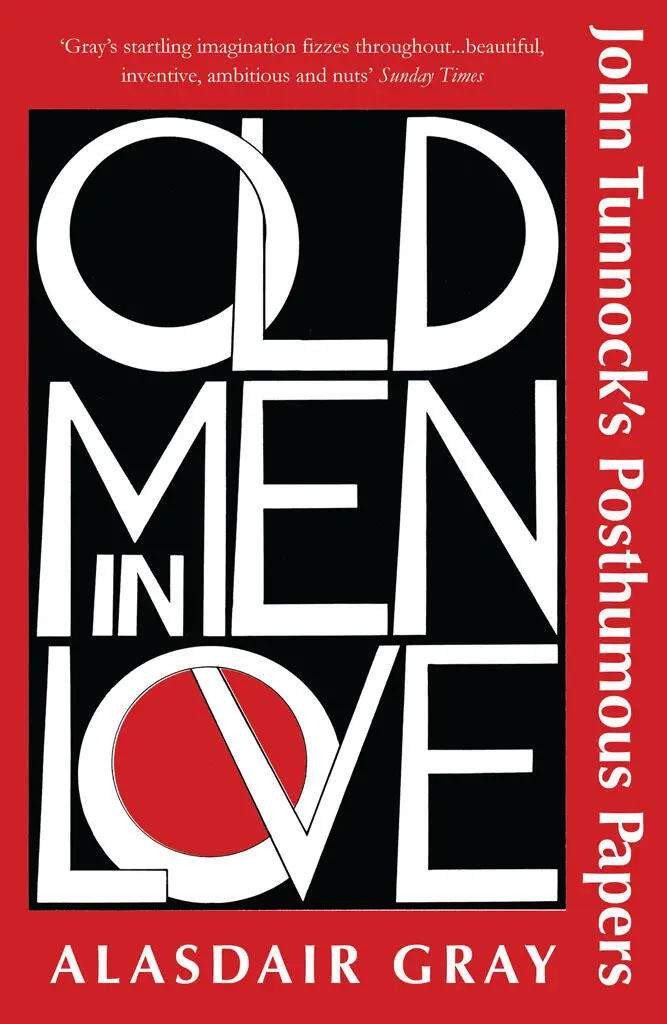
Alasdair Gray - Old Men in Love
Здесь есть возможность читать онлайн «Alasdair Gray - Old Men in Love» весь текст электронной книги совершенно бесплатно (целиком полную версию без сокращений). В некоторых случаях можно слушать аудио, скачать через торрент в формате fb2 и присутствует краткое содержание. Год выпуска: 2009, Издательство: Bloomsbury UK, Жанр: Современная проза, на английском языке. Описание произведения, (предисловие) а так же отзывы посетителей доступны на портале библиотеки ЛибКат.
- Название:Old Men in Love
- Автор:
- Издательство:Bloomsbury UK
- Жанр:
- Год:2009
- ISBN:нет данных
- Рейтинг книги:3 / 5. Голосов: 1
-
Избранное:Добавить в избранное
- Отзывы:
-
Ваша оценка:
Old Men in Love: краткое содержание, описание и аннотация
Предлагаем к чтению аннотацию, описание, краткое содержание или предисловие (зависит от того, что написал сам автор книги «Old Men in Love»). Если вы не нашли необходимую информацию о книге — напишите в комментариях, мы постараемся отыскать её.
"Our nearest contemporary equivalent to Blake, our sweetest-natured screwed-up visionary."-"London Evening Standard"
Alasdair Gray's unique melding of humor and metafiction at once hearken back to Laurence Sterne and sit beside today's literary mash-ups with equal comfort. "Old Men in Love" is smart, down-to-earth, funny, bawdy, politically inspired, dark, multi-layered, and filled with the kind of intertextual play that Gray delights in.
As with Gray's previous novel "Poor Things," several partial narratives are presented together. Here the conceit is that they were all discovered in the papers of the late John Tunnock, a retired Glasgow teacher who started a number of novels in settings as varied as Periclean Athens, Renaissance Florence, Victorian Somerset, and Britain under New Labour.
This is the first US edition (updated with the author's corrections from the UK edition) of a novel that British critics lauded as one of the best of Gray's long career. Beautifully printed in two colors throughout and featuring Gray's trademark strong design, "Old Men in Love" will stand out from everything else on the shelf. Fifty percent is fact and the rest is possible, but it must be read to be believed.
Alasdair Gray is one of Scotland's most well-known and acclaimed artists. He is the author of nine novels, including "Lanark," "1982 Janine," and the Whitbread and Guardian Prize-winning "Poor Things," as well as four collections of stories, two collections of poetry, and three books of nonfiction, including "The Book of Prefaces." He lives in Glasgow, Scotland.
Old Men in Love — читать онлайн бесплатно полную книгу (весь текст) целиком
Ниже представлен текст книги, разбитый по страницам. Система сохранения места последней прочитанной страницы, позволяет с удобством читать онлайн бесплатно книгу «Old Men in Love», без необходимости каждый раз заново искать на чём Вы остановились. Поставьте закладку, и сможете в любой момент перейти на страницу, на которой закончили чтение.
Интервал:
Закладка:
One Saturday morning I visited Renfield Street, a short street of shops in central Glasgow. It joins Sauchiehall Street, Bath Street and Argyll Street to the main bridge over the Clyde, so is always throng with pedestrians and vehicles. It is now almost incredible that second-hand books were once sold from flat-topped wheelbarrows at the corners of blocks on the western side. The spate of private cars must have swept these away in the 1960s, but in my second University year I found on one a tattered Penguin paperback of 19 thcentury verse called Hood to Hardy . Opening it at random I found it had work by poets my teachers had never mentioned, and as I read the street noises seemed to withdraw, leaving me in a silence with these words: 39
This Beauty, this Divinity, this Thought,
This hallowed bower and harvest of delight
Whose roots ethereal seemed to clutch the stars,
Whose amaranths perfumed eternity,
Is fixed in earthly soil enriched with bones
Of used-up workers; fattened with the blood
Of prostitutes, the prime manure; and dressed
With brains of madmen and the broken hearts
Of children. Understand it, you at least
Who toil all day and writhe and groan all night
With roots of luxury, a cancer struck
In every muscle; out of you it is
Cathedrals rise and Heaven blossoms fair;
You are the hidden putrefying source
Of beauty and delight, of leisured hours,
Of passionate loves and high imaginings;
You are the dung that keeps the roses sweet
I did not know what amaranths were or why they perfumed eternity, but that verse shook my intelligence awake by contradicting everything I had been taught about history and poetry at school and university — all I had been officially taught about life and would be taught for years to come. Since that day I have kept finding evidence that this grim view of what we call civilization is strictly true.
I still have and love that tattered copy of the Penguin Hood to Hardy . I bought it for ninepence. The jacket indicated that the price when new had been 2/6, meaning half-a-crown, meaning 30 pence when there were 12 pence in a shilling and 240 in a pound. How queer that old money now seems! Among notes at the end of the book I read that the author had been: John Davidson [1857–1909]. Born at Barrhead, Renfrewshire, son of a Dissenting Minister, Schoolmaster in Scotland until 1889 when he settled in London and published various plays and volumes of verse. He died in circumstances that suggested suicide . Barrhead is a small factory town in the Renfrew Hills six or seven miles south of Glasgow. It made lavatory pans, and I think could be reached by tram, before the trams were scrapped in 1963.
Davidson’s verses had been written at the start of the 20 thCentury before two world wars, huge massacres of civilian populations, and continual government-funded escalation of wars and weaponry. I discovered him when these catastrophes had left most British people feeling safe and prosperous, but what I read for myself and have since read confirms Davidson’s tragic view of civilization. It has taken a long while for me to reach the point of asserting it here. Despite great writers working to open folks’ eyes to that truth from the days of Homer and Euripides, the teachers who expounded their work did so with eyes firmly shut. The eye-opening effort is endless. In every age it must be tackled anew, but obviously it could not be tackled within the walls of a university.
I decided to support myself as a school teacher and had a practical and an idealistic reason for teaching in Molendinar Primary. Every pupil in that school except in the final year was my height or less. I also believed that good teachers are more important for primary schools than secondary schools, just as good teachers in secondary schools are more important than those in universities, because the earlier young folk get good schooling, the more it benefits their character. In those days nearly all students had their fees paid (like the armed forces) out of tax-payers’ money, because even Tories thought the nation needed all the well-educated citizens it could get. I was enough of a Socialist to believe that well-educated teachers from prosperous districts should carry their advantages to poorer ones. Most of my pupils were from Blackhill, a Glasgow municipal housing scheme built between the wars but less well-built than the housing schemes of Riddrie and Knightswood where clerks, schoolteachers and lower-paid professional folk were neighbours of skilled workmen. Blackhill was labelled a Slum Clearance Scheme and when high unemployment returned to Britain at the end of the sixties many Blackhill breadwinners lost their jobs and the number of crimes committed there greatly increased. My most difficult pupils came from fatherless homes. The poorest children lived with grandmothers. My first years in teaching made me very unhappy but I did some good. For several years I managed to take some of the poorest on camping holidays and twice got money from a charity that let me rent an H.F. guest house for them, Altshellach, in Arran. But like most idealistic teachers my enthusiasm dwindled so I was happy to become a Headmaster (the least responsible job in any school), happier to take early retirement and hide at last in research for my historic masterpiece.
The flaw in most histories is authors who pretend to be unprejudiced reporters of fact but keep describing the world coming to a good end in their own comfortable state — only Carlyle saw that nations whose only guiding principle was economic competition were preparing a Dark Age blacker than earlier ones. In the 17 thcentury Bishop Bossuet showed history culminating in Louis XIV’s Catholic France; 18 thcentury Gibbon thought it culminated in enlightened Europe; 19 thcentury Hegel in Protestant Prussia, Macaulay in post-Reform Bill England. The Outline of History by H. G. Wells viewed it as an irregular uphill struggle toward a world government of a scienctific, humanitarian kind — a successful 20 thcentury League of Nations. Mark Twain shot down such daftness by pointing out that if the age of the world was represented by the height of the Eiffel Tower, the not-quite million years of human history would correspond to the thickness of the paint on a knob at the very top. He wondered if those who thought the world had been created for mankind, and more especially for themselves, might believe the Eiffel Tower was mainly built to uphold the paint on the topmost knob and concluded, “Reckon they might. I dunno.”
If every history had a prologue describing the education of the writer’s mind, readers would know in advance why some facts dominate the narrative more than others. Dear reader you will soon see how well or badly I lay out mine. Like the Bible it starts in the only way well-educated folk now imagine the beginning.

18: MY WORLD HISTORY: PROLOGUE

A sudden endless gas explosion made all the material in this universe. Some parts collided with others, swirling into gassy clumps that got denser and hotter and became radiant globes as they rotated. Big neighbouring globes began turning round each other while smaller ones became satellites of a bigger partner. The lightest materials floated on the surface of the globes, sometimes cooling into floating plates of crust that grew bigger until their edges met, making a surface that only let out light where red-hot or where volcanoes exploded through. The air above this world of ours was of gases no life could breathe: methane, ammonia, hydrogen and water vapour. The world’s crust thickened. The surface cooled until rain water could lie there without being scalded into steam. At last a sea of water covered the world except where a rocky continent, thicker than the ground under the sea, rose above it near the equator. 40
Читать дальшеИнтервал:
Закладка:
Похожие книги на «Old Men in Love»
Представляем Вашему вниманию похожие книги на «Old Men in Love» списком для выбора. Мы отобрали схожую по названию и смыслу литературу в надежде предоставить читателям больше вариантов отыскать новые, интересные, ещё непрочитанные произведения.


Обсуждение, отзывы о книге «Old Men in Love» и просто собственные мнения читателей. Оставьте ваши комментарии, напишите, что Вы думаете о произведении, его смысле или главных героях. Укажите что конкретно понравилось, а что нет, и почему Вы так считаете.