Alasdair Gray - Old Men in Love
Здесь есть возможность читать онлайн «Alasdair Gray - Old Men in Love» весь текст электронной книги совершенно бесплатно (целиком полную версию без сокращений). В некоторых случаях можно слушать аудио, скачать через торрент в формате fb2 и присутствует краткое содержание. Год выпуска: 2009, Издательство: Bloomsbury UK, Жанр: Современная проза, на английском языке. Описание произведения, (предисловие) а так же отзывы посетителей доступны на портале библиотеки ЛибКат.
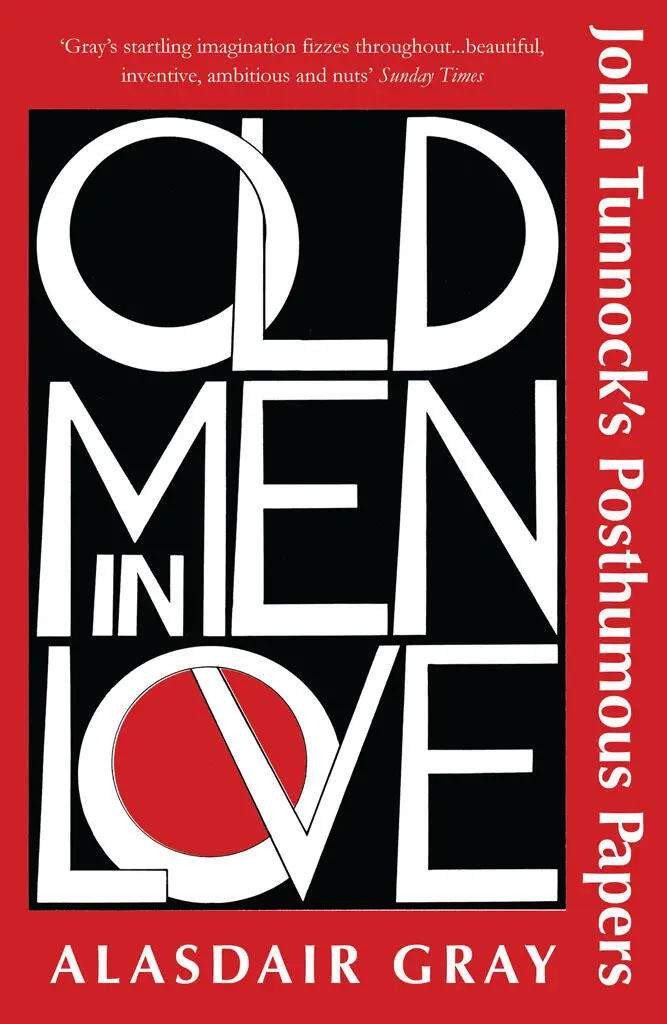
- Название:Old Men in Love
- Автор:
- Издательство:Bloomsbury UK
- Жанр:
- Год:2009
- ISBN:нет данных
- Рейтинг книги:3 / 5. Голосов: 1
-
Избранное:Добавить в избранное
- Отзывы:
-
Ваша оценка:
Old Men in Love: краткое содержание, описание и аннотация
Предлагаем к чтению аннотацию, описание, краткое содержание или предисловие (зависит от того, что написал сам автор книги «Old Men in Love»). Если вы не нашли необходимую информацию о книге — напишите в комментариях, мы постараемся отыскать её.
"Our nearest contemporary equivalent to Blake, our sweetest-natured screwed-up visionary."-"London Evening Standard"
Alasdair Gray's unique melding of humor and metafiction at once hearken back to Laurence Sterne and sit beside today's literary mash-ups with equal comfort. "Old Men in Love" is smart, down-to-earth, funny, bawdy, politically inspired, dark, multi-layered, and filled with the kind of intertextual play that Gray delights in.
As with Gray's previous novel "Poor Things," several partial narratives are presented together. Here the conceit is that they were all discovered in the papers of the late John Tunnock, a retired Glasgow teacher who started a number of novels in settings as varied as Periclean Athens, Renaissance Florence, Victorian Somerset, and Britain under New Labour.
This is the first US edition (updated with the author's corrections from the UK edition) of a novel that British critics lauded as one of the best of Gray's long career. Beautifully printed in two colors throughout and featuring Gray's trademark strong design, "Old Men in Love" will stand out from everything else on the shelf. Fifty percent is fact and the rest is possible, but it must be read to be believed.
Alasdair Gray is one of Scotland's most well-known and acclaimed artists. He is the author of nine novels, including "Lanark," "1982 Janine," and the Whitbread and Guardian Prize-winning "Poor Things," as well as four collections of stories, two collections of poetry, and three books of nonfiction, including "The Book of Prefaces." He lives in Glasgow, Scotland.
Old Men in Love — читать онлайн бесплатно полную книгу (весь текст) целиком
Ниже представлен текст книги, разбитый по страницам. Система сохранения места последней прочитанной страницы, позволяет с удобством читать онлайн бесплатно книгу «Old Men in Love», без необходимости каждый раз заново искать на чём Вы остановились. Поставьте закладку, и сможете в любой момент перейти на страницу, на которой закончили чтение.
Интервал:
Закладка:
17: FURTHER EDUCATION

After finishing in the evenings I began trying to turn my fantasies and learning into a single continuous story, always burning the results because what I wrote was obviously the work of an adolescent schoolboy. These stunted efforts still made me more of a writer than our teachers, who gave us Chaucer, Shakespeare, Jane Austen, Dickens, Thomas Hardy and only two books by Scots. Walter Scott’s Ivanhoe , set in the 12 thcentury, told how Norman conquerors and Saxon commoners are at last united as Englishmen — what a good lesson for a Scottish school child! Scott’s best novels have Scottish folk using local speech that teachers and examiners wanted us to forget. The other novel, John Buchan’s Prester John , told of a Scots minister’s son, working for the British Empire in Africa, who thwarts a black revolt planned by a black African who has fooled the white bosses by pretending to be Christian.
Gordon MacLean left Glasgow because his dad got a job elsewhere. I did not much miss him, having now other friends who also enjoyed discussing their emotional problems with an interested listener who seemed to have none. Before Gordon left he enlarged my political views without intending to. Hugh MacDiarmid’s son, a boy of nineteen, had been jailed for refusing to do his National Service, 34because the 1707 Treaty of Union with England said no Scottish soldier could be ordered overseas against his will, and MacDiarmid’s son refused to fight for the remains of the British Empire in Kenya, Crete or Malaysia, Ulster and other places he might have been sent. Gordon and I agreed his attitude was ridiculous. We thought the Treaty of Union, having merged Scotland’s parliament with the English one, was now an obsolete document. We had no wish for Scottish self-government. Gordon believed Scottish people could not rule themselves; I agreed because Britain had achieved a Welfare State through the efforts of a parliamentary Labour Party founded by Scottish Keir Hardie. I also thought Scotland and England had equal representation in London — my general knowledge was good, but I had no head for numbers. Gordon explained that England had ten times more MPs in Westminster than Scotland, a fair arrangement (he pointed out) since England’s population had always been ten times greater. I at once saw that a minority of Scots MPs in the midst of England’s richest city must be constantly outvoted to benefit the southern kingdom. For many years this did not stop me voting Labour but from then on I began to see how the Union with England had warped Scotland’s institutions, especially schools and universities.
At Gilmorehill our lecturers were mostly Oxford or Cambridge graduates, some of them Scots. 35They assumed ordinary students like me would stay in Scotland to teach the next generation what we had been taught, while brighter ones — their elite — would find work in England, former British colonies or the U.S.A. Bright Scots had been doing so for centuries, and bright people will want to please foreign masters by conforming to them, so the only tutor who mentioned Burns called him “a poor man’s Alexander Pope”. But they agreed that Wordsworth at his best, Blake, Byron, Shelley and Keats had not just been naytcha poets but (like Burns) had welcomed the French Revolution as the dawn of universal liberty, equality, fraternity. This enthusiasm was presented as forgivable but out of date, since Britain had now all the liberty, equality and fraternity it needed. I also learned that most great modern poets thought monetary greed had made life ugly. Ezra Pound turned Fascist because he thought only a dictator like Mussolini could make bankers fund important public works — Yeats wanted a nation where heroic landlords ruled admiring peasants — T.S. Eliot was nostalgic for the 17 thcentury Anglican Church where peace with God came more easily — Auden was a bouncy English public-school Communist, until World War 2 converted him to something like Eliot’s Christianity. Auden also said poetry made nothing happen and our professors agreed. 36
I remember one mocking Shelley for writing that Homer, Dante, Shakespeare and Milton had changed people’s minds more than kings, conquerors and lawgivers, therefore poets were mankind’s unacknowledged legislators. Shelley (said this professor gleefully) was an atheist, Socialist, pacifist and vegetarian, and none of his writings had persuaded anyone to become these; like other great writers Shelley had found the raw materials of art in the world around him, and what he made of them were fine poems without social consequences. I wish I had stood up and announced that Hitler, Stalin and every successful tyrant understood literature better than Auden and my professor because dictators banned and burned imaginative writing, shot or jailed poets, drove them to suicide like Mayakovsky, into exile like Brecht. 37Instead I timidly pointed out that Goethe’s novel The Sorrows of Young Werther had social consequences — it had been banned in Germany and France because young men, disappointed in love, had copied Werther by shooting themselves.
“Thank you for reminding me,” he said, chuckling, “Yes, emotional foreigners are unhealthily influenced by literature, but sane people are not. Good conversation, said Dean Swift, is life’s only sure source of happiness. I agree. We who have no interest in football find our happiest topics in books and art which are, after all, civilization’s finest blossoms.”
This thought-annihilating smugness did not silence me at first. I submitted an essay on Hamlet saying the plot was clumsily cobbled together in the hasty way Ben Jonson (a more careful playwright) deplored in Shakespeare. Hamlet is sent to England after stabbing Polonius but brought back just in time for Ophelia’s funeral by inexplicable pirates, pirates who capture his ship, let it sail on but return him to Denmark since the plot needs him there. Hamlet keeps postponing his revenge to the end of the last scene because Shakespeare, like all first class writers except Kipling, found the revenge motive too infantile to interest him, having sickened himself of it in his first and worst play Titus Andronicus . Of course all the Hamlet speeches are so entertaining that critics and audiences enjoy the play without question, accepting what happens as they accept the accidents of ordinary life. My tutor called me to his office and said, “Are you a Levisite?”
I told him I did not know what Levisites were.
“But you have read D.H. Lawrence’s opinion of Hamlet .”
“No!” I told him.
“Then where did this drivel come from?” he asked, waving the essay in my face. I said he had asked for an essay on Hamlet and I had written what I thought. He said, “You are here to learn — not think. Are you receiving a grant?”
Like most students in those days I was receiving a grant since the 1944 Butler Acts that paid the fees of working class students would never have been passed by parliament if the middle classes had not also benefited. The bastard said, “I do not see why my taxes should be used to support a student who does not understand the purpose of a university.”
I found this professor and others had written introductions to most of the plays and poems they examined us upon, so afterwards I pleased them by repeating their opinions without regard to the original texts. Luckily my main subjects were Latin and Greek where commentary was less important than accurate translation. I did so well in them that the Snell Foundation nearly sent me to Balliol, Oxford, where my life would have become very different. But I helped a fellow student write a very funny, damaging review of Professor Fordyce’s outstandingly bad edition of Catullus . 38The review was printed anonymously in G.U.M. but Fordyce was astute enough to work out who the authors were, and had enough power in the Senate to make sure we had no chance of a high academic post in Oxford or Scotland.
Читать дальшеИнтервал:
Закладка:
Похожие книги на «Old Men in Love»
Представляем Вашему вниманию похожие книги на «Old Men in Love» списком для выбора. Мы отобрали схожую по названию и смыслу литературу в надежде предоставить читателям больше вариантов отыскать новые, интересные, ещё непрочитанные произведения.


Обсуждение, отзывы о книге «Old Men in Love» и просто собственные мнения читателей. Оставьте ваши комментарии, напишите, что Вы думаете о произведении, его смысле или главных героях. Укажите что конкретно понравилось, а что нет, и почему Вы так считаете.