S. Agnon - Shira
Здесь есть возможность читать онлайн «S. Agnon - Shira» весь текст электронной книги совершенно бесплатно (целиком полную версию без сокращений). В некоторых случаях можно слушать аудио, скачать через торрент в формате fb2 и присутствует краткое содержание. Год выпуска: 2014, Издательство: Toby Press, Жанр: Современная проза, на английском языке. Описание произведения, (предисловие) а так же отзывы посетителей доступны на портале библиотеки ЛибКат.
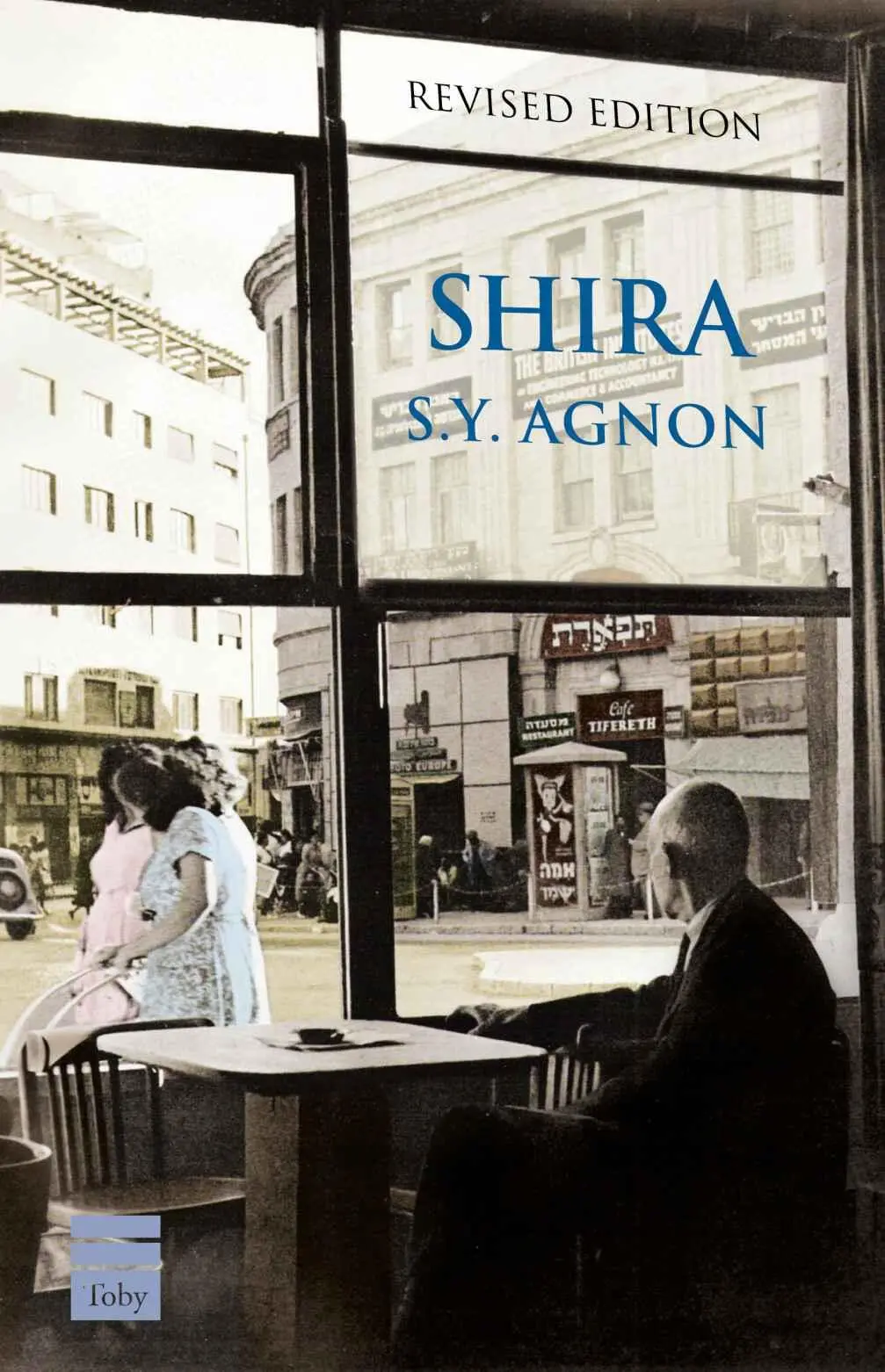
- Название:Shira
- Автор:
- Издательство:Toby Press
- Жанр:
- Год:2014
- ISBN:нет данных
- Рейтинг книги:5 / 5. Голосов: 1
-
Избранное:Добавить в избранное
- Отзывы:
-
Ваша оценка:
Shira: краткое содержание, описание и аннотация
Предлагаем к чтению аннотацию, описание, краткое содержание или предисловие (зависит от того, что написал сам автор книги «Shira»). Если вы не нашли необходимую информацию о книге — напишите в комментариях, мы постараемся отыскать её.
Shira — читать онлайн бесплатно полную книгу (весь текст) целиком
Ниже представлен текст книги, разбитый по страницам. Система сохранения места последней прочитанной страницы, позволяет с удобством читать онлайн бесплатно книгу «Shira», без необходимости каждый раз заново искать на чём Вы остановились. Поставьте закладку, и сможете в любой момент перейти на страницу, на которой закончили чтение.
Интервал:
Закладка:
“I see, Fred,” Henrietta said, “that, when it comes to your daughters, you have reason to complain. Tamara is so attached to you — she goes on a short trip, and every day there’s mail from her. I forgot to tell you. Sacharson returned the Baedeker. Why does that startle you?” “I wasn’t startled. You imagined that I was startled.” Henrietta said, “If you say you weren’t startled, I believe you. It’s all right to lend Sacharson a book. Not only did he return it in one piece, but he put it in a beautiful cover. Here’s the Baedeker. Find me Arcadia.” While Herbst was opening the Baedeker, Henrietta leaned her head on his shoulder and began singing, “I too lived in Arcadia…”
Zahara and Avraham didn’t stay very long. They spent four days with the Herbsts. Not counting the day they ate only breakfast at Henrietta’s table and the half-day they spent at Kiryat Anavim visiting a friend who had been on the training farm in Germany with Avraham, but adding the extra half-day they threw in for the yeast cake she baked them.
There was work to be done in Ahinoam, and it could not be postponed because of the sentiments of the old people, who would have had them stay on day after day. The air of Jerusalem, its cool nights, the friends from all over the country whom one runs into everywhere, the secrets the city reveals to its guests — all these things make it special. But to someone from a kvutza , particularly to a founding member, the kvutza is even more special. If there is still not a single tree — no shade, only thorns, briar, snakes, and scorpions — all the more reason why one has to hurry back to water the fragile plants, clear away the thorns and briar, and wipe out the nests of vipers.
When Henrietta realized that the children were determined to hurry back to Ahinoam, she tried to work out a compromise, to have Avraham go back to Ahinoam and leave Zahara to spend another two or three days in Jerusalem. But Zahara would not agree to stay even an hour without Avraham. Henrietta set about collecting all the things she had made for Sarah and passed them on to Zahara, specifying with each item, “This is for your baby, not for anyone else’s.” To which Zahara answered, “I can’t accept your conditions. In our kvutza , we each get what we need.” Henrietta said, “Still, this shawl, which I made myself — don’t give it to anyone.” Zahara said, “You can trust me.” Henrietta surveyed everything, praying to herself: I hope at least some of these things will be used by Zahara’s child.
Finally, she took another tack. She stopped praying, fingered the items she was especially fond of, and appropriated them with her eyes, reflecting: It’s not possible, it’s not possible that Zahara would offer this to the first taker. She couldn’t possibly give this up. She looked at Zahara and was amazed that her daughter didn’t seem to appreciate the baby clothes. And what baby clothes they were! Henrietta roamed from room to room, from closet to closet, from drawer to drawer, taking out everything, saying to herself: This will be good for Zahara. I’ll give this to Zahara, this will be very useful. As for Zahara’s statement “I can’t keep these things for myself,” those were just words. Zahara was joking. It was impossible that a treasure her mother gave up expressly for her could be offered to the world at large.
Henrietta had already forgotten what Zahara had said and was looking over other things that might suit Zahara and her unborn baby. She was suddenly overcome with worry that she had forgotten the essentials. In fact, she was certain she had forgotten the essentials, that everything Zahara and her infant were sure to need had slipped away from her mind, so that, when Zahara got back to Ahinoam, she wouldn’t find what she hoped to find, nor would she find what she needed. The pile she had dragged from Jerusalem to Ahinoam would have none of what she needed in it. Nor would those essentials be available in Ahinoam, for the entire community was made up of youngsters who had no idea what a mother needs. Henrietta refocused her thoughts, and it was not her mind that roamed through all her rooms, but her soul that roamed and fluttered like an anxious bird.
Henrietta paused for a bit, trying to remember what she had put in Zahara’s box and what she should have put in it. She did not realize that her hands were idle and her heart was empty, that her thoughts were being dispersed and no new ones were replacing them. The alarm she had felt a few minutes earlier seemed to subside, and she was utterly relaxed. Hardly conscious of the swift change, she stood beside the full carton and gazed into it, her eyes remaining fixed on its top. It seemed to her that something hidden kept emerging, some aspect of a thought about what she meant to put in the box. Her thoughts came to a sudden standstill, and all her ideas were suspended. She ignored the fact that Zahara was going to give birth. She was unaware of Zahara’s very being, as well as of her own. Like mother, like daughter: Zahara’s thoughts were dispersed too, and, between the two of them, the room was silent, like those frequently silent inner rooms on a hot summer day in Jerusalem, in houses surrounded by gardens and far from the road. In the stillness, the space within the room was suffused with the palest gray light, tinged with pale blue — paling, then darkening; darkening, then paling, until it took on an undefined hue. I don’t know whether the light was created from the space between shutter slats or from the objects in rooms. The two of them, mother and daughter, were unaware of each other and unaware of their own being as well. If I had a tendency to coin phrases, I would call this a state of “annihilated being.”
Sarah came into the room and stood there in dismay. After a moment or two, she backed up and knocked on the door from the inside, like someone who knocks before entering, and said, “Come in.” She went over to Zahara, wrapped her little arms around her big sister’s knees, and said, “Sarah loves Zahara.” Zahara bent down, placed her lips on Sarah’s, and said, “Zahara loves Sarah very, very, very much.” Sarah said, “No, no, no. Sarah loves very, very, very much.” Mother Henrietta bestirred herself and said, “Sarah, Zahara is leaving us.” Sarah looked at Zahara and said, “Zahara is leaving us?” This was not so much a question as a matter of words that were inconsistent with reality. Zahara kissed her sister again and said gravely, “I have to go home.” Sarah’s eyes scanned the room as she wondered: What did Zahara mean, ‘I have to go home’? Isn’t this home? And why did she say ‘I have to’? Mother Henrietta said to Sarah, “Tell her there’s no need to hurry.” Sarah said to Zahara, “Mother says — “ She stopped in the middle, turned to her mother, and said, “You tell her.” All of a sudden, she turned away from both of them. “What’s this?” she asked. “This…this here, this?” Zahara said, “I don’t know what you mean.” The child pointed with her thumb, repeating, “This.” Zahara turned to her mother. “Maybe you know what she means? Sarah, show me with your finger.” Sarah was annoyed at Zahara. “What I’m pointing with is a finger, isn’t it?” Mother Henrietta said, “She means the grasshopper playing on the window. It’s a grasshopper, Sarah.” Sarah repeated the word with a mixture of agreement and doubt. She said, “A grasshopper. Can I step on it?” Zahara responded with alarm, “Why step on it? Such a fine grasshopper — see how nice his wings are, what long legs he has.” Sarah said, “You don’t understand anything.” Mother Henrietta laughed and said to Zahara, “She doesn’t mean to step on it with her feet. She means to catch it.” Zahara said, “Then why did she say ‘step on it’?” While they talked, Sarah chased the grasshopper with her fingers. Zahara repeated, “Why did she say it that way?” Mother Henrietta said, “This is what happened: the first time Sarah saw a caterpillar in the garden, she was fascinated by it and finally stretched out her leg to trap it, so she could pick it up. Since then, whenever she tries to catch a butterfly, she says ‘to step on it.” Zahara said, “To think that I suspected she would crush it. Come, sweetheart, let me give you a kiss. Who’s that coming? Why, it’s Avraham.”
Читать дальшеИнтервал:
Закладка:
Похожие книги на «Shira»
Представляем Вашему вниманию похожие книги на «Shira» списком для выбора. Мы отобрали схожую по названию и смыслу литературу в надежде предоставить читателям больше вариантов отыскать новые, интересные, ещё непрочитанные произведения.










Обсуждение, отзывы о книге «Shira» и просто собственные мнения читателей. Оставьте ваши комментарии, напишите, что Вы думаете о произведении, его смысле или главных героях. Укажите что конкретно понравилось, а что нет, и почему Вы так считаете.