S. Agnon - Shira
Здесь есть возможность читать онлайн «S. Agnon - Shira» весь текст электронной книги совершенно бесплатно (целиком полную версию без сокращений). В некоторых случаях можно слушать аудио, скачать через торрент в формате fb2 и присутствует краткое содержание. Год выпуска: 2014, Издательство: Toby Press, Жанр: Современная проза, на английском языке. Описание произведения, (предисловие) а так же отзывы посетителей доступны на портале библиотеки ЛибКат.
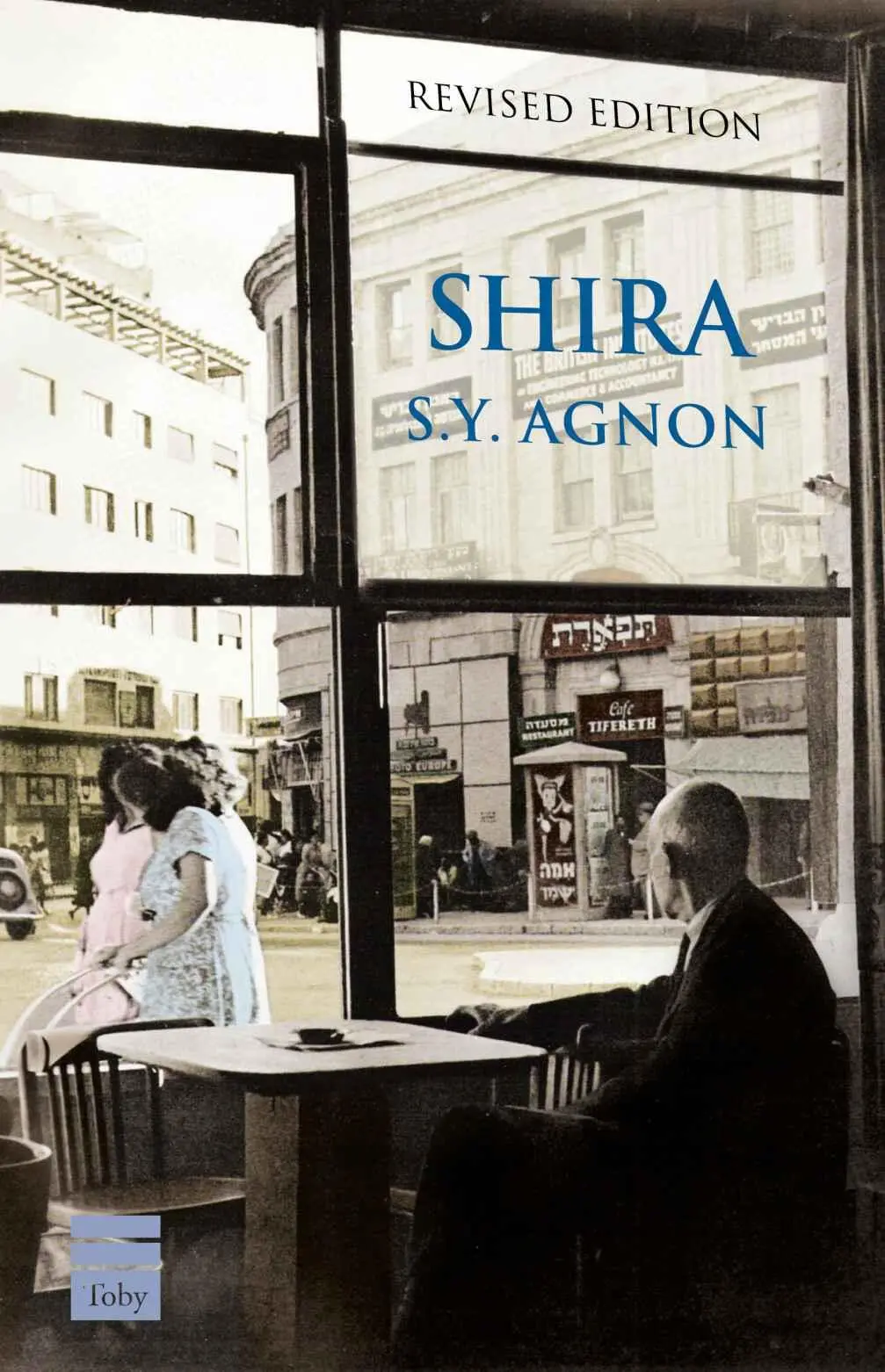
- Название:Shira
- Автор:
- Издательство:Toby Press
- Жанр:
- Год:2014
- ISBN:нет данных
- Рейтинг книги:5 / 5. Голосов: 1
-
Избранное:Добавить в избранное
- Отзывы:
-
Ваша оценка:
Shira: краткое содержание, описание и аннотация
Предлагаем к чтению аннотацию, описание, краткое содержание или предисловие (зависит от того, что написал сам автор книги «Shira»). Если вы не нашли необходимую информацию о книге — напишите в комментариях, мы постараемся отыскать её.
Shira — читать онлайн бесплатно полную книгу (весь текст) целиком
Ниже представлен текст книги, разбитый по страницам. Система сохранения места последней прочитанной страницы, позволяет с удобством читать онлайн бесплатно книгу «Shira», без необходимости каждый раз заново искать на чём Вы остановились. Поставьте закладку, и сможете в любой момент перейти на страницу, на которой закончили чтение.
Интервал:
Закладка:
Many thoughts troubled Herbst. He dismissed them, one after another, thanks to his beloved daughter. As long as she was in his mind, he felt relaxed. But he was sorry she hadn’t followed his advice. She hadn’t enrolled in the university, and her education was incomplete. Dr. Herbst had many opinions, among them that one cannot acquire an education outside of a university. Since settling in the Land of Israel, some of his opinions had changed, but he remained convinced that one could not be educated outside of a university, even by reading widely, listening to lectures, devouring the wisdom of the world. In the end, such knowledge is incomplete. He applied this rule to everyone, including his daughters.
Father Manfred doesn’t really know his daughters. This is surely true of Tamara, whose character no one really knows. But it is also true of Zahara, who is attached to her father and whose soul is as transparent as water from a spring; one can’t really say that her father knows her. Were we to summarize all of Father Manfred’s information about Zahara, it would add up roughly to this: Zahara belongs to a kvutza called Ahinoam, which foreign correspondents with Zionist sympathies mention often and journalists rush in to write about in many languages, as if it were there that humanity will be renewed — to the extent that one can barely find a kvutza member or even a shrub that hasn’t been photographed for one of these publications. Zahara is a member of this kvutza and is accepted by one and all. Its ways are congenial to her, and there is no activity in which she doesn’t participate wholeheartedly: the vegetable garden, the kindergarten, the kitchen, the dining room. Wherever she works, there are people helping her. It is the way of young men to be helpful to young women who enjoy their work, by lending a hand, giving good advice, or simply looking on. She occasionally comes to Jerusalem from the kvutza , sometimes with this young man, sometimes with that one. Today, too, she came with one of them. The early days were good, before Herbst met Shira. He used to see his daughter and her friends without being subjected to afterthoughts.
Father Herbst sits eating what his daughter serves him, straining to ward off suspicious thoughts. In the good days, before he knew Shira, he wouldn’t have entertained even the trace of a suspicion. Father Herbst raises his head so he can look at his daughter and lowers it without looking at her. He raises it again as if to say, “Go to bed, my child, you must be tired.” He also wants to ask for news of Ahinoam. The words are formed and need only to be uttered. A cough disperses them. Father Manfred lowers his head again and eats without tasting the food. Shame and regret are a harsh condiment.
Chapter twenty-four
In the morning, Herbst made a firm decision to clear his mind of all unessential business and devote himself to his major work, to check his pads, notebooks, and file cards, and determine what was new material — i.e., quotations and summaries distilled from documents unnoticed by other researchers. Caution is crucial to scholarship, and careful verification is crucial to caution. Not once, but constantly, for without frequent verification, material already presented by others could be copied into your book. Many times Wechsler had boasted to him that he had discovered a document no one had seen before; a simple document, one would assume. But not so. Were he to publish it, it would fly in the face of all our historians and reveal that they were, one and all, a band of illiterates. Herbst showed him half a dozen books citing that very document and basing theories on it; finally, he showed him a small volume that dismissed it with a curt phrase from which its fraudulence was obvious.
After eating and drinking, he returned to his study. He took out his pads, his notes, his index cards. Though his notebooks were full, with writing on both sides of the paper, and the box was stuffed with cards, he wasn’t arrogant, like those who presume that their book is done if they have enough notes.
Herbst sat at his desk for about two hours, arranging notes by subject, discarding duplicates and triplicates, for sometimes one sees an item and imagines it is new, not remembering he has already copied it two, three, four times. Although he found several new items in his notes, he didn’t delude himself into thinking he had achieved his goal. Nor did he err in the direction of despair, like those who feel helpless when they see they have failed to achieve their goal and say, “Why struggle, when it’s clear I’ll never finish?” One should know that every beginning has an end. Day after day, one does what he does, until finally the beginnings add up to a conclusion.
There were several articles that were similar in subject and in good shape. If he had retained his youthful vigor, he would not have stirred before finding additional material and combining the fragments into a book. But Herbst’s youth was over. This was not the Herbst who used to work so diligently that nothing could distract him. Now some frivolous woman could appear, disrupt him, and turn him on end.
Now that he was thinking of that woman, he began to scrutinize her actions. She sometimes sought distance, sometimes closeness, behaving at times as if there had never been anything between them. If she had allowed him to approach her yesterday, it was only after many rejections. Herbst leaned his head to the left, pondering: Maybe I myself am the guilty one. Had I gone back to her right then, after I was first close to her, she might have offered me her love. Did I think I was so attractive that I could stay away and she would still leap up and shower me with affection whenever I showed my face? She was, no doubt, deeply drawn to me at first, withholding nothing. But I didn’t show up again for several months, and when I did, I ran off because of the curfew and didn’t come back for a month and a half. Meanwhile, someone else found her. Why did Shira decide to tell me the story of the whip? Did she mean to make me jealous? Does she imagine I’m fool enough to think she keeps herself for me? Anyway, the engineer’s behavior was a disgrace. Shira herself is even more of a disgrace, since her behavior provokes insolence, even violence. It’s a fact: any woman who invites a man home after one conversation deserves what she gets. She deserves to be beaten, not loved. The man who beat her was wielding his charm, to take revenge, to make her pay for her misbehavior. “What do you want from me?” Herbst cried out, as if Shira were there, torturing him. “My God, my God,” he cried out, and as he cried out he was overcome with wonder, like a man in trouble who sees help and salvation.
The night they walked along the road to Beit Yisrael, Shira had asked Herbst, “Are you Orthodox?” She had told him, “I’m not Orthodox, and I don’t care for the Orthodox.” When she said this, he hadn’t given it a second thought. Now that he was alone, thinking of her and her behavior, an undefined question began to form in his mind. It could be articulated in these terms: It’s true, isn’t it, that, when one rejects religion, spiritual restraints are also suspended, that the soul casts off its restraints, and actions are no longer examined? Herbst was neither a believer nor an atheist. His research never led him to consider questions of faith. Not many of those who studied Byzantium were as familiar as Herbst with the endless strife, disputes, intrigues, conspiracies, murders, and massacres in the name of religion that occupied Christian sects in Byzantium from the time of Christianity’s early triumphs to Islam’s conquests. Still, his erudition did not compel him to reflect on the nature of his own faith. Now that he was invoking heaven because of his distress, a spark flared up for him and died as soon as it was lit. A spark that goes out immediately gives no light; it doubles the darkness. Out of anger, out of anguish, out of foolish self-pity, out of a need to act, he picked up a book and banged it on the table. With the exception of a cloud of dust, the act achieved nothing.
Читать дальшеИнтервал:
Закладка:
Похожие книги на «Shira»
Представляем Вашему вниманию похожие книги на «Shira» списком для выбора. Мы отобрали схожую по названию и смыслу литературу в надежде предоставить читателям больше вариантов отыскать новые, интересные, ещё непрочитанные произведения.










Обсуждение, отзывы о книге «Shira» и просто собственные мнения читателей. Оставьте ваши комментарии, напишите, что Вы думаете о произведении, его смысле или главных героях. Укажите что конкретно понравилось, а что нет, и почему Вы так считаете.