S. Agnon - Shira
Здесь есть возможность читать онлайн «S. Agnon - Shira» весь текст электронной книги совершенно бесплатно (целиком полную версию без сокращений). В некоторых случаях можно слушать аудио, скачать через торрент в формате fb2 и присутствует краткое содержание. Год выпуска: 2014, Издательство: Toby Press, Жанр: Современная проза, на английском языке. Описание произведения, (предисловие) а так же отзывы посетителей доступны на портале библиотеки ЛибКат.
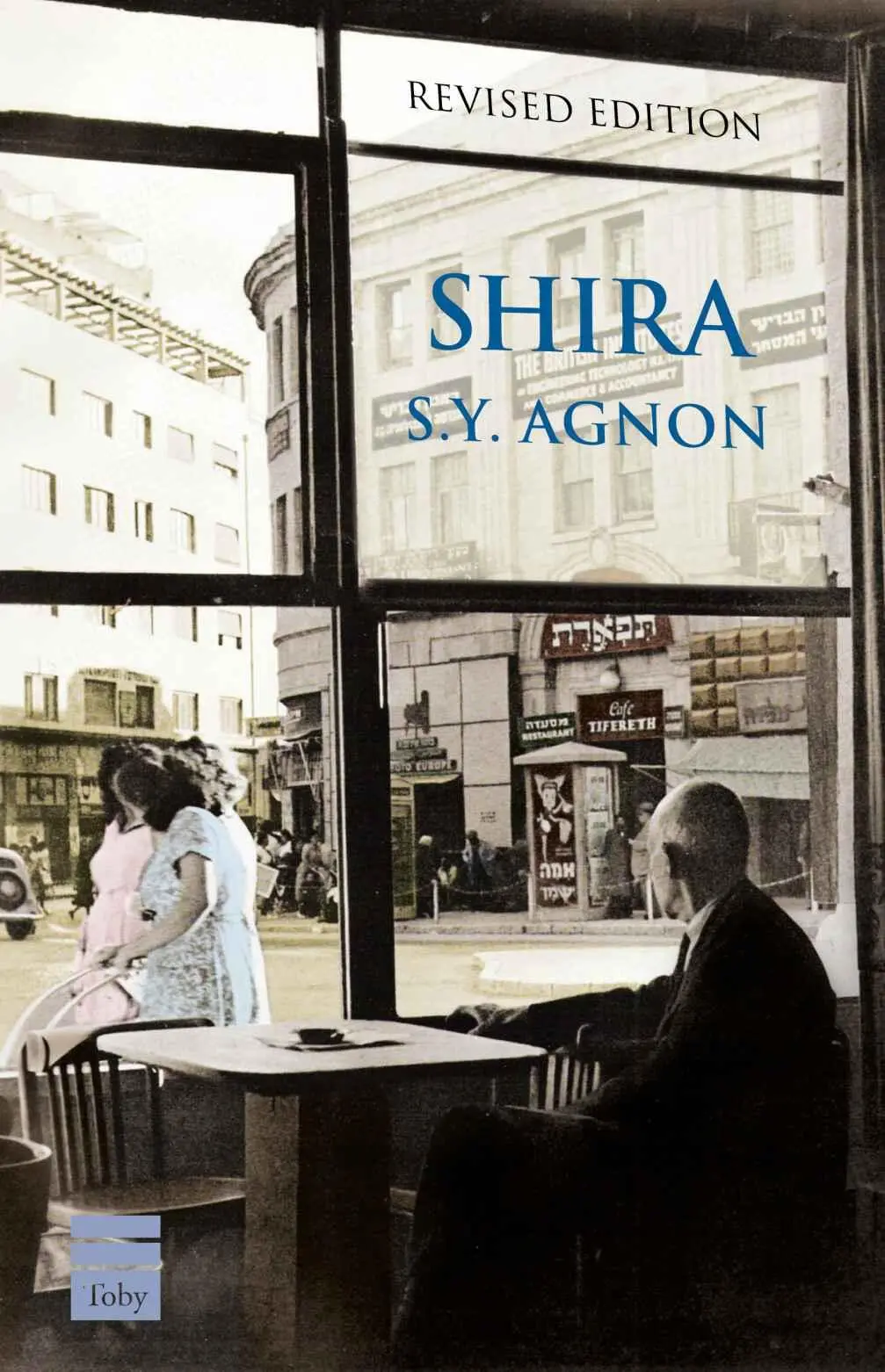
- Название:Shira
- Автор:
- Издательство:Toby Press
- Жанр:
- Год:2014
- ISBN:нет данных
- Рейтинг книги:5 / 5. Голосов: 1
-
Избранное:Добавить в избранное
- Отзывы:
-
Ваша оценка:
Shira: краткое содержание, описание и аннотация
Предлагаем к чтению аннотацию, описание, краткое содержание или предисловие (зависит от того, что написал сам автор книги «Shira»). Если вы не нашли необходимую информацию о книге — напишите в комментариях, мы постараемся отыскать её.
Shira — читать онлайн бесплатно полную книгу (весь текст) целиком
Ниже представлен текст книги, разбитый по страницам. Система сохранения места последней прочитанной страницы, позволяет с удобством читать онлайн бесплатно книгу «Shira», без необходимости каждый раз заново искать на чём Вы остановились. Поставьте закладку, и сможете в любой момент перейти на страницу, на которой закончили чтение.
Интервал:
Закладка:
As soon as Herbst mentioned Taglicht, Weltfremdt was alarmed. When he told him why he had come, he was relieved. He got up and hid his lecture notes, placed his hand on Herbst’s shoulder, and said, “Neu, Neu. Yes, yes…. I know a woman called Neu. Yes, yes. If I’m not mistaken, she’s considerably older than Taglicht.” Herbst said, “If you’re referring to the mother, she’s older than Taglicht. As for the daughter, she’s younger.” Weltfremdt said, “Yes, yes, Dr. Herbst, the old are old, and the young are young. Incidentally, just yesterday I read your paper comparing the Code of Leo the Isaurian to the Hammurabi Code. Not bad, not bad at all. But, judging by the date under the paper, you wrote it two years ago. Two years ago, and you haven’t published anything since. Not a thing. This is contrary to university policy. We don’t require that each faculty member produce a weighty tome annually, but it would be appropriate to publish an article or a monograph every year or so. And you, doctor, turn out one article in two years. As for the piece itself, others have in fact dealt with the same subject, though yours is not without new insights. I pointed it out to our colleagues, especially to Professor Bachlam, who resents other people’s insights and always uses them to support what he has written or what he means to write, even in fields whose terminology he doesn’t understand. What were we talking about? Yes, yes, about Professor Neu’s relative. If I’m not mistaken, you — that is, you and Mrs. Herbst — are interested in making a match between Taglicht and Miss Neu, mainly because he and she are available. In that case, one should speak to them first, to both Dr. Taglicht and Miss Neu. Though you and Mrs. Herbst both agree that they — I mean, Taglicht and Neu — are suited to each other, that’s not good enough. You — I mean, you and Mrs. Herbst — have taken on a big job. I myself can’t imagine how these things happen — how you come to a fellow and say, ‘I’ve found a girl for you,’ not to mention coming to a girl and delivering the same message with the appropriate changes. Yes, indeed. Incidentally, doctor, have you noticed that Leo’s Code, though he is considered an outright atheist, is derived from the Torah and from the Evangelists, which is not the case with Justinian? Incidentally, doctor, if you see my cousin Julian, tell him that, though he maligns me in every café in Jerusalem, he is welcome for coffee at my house anytime. I see you’re hurrying. If you wait a bit, we can have coffee together. Not the kind you usually drink, which keeps you awake, but a harmless brew. Incidentally, tell me, how did you arrive at the comparison between the Code of Leo the Isaurian and the Hammurabi Code? If I were allowed to allow myself the liberty, I could, perhaps, give myself some of the credit, as I was the one who lent you David Heinrich Miller’s edition of the Hammurabi Code. Yes, yes. Incidentally, what do you think about Bachlam? Taglicht says that Bachlam writes ‘flaxen Hebrew.’ I can’t imagine what ‘flaxen Hebrew’ is. Welcome, Mrs. Weltfremdt. Did you manage to rest a bit? Now, Herbst, you can’t escape without drinking coffee with us first. What do you think, Dikchen, will Professor Herbst find some coffee in our house?”
Herbst stayed at Weltfremdt’s, where he drank coffee that doesn’t keep one from sleeping and ate cake that doesn’t keep one’s middle from expanding. They talked about the university, its faculty, and many other matters. When Dr. Ernst Weltfremdt publishes his autobiography, we’ll have more details.
To please his wife, Weltfremdt suggested that she show their guest the rhymes she had composed on the marriage of their eldest daughter. Professor Weltfremdt’s wife, Rikchen, poetized every family event. Her relatives in Germany were fond of her rhymes, but here in Jerusalem, where public events tended to overshadow personal ones and the Hebrew language was beginning to take over from German, she had no audience. If not for her husband, who sometimes told his guests about her rhymes, we would be unaware of Mrs. Weltfremdt’s talent.
While she went to get her rhymes, Weltfremdt gave Herbst the galleys of his article for Bachlam’s jubilee volume. As Herbst leafed through the galleys, Weltfremdt began discussing other individuals who had been similarly honored. Typically, as they approached the age of fifty or sixty, these men would go from professor to professor, asking how to avoid the notoriety to which they were about to be subjected. They would confide that the most erudite scholars had already met and formed a jubilee committee — a committee of unprecedented distinction — which they nevertheless considered flawed, “because Ernst Weltfremdt’s name is not included.” “Whether I want to or not, I add my name. They press me to contribute an article to the jubilee volume to be published in honor of that academic pest. They press me to hand it in immediately and then delay my article, along with the entire book, so that, when it finally appears, my insights are outdated. A learned man once said wisely, ‘All those jubilee volumes are burial grounds for the written word.’ I would amend this — they’re burial grounds for mummies. Yes, for mummies!”
Mrs. Weltfremdt returned, carrying a bunch of notebooks tied together with colorful string. She looked warmly at Professor Herbst, who had agreed to hear her verses, and imploringly at her husband, wishing he would stop talking and let her read. Her husband took no notice but went on talking to Herbst, explicating every new point in his article, for he gravely doubted that his colleagues would grasp it. “I’m not saying that all of our eminent colleagues are imbeciles. There are surely one or two — perhaps even three — who are capable of grasping my insights, but since they measure with their own yardsticks, they have the impression that my insights are no better than theirs. In any case, there’s nothing to stop them from claiming my insights as their own, with a change of language or an additional phrase, to the point where the sheer verbiage disguises the source.” If not for Lemner, who loved to disclose the sources authors use, none of them would realize that many of Weltfremdt’s insights were incorporated in their books. Mrs. Weltfremdt saw there was no end in sight and went off. In the interim, the sun set, the day darkened, and Herbst got up to go.
Weltfremdt remembered his wife and her verses. He opened the door and called, “Dikchen, Dikchen, what’s going on? We have here one-third of one-half of one dozen distinguished gentlemen eager to bask in your delightful verse, and you withhold its light.”
Mrs. Weltfremdt heard him and appeared. Professor Weltfremdt said, “It’s good you came, Dikchen. I was talking to our friend, Doctor Herbst, about our revered cousin, who never deigns to come to us, and I asked Doctor Herbst, if he should see our cousin, to tell him to be so kind as to come. What’s your opinion, Dikchen? Will he find a place to sit in our house? As for your verses, it’s good you brought them. Let me see if you brought the notebook with the humorous ones. Yes, yes. Here’s the notebook, and here are the verses. Bravo. What was I going to ask? Yes, yes…. Who’s that knocking? Isn’t there a bell in the house? Problems with the electricity again. Storrs may be right to keep everything modern out of Jerusalem. Even the electric lights go out most nights, leaving us in darkness. Dikchen, I see we won’t get to your verses tonight. I certainly won’t agree to let you ruin your eyes in the light of the kerosene lamp. I don’t know how anyone reads in that light. When I touch a kerosene lamp, I can’t get rid of the smell. Now, Doctor Herbst, it isn’t right to keep you here in this dark dungeon. Dikchen, allow me to go two or three steps with Doctor Herbst, and don’t be upset if I make it four or five. You know I’m no mathematician.”
Читать дальшеИнтервал:
Закладка:
Похожие книги на «Shira»
Представляем Вашему вниманию похожие книги на «Shira» списком для выбора. Мы отобрали схожую по названию и смыслу литературу в надежде предоставить читателям больше вариантов отыскать новые, интересные, ещё непрочитанные произведения.








Обсуждение, отзывы о книге «Shira» и просто собственные мнения читателей. Оставьте ваши комментарии, напишите, что Вы думаете о произведении, его смысле или главных героях. Укажите что конкретно понравилось, а что нет, и почему Вы так считаете.