S. Agnon - Shira
Здесь есть возможность читать онлайн «S. Agnon - Shira» весь текст электронной книги совершенно бесплатно (целиком полную версию без сокращений). В некоторых случаях можно слушать аудио, скачать через торрент в формате fb2 и присутствует краткое содержание. Год выпуска: 2014, Издательство: Toby Press, Жанр: Современная проза, на английском языке. Описание произведения, (предисловие) а так же отзывы посетителей доступны на портале библиотеки ЛибКат.
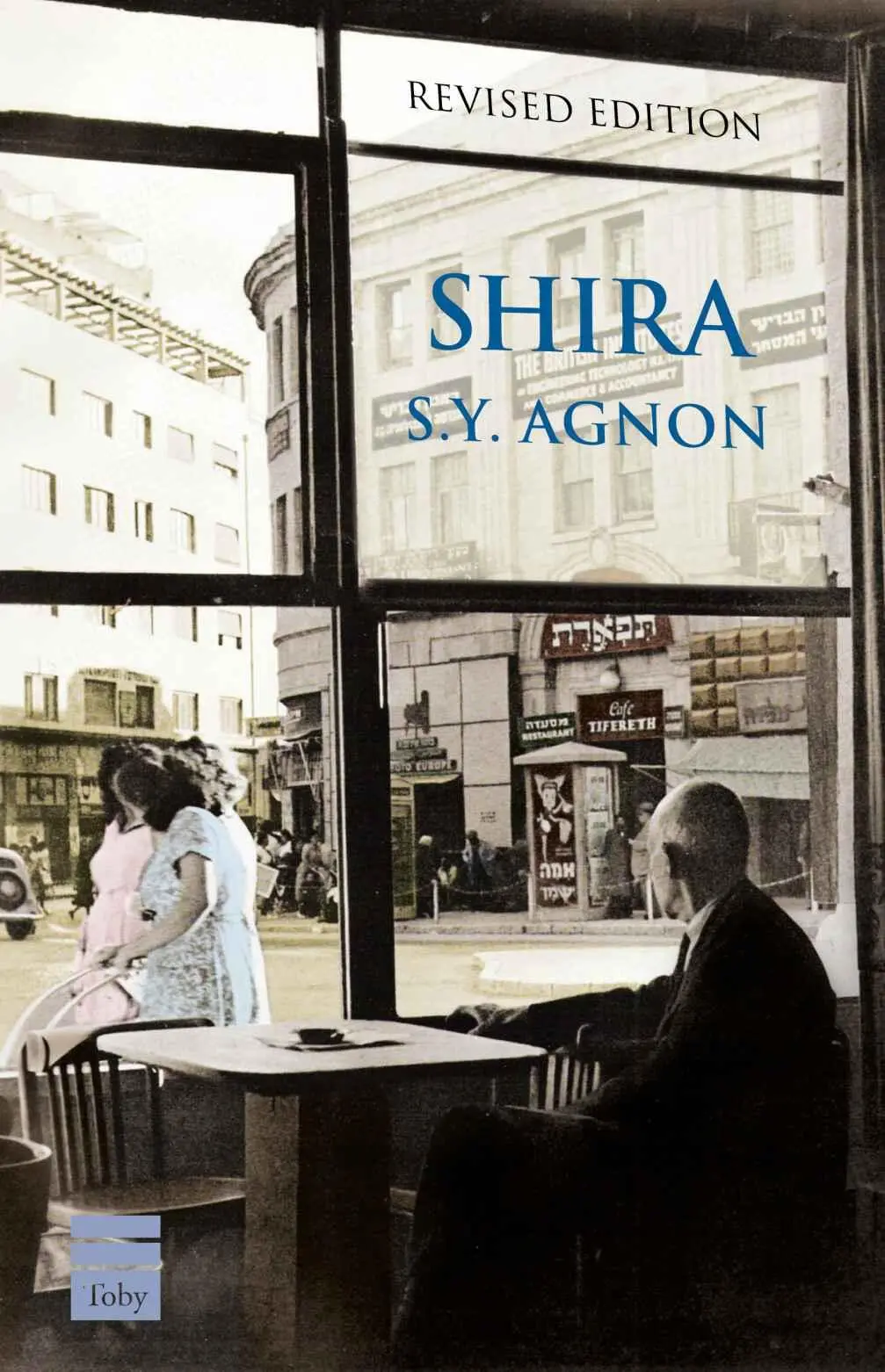
- Название:Shira
- Автор:
- Издательство:Toby Press
- Жанр:
- Год:2014
- ISBN:нет данных
- Рейтинг книги:5 / 5. Голосов: 1
-
Избранное:Добавить в избранное
- Отзывы:
-
Ваша оценка:
Shira: краткое содержание, описание и аннотация
Предлагаем к чтению аннотацию, описание, краткое содержание или предисловие (зависит от того, что написал сам автор книги «Shira»). Если вы не нашли необходимую информацию о книге — напишите в комментариях, мы постараемся отыскать её.
Shira — читать онлайн бесплатно полную книгу (весь текст) целиком
Ниже представлен текст книги, разбитый по страницам. Система сохранения места последней прочитанной страницы, позволяет с удобством читать онлайн бесплатно книгу «Shira», без необходимости каждый раз заново искать на чём Вы остановились. Поставьте закладку, и сможете в любой момент перейти на страницу, на которой закончили чтение.
Интервал:
Закладка:
From here on, whenever the two of them were alone, Herbst and Shira addressed each other in the familiar second person.
Shira said, “We’re already at Jaffa Road. Where would you like to eat?” Herbst said, “As long as it’s not where I ate this afternoon.” “Why? Didn’t you like the food?” Herbst said, “Not only did I find good food, but I also found a lovely waitress.” Shira said, “Then let’s go there.” Herbst said, “Aren’t you jealous?” Shira said, “It’s not time for jealousy yet.” Herbst took her hand in his and said, “Forgive me, Shira. Forgive me.” Shira slipped her hand away and took out some powder, which she sprinkled on the tip of her nose. When she returned the powder to her purse, she straightened her eyeglasses and held on to her necklace with her left hand. The moon was bright, and Shira’s face was melancholy.
Chapter fourteen
Henrietta came home from the hospital, bringing an additional daughter. The little one occupied minimal space, but her presence filled the house. Herbst tried to get back to work and to prepare lectures for the winter term.
He was busy preparing his lectures, and his wife was busy with her child and with the wetnurse. The Fashioner of All Things creates many needy souls with a symmetry that maintains life, giving this one a daughter and that one a daughter. One has no milk for her child; the other has no way to support her family. He brings them together. One nurses the other’s child and is paid for the service, so that each one lives off the other’s flaw. One is from Kurdistan, the other from Germany. Kurdistan and Germany being far from each other, what does He do? He brings them both to Jerusalem, for a Jew’s eyes look to Jerusalem.
Sarini, the Kurdish wetnurse, is a handsome, healthy woman. Her face is dark brown, her hair dark gray. Her shiny eyes are green, her teeth like peeled garlic cloves and harder than rock. She is always laughing, and every year she gives birth. She has already produced eight male children, apart from the daughter we mentioned, all of them alive and healthy. They are no trouble during pregnancy or birth, being aware that none of them is an only child, that, should she wish to, she can produce many more. They don’t trouble her for another reason: it is she who supports them. Their father — which is to say, their mother’s husband — has many trades, none of which provides much income. There are times when he is a scholar in the yeshiva, times when he ties a rope around his waist to be a porter, times when he sells books, times when he does magic. He can look into a glass of clear water and tell if a particular woman was a virgin when she married. And, whispering gently over a pinch of salt and a sugar cube, he can cause you to forget to say the prayer for the new moon. He has many other accomplishments, foremost among them the fact that he is the husband of this prolific, powerful, shrewd woman who supports a houseful of children, besides two sets of parents, and is at war with the Mandate government for obstructing immigration. And, of course, she does her bit at home, so that the seed of our father Abraham will not vanish from the earth. Although Sarini has intelligence and good deeds to her credit, Henrietta has to exert considerable effort to get her to bathe and wear clean clothes, and to provide her with a wholesome diet, since she comes from a neighborhood of tin huts and lives in a dingy room with straw mats for bedding, coarse food, and foul water.
Henrietta is busy with other matters, apart from the wetnurse and the kitchen, such as driving away the goats the Arab shepherds send into the garden. While in the garden, she picks three or four flowers to put in a vase. If they are especially nice, she brings them to Manfred and sets them on his desk. She tiptoes in and tiptoes out again, going back to her pots and her stove until lunch is ready. After lunch, she has a short nap and tends to the remaining tasks, such as mending, ironing, and collecting milk so the baby won’t be hungry when the wetnurse is gone. Since Sarini can’t support her family on what Herbst can pay she has to supplement her income elsewhere. When Henrietta has an extra bit of energy, she goes into town on other business, such as obtaining certificates for her relatives in Germany, and making bank payments. On the way, she stops at the doctor to consult about the baby, at the dentist to have her teeth checked, at the tinsmith to have the kettle repaired, and at Krautmeir, the gynecologist. With all this business to attend to, Henrietta has no time for her husband. Similarly, he, with all his business, has no time for Henrietta. New students from Germany cannot be offered the usual fare; you have to be well prepared, for they come from German schools, where scholarship is serious. They each go their own way: Manfred doesn’t intrude on Henrietta’s domain, and Henrietta doesn’t intrude on Manfred’s.
Herbst is at his desk, which is filled with open books, reading a page here and a page there, writing, copying, adding to the pile of notes and comments, to the series of lectures on such-and-such an emperor — a Byzantine whose name I forget, a very short fellow who required that all his ministers stoop to a level below his shoulders. Herbst takes no shortcuts. He consults every book in Jerusalem pertaining to his field and orders books and photographs from abroad. Though the books are numerous and there is no shortage of scholars, there is room for innovation. If he had more books, he would make more discoveries, for it is in the nature of books that each one offers a different theory, and a reader with the capacity to innovate adds his own opinion. If his wisdom is significant, what he adds is significant. Whether you know it or not, Dr. Manfred Herbst is an expert on the Byzantine period, and, when Byzantine scholars are mentioned, his name is always included. So he has reason to be pleased with himself.
But this is not the case. Often Herbst shoves away his books, photographs, index cards, and notes, rests his left arm on the desk, and leans his head on his arm. This pose, if I am not mistaken, is hardly the one in which painters portray learned men. When he sits in this position, he resembles a man trying to dismiss his worries. Which of them did he succeed in dismissing, and which did he fail to dismiss? He succeeded in dismissing Lisbet Neu from his mind, but he failed to dismiss Shira.
Shira displays herself in an array of guises, and every one of her guises compels his eyes and heart. But he does not move from his spot or run to her, and he is surprised at himself for not running to her. A single verse he read by chance remains fixed in his mouth, and he mumbles, “Flesh such as yours / Will not soon be forgotten.” He determines to go to her. When night comes, he finds an excuse and doesn’t go. He looks for Henrietta and insists on helping her in the kitchen, even though she has told him he doesn’t belong among the pots. This sometimes becomes a quarrel. And when she hears his footsteps, she locks the door. What does he do? He takes Sarah out of her crib, carries her in his arms, knocks on the door, and says, “I think the baby needs you.” Henrietta comes out, takes the baby, and walks Manfred to his room and to his desk, saying, “This is where you belong, Fred. Sit down and do your work.” What does he do? He remembers there is no butter in the house. Since there is no dairy in Baka, he goes to Talpiot to buy butter. In Talpiot, he meets up with some of his students, who are protecting the neighborhood from Arab snipers. Herbst does another thing: he writes letters to friends abroad, as well as to his two daughters who are in the same country, for a father is required to educate his daughters. If he didn’t educate them when they were at home, he is educating them now, from a distance. He also occupies himself with a matter that occupies few of his Jerusalem colleagues: he is engaged in clarifying and establishing just who deserves to be considered a Church Father. As Vincent of Lerins has already noted, not all the early Church writers should be considered Church Fathers, since God was testing the Christians through these great teachers, et cetera.
Читать дальшеИнтервал:
Закладка:
Похожие книги на «Shira»
Представляем Вашему вниманию похожие книги на «Shira» списком для выбора. Мы отобрали схожую по названию и смыслу литературу в надежде предоставить читателям больше вариантов отыскать новые, интересные, ещё непрочитанные произведения.










Обсуждение, отзывы о книге «Shira» и просто собственные мнения читателей. Оставьте ваши комментарии, напишите, что Вы думаете о произведении, его смысле или главных героях. Укажите что конкретно понравилось, а что нет, и почему Вы так считаете.