Norman Lock - The Boy in His Winter
Здесь есть возможность читать онлайн «Norman Lock - The Boy in His Winter» весь текст электронной книги совершенно бесплатно (целиком полную версию без сокращений). В некоторых случаях можно слушать аудио, скачать через торрент в формате fb2 и присутствует краткое содержание. Год выпуска: 2014, Издательство: Bellevue Literary Press, Жанр: Современная проза, на английском языке. Описание произведения, (предисловие) а так же отзывы посетителей доступны на портале библиотеки ЛибКат.
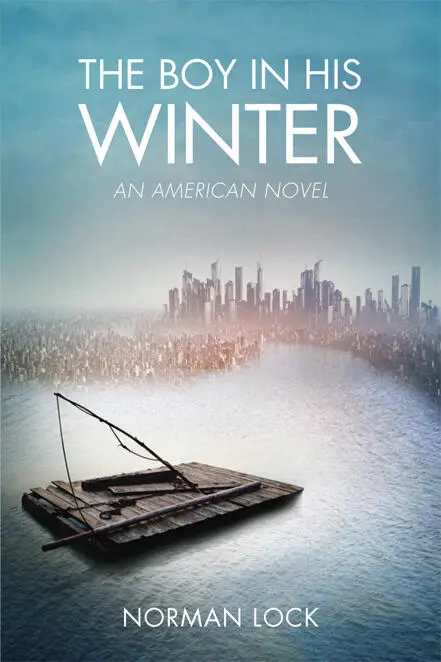
- Название:The Boy in His Winter
- Автор:
- Издательство:Bellevue Literary Press
- Жанр:
- Год:2014
- ISBN:нет данных
- Рейтинг книги:5 / 5. Голосов: 1
-
Избранное:Добавить в избранное
- Отзывы:
-
Ваша оценка:
The Boy in His Winter: краткое содержание, описание и аннотация
Предлагаем к чтению аннотацию, описание, краткое содержание или предисловие (зависит от того, что написал сам автор книги «The Boy in His Winter»). Если вы не нашли необходимую информацию о книге — напишите в комментариях, мы постараемся отыскать её.
The Boy in His Winter
The Boy in His Winter — читать онлайн бесплатно полную книгу (весь текст) целиком
Ниже представлен текст книги, разбитый по страницам. Система сохранения места последней прочитанной страницы, позволяет с удобством читать онлайн бесплатно книгу «The Boy in His Winter», без необходимости каждый раз заново искать на чём Вы остановились. Поставьте закладку, и сможете в любой момент перейти на страницу, на которой закончили чтение.
Интервал:
Закладка:
“What’s that sticking in your ears?” I asked, pointing to a Y-shaped wire disappearing into James’s blue-denim shirt pocket. It was, I tell you, a diversion, nothing else: I didn’t want to appear flummoxed in front of James.
“My iPod,” he said, his hand beating time on the polished ball of the throttle. “It’s music, man! Where’ve you been hiding, Mr. Albert? On Mars?”
If only he knew. I leaned toward him and heard a faint and distant singing, reminiscent of a wasp caught in a jar of marmalade. For all I knew of iPods, the sound really might have originated on Mars.
“That’s ‘Slave Driver’ by my righteous man Bob Marley. Listen up, Mr. Albert,” James said while he pushed one of the “buds” in my ear.
I listened without enthusiasm. I did not dislike what I heard; I was indifferent. My heart had moved too strongly toward a recognition of — how do I say it without sounding impossibly vain and pretentious? I guess I can’t, and the reader, if I have one yet, must take me as I am: thoughtful. Call me a thoughtful man who wishes to make himself understood in matters closest to his soul and is in love with words.
So, my heart had transported me, while I watched the golden Gulf water slide and churn up ingots, toward a recognition of transcendence and eternity. Even a boy born on a mudflat can sense, sometimes, the weight of things and see, for a moment, what the moment holds. I had drifted into familiar waters — not that I’d been on the Gulf before. But a timeless feeling stirred me, produced by the light and a sweetness carried on a seaward breeze across Chandeleur Sound. Good Lord, what would Tom Sawyer say to hear such hogwash, such a load of bull? Don’t misunderstand me: I did not yearn for my past life on the river. I was done with it. But in years to come, I’d grow nostalgic for it nonetheless.
The sun had nearly vanished behind me. The shadows on the bridge inched toward the east. I couldn’t see the brothers, but their shadows sparred against the cockpit sole. I shivered with an unnamable fear while, one by one, the nameless stars appeared. For the first time, I wondered about my life; I’d been careless of it before. But with care comes fear, such as when we take something fragile and newly fledged in our hands. I looked at mine, barely visible by the compass light, now that night was falling. With a finger, I traced the boat’s name incised onto a brass plate on the instrument dash: Psyched . I didn’t know what the word meant. But in Hannibal, I’d known psychics and mediums. I told you Marie Laveau could resurrect frogs and see the future in a crystal ball. (Miss Watson knew I’d come to a bad end, without benefit of any devil’s instrument.) There was also Madame Ambrogio, to whom the spirits dictated prophecies concerning Armageddon and what your aunt in Topeka would be sending you at Christmas. During a tent show, Tom and I marveled at a Russian mystic in a pink-striped vest who could poach an egg with the heat of his gaze and scuttle spoons across the table by the power of suggestion. My favorite psychic was an ancient black man who could foretell the year of your death by the number of worm holes on an apple. After he was finished, he’d eat it for good measure. Jim used to throw chicken bones, but I was not convinced he had the knack of it. Christian teachings must have corrupted his finer animal instincts.
Was I gifted? I had “feelings” rare in a man, but not so uncommon in a child, especially one whose childhood spanned much of the nineteenth century and the entire twentieth. But I couldn’t levitate, divine the future, dowse for water, invoke the devil (except my own familiars), or cause spirits to appear, regardless of how they would appear to me. And rarely did I communicate by occult means with either the quick or the dead. Many years ago, I attended a séance. After a half hour’s ungracious silence while we waited, in a gloom fragrant with lavender and dust, for a spirit to rap, I received a message — in dots and dashes — from Tom Sawyer. Having obtained a practical knowledge of Morse code in the Hannibal telegraph office, where smuggled whiskey and cigars were given to select boys in return for sweeping the floor and emptying the cuspidors, I interpreted the uncanny transmission in this way: You will find buried treasure at such and such latitude and longitude, both of which I intend to keep secret to safeguard a certain public official’s prized flower beds from destruction. I did, in fact, unearth a mob of forget-me-nots and found nothing more valuable than a pair of old waders. Tom was ever a trickster.
Night had fallen like a scythe, as it will in subtropical latitudes. Our running lights shone on the black water, and James was following the channel markers into the harbor at Gulfport. We’d left Port Eads and crossed Chandeleur Sound to the Mississippi coast in six hours at a speed less variable than that of the raft, which might ply a river mile in minutes or in what seemed to Jim and me an age, according to aspects of time impossible to plot. I’ve tried to recollect how celestial bodies behaved during my childhood — the charmed one where my atoms were not obliged by gravity to move in ever-tightening orbits around the pivot, death. I can’t recall what pictures the stars made against the sky, if the moon wore a lopsided grin during its phases, if meteors streamed from out of the farthest corners of space, or if the sun, in its day, arrived in green-and-rose bunting and, later, set in rags of red and gold. Tom would have sneered at such purple, but my imagination had fed on the Sir Walter Scott novels he read to me. The night sky may be a perfect emptiness outside of time or, on the other hand, a crowding light; the day, a brilliance whose source is God or a supreme fission. (Or are the terrible secrets hidden in a dusk?)
That night, standing on the bridge with James, the stars told complicated stories in a language all their own. Had I kept dogwatch through the late hours, I might’ve seen the grinning moon sail across the darkness, showers of burning ice, and perhaps a golden planet advancing in a slow processional. James slowed the boat and brought her fenders lightly against the dock. Edgar and Edmund leaped from their respective places on the fore and aft decks and tied up to a pair of rusty bollards.
“How many knots did she make?” I asked James after he had turned the motors off. They grumbled a few seconds before giving up the ghost — a black and choking stench of diesel smoke.
“Eighteen, nineteen,” he said.
“Can she do more?”
Boys love speed and recklessness. Long before this, I’d stretched out on top of a Hannibal & St. Joseph railroad car — the first in the territory — while the locomotive clicked down shining rails at eighteen miles per hour, raining on me sparks and cinders from the firebox. I tell you I was thrilled to death to move at such a speed! On the river, sometimes its banks would blur as the material world disappeared. I can’t even guess how fast we traveled. Lishkovitz may have calculated time’s escape velocity, but not in regard to a boy and a runaway slave on a raft.
“She’ll cruise at twenty-three knots,” James said. Had Psyched been a racehorse, he would have stroked her flank. “Wide open, she’ll do twenty-seven or — eight, depending. We fitted her with bladder tanks to carry extra fuel, which make her heavy. But she’s got long sea legs! We won’t need to refuel as often.”
I wanted to know why we hadn’t gone faster. I didn’t believe in saving — money, energy, or myself for a future consummation. I spent what came my way as quickly as it arrived, squandered resources so as not to miss an opportunity. Mark Twain never understood the extent of my ambition. I was no ordinary Huckleberry!
Читать дальшеИнтервал:
Закладка:
Похожие книги на «The Boy in His Winter»
Представляем Вашему вниманию похожие книги на «The Boy in His Winter» списком для выбора. Мы отобрали схожую по названию и смыслу литературу в надежде предоставить читателям больше вариантов отыскать новые, интересные, ещё непрочитанные произведения.









Обсуждение, отзывы о книге «The Boy in His Winter» и просто собственные мнения читателей. Оставьте ваши комментарии, напишите, что Вы думаете о произведении, его смысле или главных героях. Укажите что конкретно понравилось, а что нет, и почему Вы так считаете.