Norman Lock - The Boy in His Winter
Здесь есть возможность читать онлайн «Norman Lock - The Boy in His Winter» весь текст электронной книги совершенно бесплатно (целиком полную версию без сокращений). В некоторых случаях можно слушать аудио, скачать через торрент в формате fb2 и присутствует краткое содержание. Год выпуска: 2014, Издательство: Bellevue Literary Press, Жанр: Современная проза, на английском языке. Описание произведения, (предисловие) а так же отзывы посетителей доступны на портале библиотеки ЛибКат.
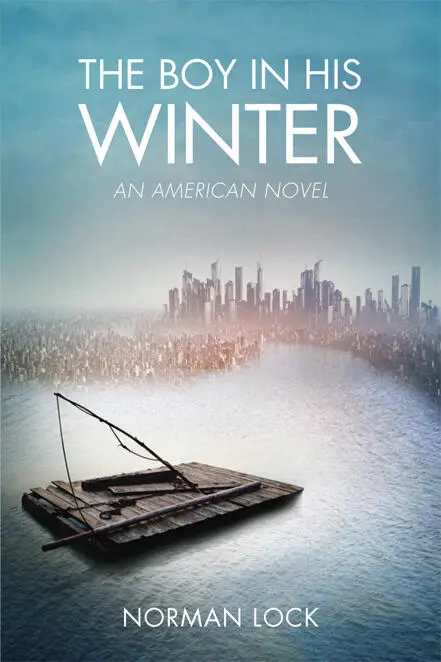
- Название:The Boy in His Winter
- Автор:
- Издательство:Bellevue Literary Press
- Жанр:
- Год:2014
- ISBN:нет данных
- Рейтинг книги:5 / 5. Голосов: 1
-
Избранное:Добавить в избранное
- Отзывы:
-
Ваша оценка:
The Boy in His Winter: краткое содержание, описание и аннотация
Предлагаем к чтению аннотацию, описание, краткое содержание или предисловие (зависит от того, что написал сам автор книги «The Boy in His Winter»). Если вы не нашли необходимую информацию о книге — напишите в комментариях, мы постараемся отыскать её.
The Boy in His Winter
The Boy in His Winter — читать онлайн бесплатно полную книгу (весь текст) целиком
Ниже представлен текст книги, разбитый по страницам. Система сохранения места последней прочитанной страницы, позволяет с удобством читать онлайн бесплатно книгу «The Boy in His Winter», без необходимости каждый раз заново искать на чём Вы остановились. Поставьте закладку, и сможете в любой момент перейти на страницу, на которой закончили чтение.
Интервал:
Закладка:
“Nobody at all, sir.”
James picked at his tooth’s golden valentine with the mermaid swizzle stick, and I thought, momentarily, of the overthrow of enchantment and the ruined world of myth.
“Then why don’t you come with us?” Edgar suggested, looking at his brother, who growled a fierce assent.
My nose wrinkling, I sensed the possibility of an adventure that would impress even Tom Sawyer. Then I recalled that Tom was dead and a long time underground, and a tear coursed down my grimy cheek. The tear was genuine. Uncertain of themselves, the men shambled foolishly.
“Poor boy,” said James.
“Pathetic,” rumbled Edmund ambiguously.
Edgar put an arm around my shoulder. Affection such as this had never before been shown me — not even by Jim, who knew better than to touch anyone belonging to the white race, regardless of how dissolute. Soon, I was crying in earnest. Embarrassed, the men went inside the boat, leaving me the cockpit to wallow in. Thankfully, emotions Tom would have considered unbecoming were rare in me. I blew my nose nonchalantly into my hand, after the fashion of boys everywhere (and of professional men like baseball players, who find themselves marooned in a desert of grass without a hankie). After wiping my hand on the back of the transom door, I went into the cabin to see what would come next.
“Where’re we going?” I asked, sliding behind the galley table, next to James.
He was poring over a nautical chart. I’d seen enough of them to know, in steamboat chart houses where Tom and I had crept in hopes of discovering the location of sunken ships that might contain treasure. We were always interested in enriching ourselves, although we never found anything more fabulous than arrowheads and the teeth of prehistoric sharks, dug from the mud below Hannibal.
“Across the Gulf to the east coast of Florida, then up the Inland Passage, across the C&D Canal to Delaware Bay, south around the Jersey capes to the Atlantic, then north to Atlantic City,” said James, tracing the lengthy route with a scaly index finger. “Should take us twelve days, barring the unforeseen.”
I must have looked either dazzled or baffled by the possibility of a second journey — a right smart pace in space, if brief in time. Edgar felt obliged to elaborate on James’s sketchy itinerary.
“It’s a fishing trip,” he said. “You’ll be our gaff man, mess boy, steward, and mate. What do you say, Al — sound like fun?”
It did sound like fun, but I wasn’t sure I wanted to exchange a raft for a fifty-eight-foot twin-diesel fishing boat. If anybody deserved shore leave, after 170 years on the water, I did.
“We need to leave now if we want to make Gulfport before dark,” said Edmund, reminding his brother of the urgency of their departure.
“What about it, Al? You want to come, or stay and wait for the Coast Guard to show up?”
I thought of spending the night alone in Port Eads, without fresh water or a chicken to be plucked from a tree. I looked at the saloon, with its upholstered chairs and sofa, at the galley, with its stove and a box from which Edmund had just taken a beer, beaded with condensation like a bottle of milk from the icehouse. I recalled the cabin where I’d wakened on a soft mattress and a pillow — the light from the porthole, stained green by cypress trees, falling on me like an insinuation of a world beyond worry and travail.
“They’ll put you in the New Orleans Superdome with ten thousand other homeless people lined up for the toilets,” Edgar said. “When they find out you’ve no family, they’ll stick you in an orphanage. Not much fun there, my friend.”
“Time to move!” Edmund barked.
“I’m afraid he’s right,” said James, folding up his chart. “We’ll lose the tide and the light if we wait much longer. It’s now or never, Mr. Albert.”
All three turned their eyes on me. I was like a fish, free in its ignorance of the dragnet that shortly will begin to close on it, circumscribing its life with each haul on the line, till not even a sliver of freedom is possible. My instincts warned me to take my chances in the bayou, but the moment had already crystallized around the contrary decision, indifferent to my qualms. (All my life thereafter, at each crux, I would wonder just who or what threw its weight into the scales, deciding my next move.)
“I’ll go,” I said in a voice drained suddenly of possibility.
Did I regret my choice?
Yes, no, yes, no, catch a tiger by the toe. Think of any momentous decision in your own life. You have a wife, I know. Do you regret having married her? It doesn’t matter whether you’re happy at this moment or not; instant by instant, your mind wavers, unable to make itself up. Instant by instant, for as long as you both shall live, regret and contentment will be interchangeable terms in your life’s balance sheet.
“I’ll go,” I said, this time with a greater show of enthusiasm. I did not want to go with them, and yet I did. Our fear of the future and our thrill before it are concurrent in us — even, I sometimes think, if the future can mean only death.
Edgar clapped me on the back; Edmund gazed inscrutably at me; James saluted with two fingers touching the garlanded visor of his cap before climbing the stairs to the bridge to wake the sleeping engines. Moments later, the boat lurched. Gravity and the heaviness of matter reinstated themselves. A boy who’d never been to school or watched a science documentary could not have articulated the physics. My back and buttocks pressed against the chair — a sensation to remind me of my place on earth, bound by iron physical law.
I remembered The Time Machine found by Tom Sawyer’s deathbed. A slow reader, I’d never finished; and it had changed the terms of its existence to become a lump of papier-mâché or, reduced to its elements, a primal goo retaining not a word of its former self. No, I could be wrong. Whatever’s left of the book may keep the memory of its vanished words. I would prefer to believe that things possess the power of recall, of recollection. That things are memoirs of the existences that once were theirs, if only we knew how to read them. This is what illuminates the merest stone or shell, arrowhead or shark’s tooth. This is what can make mud shine. And Tom? And Jim? And me at the end of my time? Our bones, the carbon of their pulverized dust, will tell a story of our lives.
I SAT IN THE COMPANION’S SEAT, next to James while he led the boat out from the bayou into the Gulf. Ahead, its water had turned golden like a molten ore poured down from the foundry of the sun. It slipped and rolled in shining disks, and white ibis, gulls, and albatross, come to rest or hunt, turned golden, too, like idols. Much later, in a travelogue, I would see a holy man walk down a stone ghat into the Ganges and sink to his chest into such a gold. The water, at this late-afternoon hour off the Mississippi coast, might have hidden in its depths the ancient water gods: Repun Kamui, Lir, Mazu, Vedenemo, Galene, Chalchiuhtlicue, Kanaloa, Idliragijenget, Mizuchi, Tangaroa, Nammu, and Rán, who, in her nets, collected drowned men for the Norse. Of course, I knew nothing about the heathen deities — my religious education having been limited to what I saw enacted in Sunday school Nativity and Easter plays. Miss Watson would tempt me with cookies and doughnuts to spruce up and bruise my backside against a hard pew. But while James steered northeasterly for Gulfport, I felt what must have been reverence. Maybe an intimation from my own timeless days reached me while I sat on the bridge and stared at the transfigured water. Or I may have sensed the presence of gods with whom — unknown to me — I’d shared a mythic past.
You’re right, it sounds far-fetched, even for me. Why don’t we put it this way: Childhood had made me susceptible to evening’s fugitive beauty. Those sensations of awesomeness — nettlesome and unfamiliar — must have scared me; I broke my spellbound stare and turned to James, like a boy throwing stones at a stained-glass window to prove himself a roughneck and a clod. No boy wants to be thought an angel!
Читать дальшеИнтервал:
Закладка:
Похожие книги на «The Boy in His Winter»
Представляем Вашему вниманию похожие книги на «The Boy in His Winter» списком для выбора. Мы отобрали схожую по названию и смыслу литературу в надежде предоставить читателям больше вариантов отыскать новые, интересные, ещё непрочитанные произведения.










Обсуждение, отзывы о книге «The Boy in His Winter» и просто собственные мнения читателей. Оставьте ваши комментарии, напишите, что Вы думаете о произведении, его смысле или главных героях. Укажите что конкретно понравилось, а что нет, и почему Вы так считаете.