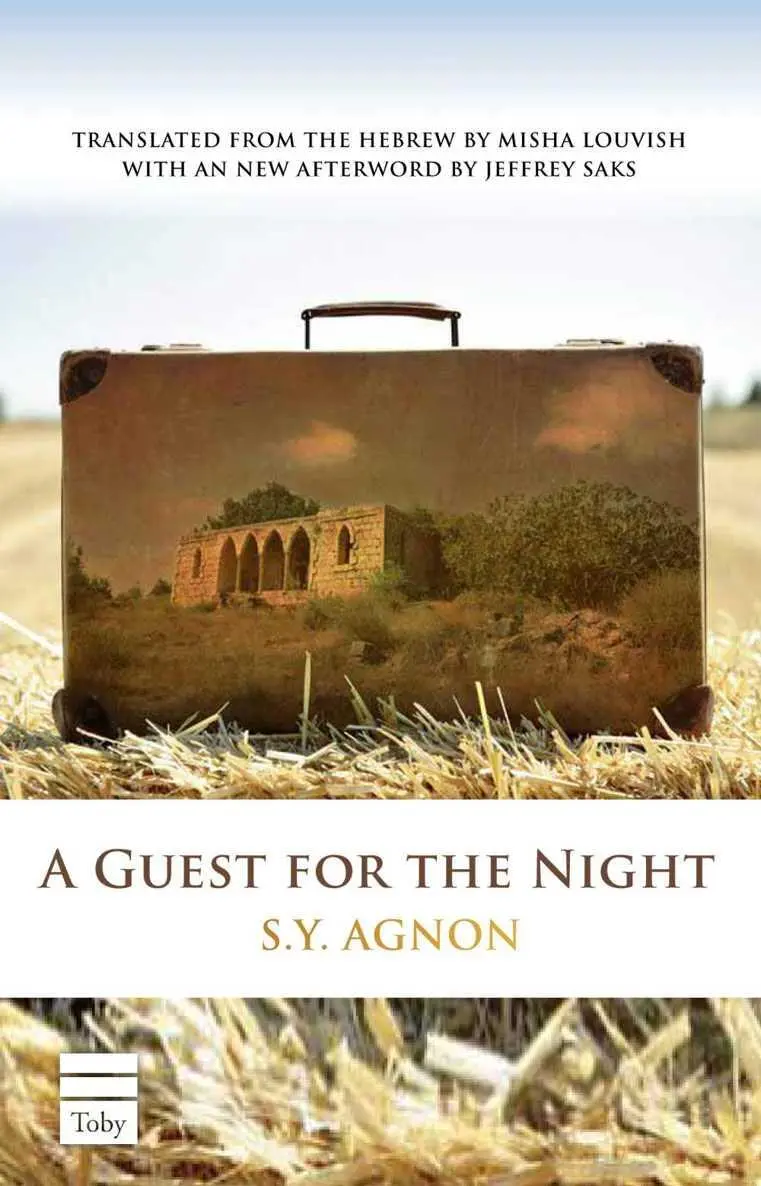
S. Agnon - A Guest for the NIght
Здесь есть возможность читать онлайн «S. Agnon - A Guest for the NIght» весь текст электронной книги совершенно бесплатно (целиком полную версию без сокращений). В некоторых случаях можно слушать аудио, скачать через торрент в формате fb2 и присутствует краткое содержание. Год выпуска: 2014, Издательство: The Toby Press, Жанр: Современная проза, на английском языке. Описание произведения, (предисловие) а так же отзывы посетителей доступны на портале библиотеки ЛибКат.
- Название:A Guest for the NIght
- Автор:
- Издательство:The Toby Press
- Жанр:
- Год:2014
- ISBN:нет данных
- Рейтинг книги:5 / 5. Голосов: 1
-
Избранное:Добавить в избранное
- Отзывы:
-
Ваша оценка:
A Guest for the NIght: краткое содержание, описание и аннотация
Предлагаем к чтению аннотацию, описание, краткое содержание или предисловие (зависит от того, что написал сам автор книги «A Guest for the NIght»). Если вы не нашли необходимую информацию о книге — напишите в комментариях, мы постараемся отыскать её.
depicts Jewish life in Eastern Europe after World War I. A man journeys from Israel to his hometown in Europe, saddened to find so many friends taken by war, pogrom, or disease. In this vanishing world of traditional values, he confronts the loss of faith and trust of a younger generation. This 1939 novel reveals Agnon’s vision of his people’s past, tragic present, and hope for the future.
Cited by National Yiddish Book Center as one of "The Greatest Works of Modern Jewish Literature".
A Guest for the NIght — читать онлайн бесплатно полную книгу (весь текст) целиком
Ниже представлен текст книги, разбитый по страницам. Система сохранения места последней прочитанной страницы, позволяет с удобством читать онлайн бесплатно книгу «A Guest for the NIght», без необходимости каждый раз заново искать на чём Вы остановились. Поставьте закладку, и сможете в любой момент перейти на страницу, на которой закончили чтение.
Интервал:
Закладка:
Three or four people came forward, lifted him, and brought him to the old Beit Midrash, where they put him on a table, raised his head, sprinkled water on his face, and wet his dry lips. They took the cloth from the reading desk and a tattered prayer shawl that no one would claim and put them under his head. They wanted to bring brandy and some food. The tailor opened his eyes, looked around and said, “There’s no time, sir, I’m too busy. Why are you crowding around me? Can I clothe the whole town?” While he was talking, he dozed off again and fell asleep. His lips grew paler and paler, but his smile did not go away, as if it had frozen on his lips.
So the stricken body lay on the table in the Beit Midrash, and the pure soul ascended to beg mercy for him. It was good for the body to lie still without being vexed by the soul. And while the one was lying and the other was pleading with its Maker, brandy was brought, and they opened his mouth and poured some into it. Reb Hayim came with a pot of black coffee in one hand and a piece of sugar in the other, and made him drink the coffee, sweetened with the sugar. Little by little the tailor returned to health to undergo fresh tribulations.
As I left, the rabbi saw me and greeted me amicably. Did I like his sermon? he asked, and what did I like about it? Finally he said that he had wanted to say more, but he saw that the congregation was weary with the fast and there were no learned men in it to understand the profundities of the Torah, so he cut it short. In the end he took my hand and said, “Come to break your fast with me, sir, and I will tell you all I left out.”
I said to myself: If you have been in a place once, it is known that you will go back there. I will go today and I shall not have to go some other day. I asked his permission to come after the meal; I knew that he was a poor man and I did not wish to eat of a meal that is not sufficient even for the hosts themselves.
The people of the hotel were sitting at table with the guests. Krolka hurried in confusion to bring the fasters their food. Dolik and Lolik sat with their heads covered, as at the Sabbath meal, and ate as after a fast. Babtchi, too, ate her fill. Opposite her sat Rachel and looked as if she were eating.
My host sat at the head of the table and his face was sad. Because of the pain in his legs that had been troubling him all day, he had been unable to go to the synagogue to pray with the congregation. Now that the pain had gone, he sat and rubbed the sore places, either to pamper them because they were not molesting him, or to molest them because they had annoyed him all day. While he was occupied with his legs, he raised his eyes and looked at Rachel. His lips shook and he cried, “Eat, you wicked girl, eat!” Shaken, Rachel picked up her spoon and pushed closer to the table, and her face went red as fire. When her mother saw this, she looked at her husband with surprise, and also at Rachel.
Between one course and the next, the guests talked about the day’s doings. One of them, who once had studied but then had stopped, said, “This was a fast in the true meaning of the word. For it is said in the Gemara: ‘Any fast which does not include the transgressors of Israel is no fast,’ and now some of the transgressors of Israel have fasted.” Another spoke up and said, “As far as a fast goes, it was a fast, but what about the fasting money?” “Fasting money? What is that?” Said the other, “It is the payment a faster makes for what he would have laid out on his food if he had not fasted.” Someone else spoke up, “How the Gemara begrudges the Jews any advantage, for they are not allowed to profit even from a fast.” Another spoke up, “I undertake to pay five zlotys as fasting money. If you don’t mind, Mrs. Zommer, take the money and give it to Hanoch’s wife.” The whole company praised the giver, and he added, “And if the mistress of the house thinks that the account is not correct, I will add another two or three zlotys.” By the time they had finished eating and drinking, a small sum had been collected for the benefit of that forsaken woman, Hanoch’s wife.
Another spoke up and said, “Now let us make a deal.” “A deal? I have never heard of a deal in Szibucz.” “Let us sell the grace after meals. Whoever gives most will lead the grace.” “An American auction?” “What’s an American auction?” “All those who want to buy pay in their money, and even if someone’s bid was not the highest, he still has to leave as much as he specified.”
Babtchi asked, “Can the women join in too?” “For giving money, why not?” “And if I win?” said Babtchi. “You can give your father the honor,” was the reply. Said Lolik to Babtchi, “What are you arguing about? Do you know how to say the grace?” “Do you?” “If I had been taught I would know.” By the time they had said grace, another sum was added to the first.
When I reached the rabbi’s house I told him all that had happened. “I will tell you something edifying,” the rabbi said. “Once the great scholar, the author of The Deliverances of Jacob , was preaching on the duty of providing for a certain poor bride. After the sermon, the great scholar said, ‘Never has a preacher preached so persuasive a sermon as I have preached.’ The congregation were surprised to see a rabbi so God-fearing and distinguished in the Torah praising himself in this way. The rabbi noticed this and said, ‘I have persuaded myself, and given her half her dowry.’ For that great scholar was a rich man — learning and great wealth in one place. What do you say to that, sir? Is such a power not to be envied? Blessed is he who preaches well and practices well.”
The rabbi stroked his beard and said, “Thank God that I have had the privilege of arousing a number of people for the benefit of that poor woman.”
Going from one subject to another, we came to the subject of the sages of the time.
The rabbi told me of things that had happened to him at the great convention of the Agudat Israel in Vienna, where some of the rabbis had objected to a legal ruling he had given on a certain matter, and he had outargued them all, until they admitted that the law was as he had said. While he was talking he handed me a bundle of letters that they had written and he had written.
I glanced at the letters and remembered the words of a certain wise man about the books of the wise men of the time. If these authors knew what was written in their books, said he, they too would be wise, for among their own words they cite words from the Gemara.
“What do you say?” said the rabbi. “Did I not outargue them thoroughly?” “What shall I say?” said I. “I am from the Land of Israel, and the scholars in the Land of Israel study the Torah for its own sake, and it makes no difference who outargues whom, for their only purpose is that things should be made plain and the law should be clearly established.” The rabbi grasped his beard angrily and said, “And your people are all righteous, I suppose. And those quarrels and feuds, the slandering and the tale-bearing we hear about from there, all these are only meant to clarify the law of the Torah? Even the Zionists are ashamed of you.”
“It is a punishment from heaven,” said I, “because they opposed the kingdom of the House of David. But although there are numerous men of strife in Jerusalem, there are more men of peace, who deny themselves and forego the honor due them, who study the Torah in poverty and rejoice at sufferings, and because of their love of the Torah do not feel all the troubles that befall them. Their actions are as goodly as their learning, and all their deeds are sincere. And their prayers are as goodly as their actions. I will show you a congregation of pious men in Jerusalem who spend all their days in prayer, seeking nothing for their own affairs, but only that His Blessed Name be magnified in the worlds He has created. Some men are privileged to pray such a prayer once in seventy years and some once a year, but they pray in this way three times a day.” “And what do your young men do?” said the rabbi. “As for the young men of Israel,” I said, “may I myself serve as expiation for their sins. They do not study like the scholars or pray like the pious men, but they plow and sow and plant, and give their lives for this Land that the Lord swore to give to our forefathers. That is why they have been privileged to have the Holy One, blessed be He, appoint them as guardians over His Land. Because they give their lives for the Land, He has entrusted the Land to them.”
Читать дальшеИнтервал:
Закладка:
Похожие книги на «A Guest for the NIght»
Представляем Вашему вниманию похожие книги на «A Guest for the NIght» списком для выбора. Мы отобрали схожую по названию и смыслу литературу в надежде предоставить читателям больше вариантов отыскать новые, интересные, ещё непрочитанные произведения.












Обсуждение, отзывы о книге «A Guest for the NIght» и просто собственные мнения читателей. Оставьте ваши комментарии, напишите, что Вы думаете о произведении, его смысле или главных героях. Укажите что конкретно понравилось, а что нет, и почему Вы так считаете.