S. Agnon - A Guest for the NIght
Здесь есть возможность читать онлайн «S. Agnon - A Guest for the NIght» весь текст электронной книги совершенно бесплатно (целиком полную версию без сокращений). В некоторых случаях можно слушать аудио, скачать через торрент в формате fb2 и присутствует краткое содержание. Год выпуска: 2014, Издательство: The Toby Press, Жанр: Современная проза, на английском языке. Описание произведения, (предисловие) а так же отзывы посетителей доступны на портале библиотеки ЛибКат.
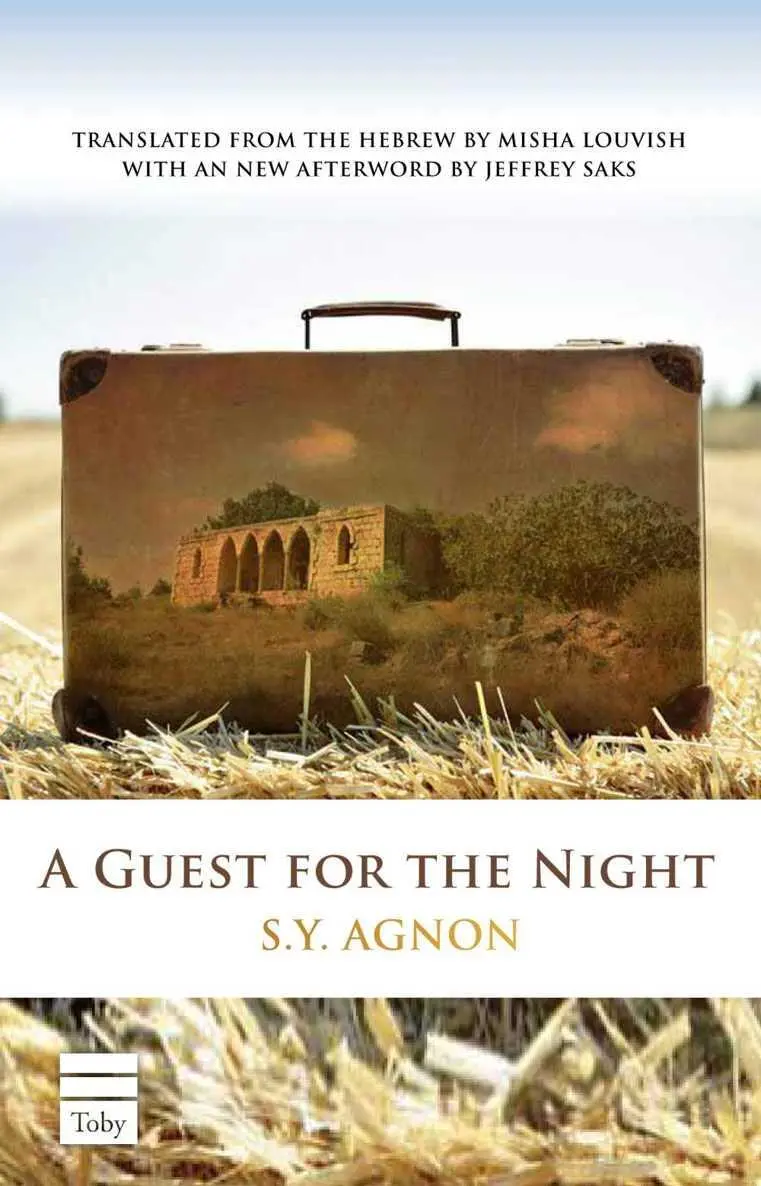
- Название:A Guest for the NIght
- Автор:
- Издательство:The Toby Press
- Жанр:
- Год:2014
- ISBN:нет данных
- Рейтинг книги:5 / 5. Голосов: 1
-
Избранное:Добавить в избранное
- Отзывы:
-
Ваша оценка:
A Guest for the NIght: краткое содержание, описание и аннотация
Предлагаем к чтению аннотацию, описание, краткое содержание или предисловие (зависит от того, что написал сам автор книги «A Guest for the NIght»). Если вы не нашли необходимую информацию о книге — напишите в комментариях, мы постараемся отыскать её.
depicts Jewish life in Eastern Europe after World War I. A man journeys from Israel to his hometown in Europe, saddened to find so many friends taken by war, pogrom, or disease. In this vanishing world of traditional values, he confronts the loss of faith and trust of a younger generation. This 1939 novel reveals Agnon’s vision of his people’s past, tragic present, and hope for the future.
Cited by National Yiddish Book Center as one of "The Greatest Works of Modern Jewish Literature".
A Guest for the NIght — читать онлайн бесплатно полную книгу (весь текст) целиком
Ниже представлен текст книги, разбитый по страницам. Система сохранения места последней прочитанной страницы, позволяет с удобством читать онлайн бесплатно книгу «A Guest for the NIght», без необходимости каждый раз заново искать на чём Вы остановились. Поставьте закладку, и сможете в любой момент перейти на страницу, на которой закончили чтение.
Интервал:
Закладка:
As soon as I entered the synagogue, Zechariah Rosen came up to me and began talking to me without resentment. In the course of his talk he told me how the earlier generations used to behave in every trouble and tribulation, and what psalm they used to recite. In the case of schiiler gelauf they would say such-and-such psalms, and in other troubles they would say such-and-such psalms. There were some troubles that he had heard about from his parents, who had heard from their parents, who had heard from their parents who had lived at the time of those troubles, and there were troubles he had heard about from old men who had read of them in the old register our town used to have. That register had been burned, unfortunately — though not, as many believed, by a certain elder because he found things in it derogatory to his family; it was his son, a scholar and a distracted man, who had burned it, not on purpose but by mistake. It happened once on the eve of Passover that while clearing away the leaven he cleared away, too, all the tattered papers that had no more worth or interest, and by mistake he burned the old register together with them. It is a pity about that old register which had been burned, for it chronicled events of three hundred years and more, but you cannot condemn the inadvertent as you would the willful transgressor.
And now that Zechariah Rosen’s memory had been stimulated by bygone days, he did not stop until he had told me a number of things that happened in our town. For instance, at first our old Beit Midrash was at the top of the hill and its entrance faced the bathhouse, and the tailors’ synagogue was down below in the courtyard of the Great Synagogue. The less serious among our young men used to watch the women going to the baths and be led into bad thoughts; so the elders of those days had exchanged the position of the two.
And Zechariah Rosen also told me, “I am surprised that it has not occurred to you to ask why you find a tailors’ synagogue and not one of cobblers or of other trades. The reason is that once the Polish authorities oppressed the Jews; so the Jews proclaimed a ban among themselves: that no Jewish craftsman should do any work for the Poles until they had mended their ways — at that time the Poles had no craftsmen of their own. The tailors violated the ban, and the Jews refused to pray together with the transgressors, so the tailors had to make houses of prayer for themselves.” And Zechariah Rosen also told me, “If you come to my house I will tell you some things worth hearing. As for Rav Hai, let me tell you that you and all your colleagues were not perfectly correct; I have piles and piles of proofs that I am a descendant of Rav Hai.”
While I was standing with Zechariah Rosen I saw a man looking at me. When Zechariah left me this man came up and asked how I was, and stroked my coat, as one who has a liking for me and for my clothes.
He was dressed in a thin, patched garment with a tattered collar sticking up toward his chin. His face was very lean and his eyes shining. He was bending his fingers, putting them up to his mouth to warm them with his breath, and talking to me between the blue fingers. Seeing that I did not recognize him, he smiled and said, “Don’t you recognize me, sir? You used to visit me often.” I asked him if he was the photographer.
What was there that made me ask him if he was the photographer? And what if he was the photographer? I had never had anything to do with the photographer. Again he stroked my coat and asked, “Are you pleased with this coat I made for you?” I took his cold fingers in my hands and apologized for having been so preoccupied with Hanoch’s trouble that I did not recognize him at once, and now that I had recognized him, I wondered at my failure to do so before. I asked him how his wife was.
Schuster smiled and said, “Healthy and good, thank God, like a merry devil in the women’s balcony of the synagogue. As for her lying in bed, that is first of all to spoil herself, and second so that her neighbors should come to visit her and see her bedclothes, which have come from a count’s mansion — for the friendship between us I do not give his name, because he has gone down in the world, and it is no honor to a noble to speak about his decline. But I will tell you in a whisper that I did him a good turn and took them in payment for clothes I made him. As for Hanoch, I say definitely that it’s a bad business.”
The tailor sighed deeply, put his blue fingers to his mouth, and said again, “A bad business.” I asked him if he found the fast a hardship. He twisted his lips into a kind of smile and said, “The fast a hardship? Why should I find the fast a hardship? I am not fasting. I redeemed myself with money. I am a craftsman, full up with work, and I can’t waste even an hour, and anyone who fasts can’t work, especially in the cold weather, when the chill drives a man to distraction. It’s a bad winter we have, and everyone wants warm clothes. Even lords and ladies, who have many clothes, want to have more made. The district governor has already sent for me, saying, ‘Make me two suits, and a third for ceremonial occasions, for I am invited to meet Pilsudski.’ I sent to tell him I was busy and could not go to him. He sent back, ‘If you do not make them for me I will be angry with you.’ I sent back, ‘Your honor knows that the whole town is practically naked; if I go to you that will keep me from my work, and the whole town will die of cold. Even for myself I do not find the time to make a coat. No, your honor, have pity. Jews are dying of cold.’”
Here the tailor’s compassion was aroused and enveloped his smile. His face grew pale and his lips began to quiver. Finally he made a downward motion with his hand and said, “And I tell you, sir, all our trouble is in vain. Hanoch is already dead. How? Well, he follows on behind his cart, and the horse walks on in front, and the snow is falling, and Hanoch’s hands get colder and colder, and all his body is cold. Still he summons up strength and goes up to his horse to see if the horse is not dead. The horse is still alive, but Hanoch is cold as a corpse. Hanoch stretches out his hands to his horse’s neck and embraces him, and so they stand together. The one is cold and the other is cold, but when they stand together it seems to them that they are getting warmer, because of the power of imagination that is in every creature. Says Hanoch to his horse, ‘ Kindchen , are you cold?’ ‘No, I am not cold,’ says the horse to Hanoch. ‘I know you are cold,’ says Hanoch to the horse, ‘but you say that so as not to grieve me. I am sure your words will not be counted against you as lies. Kindchen , are you cold?’ Before the horse can reply, the snow covers him and Hanoch. Hanoch peers from the snow and wants to get out, to reach a place where Jews live, so that he can be buried in a Jewish grave. He lifts one foot out of the snow. But what is the use of lifting one foot when you have to sink it back into the snow to take out the other foot that is sunk in the snow? But Hanoch does not think anything, for his mind is frozen and he is not capable of any thoughts in the world, but he takes out a foot and puts in a foot and bends his whole body, sometimes one way and sometimes the other, as I am showing you. But since his blood has been chilled, the body has no strength to stand, and he collapses. When he collapses he falls, and when he has fallen he cannot rise, and so he collapses and falls.” As the tailor was demonstrating Hanoch’s fall, his legs collapsed, and he fell.
At the sound of his fall, many were startled and alarmed. Some moved farther off and some came closer. Cries of alarm were heard. “Bring water, water!” “No, vinegar, vinegar!” “Bring a little water!” “A man has fainted!” “He can’t lie there, you should rub him, so that his blood shouldn’t freeze.” “Who’s fainted here?” “It’s the tailor from Berlin.” “But only a minute ago I saw him talking.” “It seems he found it too hard to fast.” “If so we’ll have to make him eat.” “Father in heaven, what are you standing there for? Move away.”
Читать дальшеИнтервал:
Закладка:
Похожие книги на «A Guest for the NIght»
Представляем Вашему вниманию похожие книги на «A Guest for the NIght» списком для выбора. Мы отобрали схожую по названию и смыслу литературу в надежде предоставить читателям больше вариантов отыскать новые, интересные, ещё непрочитанные произведения.









Обсуждение, отзывы о книге «A Guest for the NIght» и просто собственные мнения читателей. Оставьте ваши комментарии, напишите, что Вы думаете о произведении, его смысле или главных героях. Укажите что конкретно понравилось, а что нет, и почему Вы так считаете.