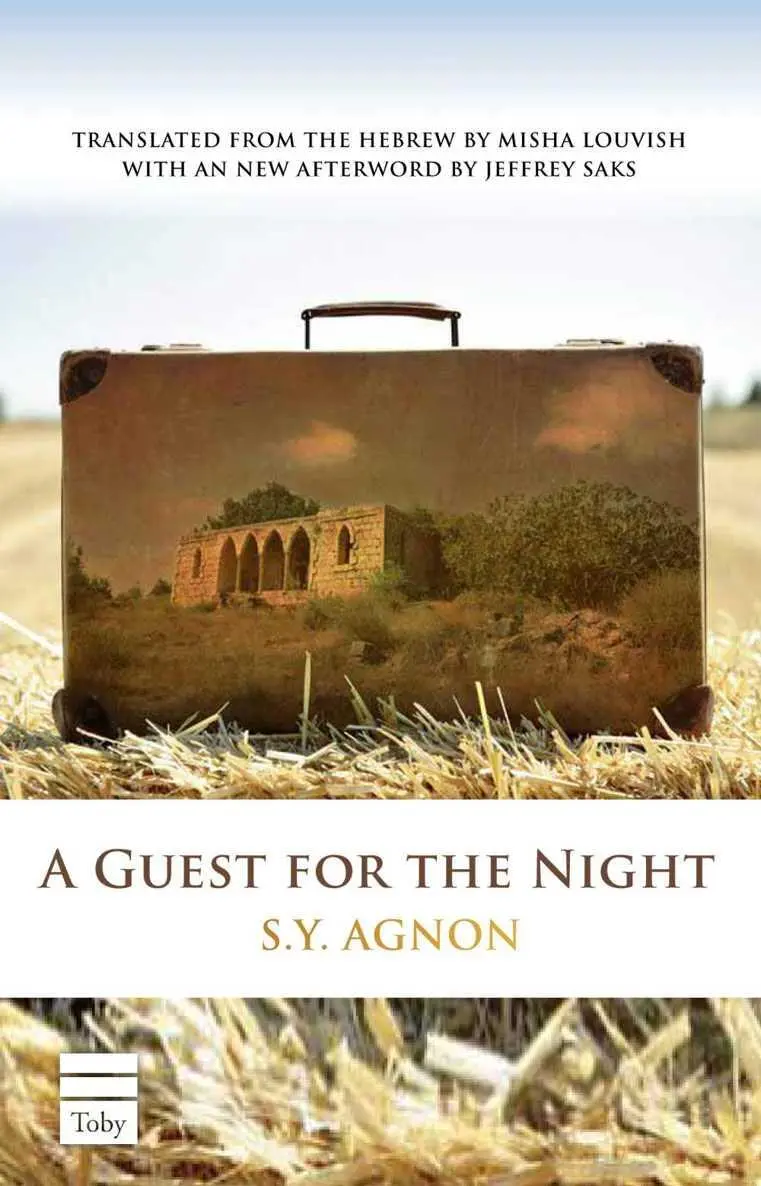
S. Agnon - A Guest for the NIght
Здесь есть возможность читать онлайн «S. Agnon - A Guest for the NIght» весь текст электронной книги совершенно бесплатно (целиком полную версию без сокращений). В некоторых случаях можно слушать аудио, скачать через торрент в формате fb2 и присутствует краткое содержание. Год выпуска: 2014, Издательство: The Toby Press, Жанр: Современная проза, на английском языке. Описание произведения, (предисловие) а так же отзывы посетителей доступны на портале библиотеки ЛибКат.
- Название:A Guest for the NIght
- Автор:
- Издательство:The Toby Press
- Жанр:
- Год:2014
- ISBN:нет данных
- Рейтинг книги:5 / 5. Голосов: 1
-
Избранное:Добавить в избранное
- Отзывы:
-
Ваша оценка:
A Guest for the NIght: краткое содержание, описание и аннотация
Предлагаем к чтению аннотацию, описание, краткое содержание или предисловие (зависит от того, что написал сам автор книги «A Guest for the NIght»). Если вы не нашли необходимую информацию о книге — напишите в комментариях, мы постараемся отыскать её.
depicts Jewish life in Eastern Europe after World War I. A man journeys from Israel to his hometown in Europe, saddened to find so many friends taken by war, pogrom, or disease. In this vanishing world of traditional values, he confronts the loss of faith and trust of a younger generation. This 1939 novel reveals Agnon’s vision of his people’s past, tragic present, and hope for the future.
Cited by National Yiddish Book Center as one of "The Greatest Works of Modern Jewish Literature".
A Guest for the NIght — читать онлайн бесплатно полную книгу (весь текст) целиком
Ниже представлен текст книги, разбитый по страницам. Система сохранения места последней прочитанной страницы, позволяет с удобством читать онлайн бесплатно книгу «A Guest for the NIght», без необходимости каждый раз заново искать на чём Вы остановились. Поставьте закладку, и сможете в любой момент перейти на страницу, на которой закончили чтение.
Интервал:
Закладка:
No wagon came to take me to the hotel, so I remained standing in the marketplace. In front of me sat a few peddler women wrapped in rags, with sacking wound around their legs and various kinds of boxes lying before them, from which rose all kinds of smells of pickled cabbage and apples that had rotted. No doubt there were goods for sale in or on these boxes. Languidly, the peddler women fixed their eyes on me and asked, without word or speech: What kind of goods are you looking for? Three or four women were walking around the marketplace with their baskets in their hands. Among them was Krolka. She did not see me, and it was good she did not, although I did not know why I should care whether she saw me or not. Finally she turned her head toward me and said, “You here too, sir? I came out to buy something in the market, but there’s nothing to buy — only pickled cabbage or rotted carrots. But what I refused yesterday I will buy today. Isn’t that what they say, ‘The Jews despised the manna and now they eat filth’?”
The women went away. The peddlers shrank into their rags, screwed up their eyes, and closed their lips, and the marketplace was silent. The well suddenly gave tongue, its water flowed faster, and a damper chill began to rise.
One woman opened her eyes and looked at me, saying, “Will the gentleman buy something?” I said to myself: What does this foolish woman want me to buy from her? There was Krolka, the servant at the hotel, who had inspected all the boxes and yet went away empty-handed, and this peddler woman says, “Buy something from me.”
“Sir,” said the woman’s neighbor, “buy from her. Buy from her, sir. You’ll be doing a great good deed — a house full of orphans, living orphans.” “What shall I take it in, mother?” said I, “I haven’t a basket.” “Buy whatever you like, sir,” said she, “and Hanoch’s wife will bring you the goods to any place you say. Isn’t that so, Hanoch’s wife?” Hanoch’s wife nodded her head to indicate yes. Said her neighbor, “Why don’t you tell the gentleman that you will bring him his goods?” And to me she said, “She’s a sorrowful woman and she finds it hard to speak. Alas, Hanoch’s wife, you want to be a peddler but you don’t want to open your mouth. As I’m a true Jewess, sir, it’s good stuff she has, apples and eggs. Apples you would think had just been picked from the tree.”
“What goods do you have here?” said I to Hanoch’s wife. “A dozen eggs a Gentile woman brought me from the village,” said she, “all laid this week.” “The gentleman can believe her,” said her neighbor. “She doesn’t tell a lie.” “Good,” said I. “Here is the money, and bring them to me to the old Beit Midrash.” “I knew the gentleman had a good heart,” said her neighbor. “Perhaps you need something else?” Said I to myself: If I do not need anything, perhaps Reb Hayim does. I said to Hanoch’s wife, “Have you something else?” “She can bring you anything you like, sir,” said her neighbor. “Here is the money,” said I. “Bring me a pound of coffee, the best coffee, and three pounds of sugar.”
I went back to the Beit Midrash and waited for Hanoch’s wife to bring me my purchases. When she brought them my spirits sank. How should I give Reb Hayim my goods?
After the people had left the Beit Midrash and when I was about to lock the door, I told Reb Hayim the whole story and said to him, “As I did not refuse that woman, you will not refuse me, and will take what the woman brought.” Reb Hayim’s face paled and he looked angry. “What was I to do?” said I. “I did not run after the chance to do a good deed. It was a matter of necessity. Now what shall I do with all these things? Perhaps I should take them to the Land of Israel and throw them into the Dead Sea?” Reb Hayim swallowed his anger and said melodiously, “There is no need for you to trouble yourself with such things. Thank God, I am short of nothing. I saved while I was working and I have enough to keep myself for the time being, and if God spares me He will provide me with a livelihood in the future as well.” I took hold of his coat and said, “Do me the same kindness as I did to Hanoch’s wife.” He took the goods and said, “May God bless you.” “And you too, sir,” said I.
Chapter three and thirty. Reb Hayim and His Daughters
This is the place to tell something of Reb Hayim’s daughters. Indeed, I should have done so at the beginning of his story, but I did not know enough about the details. Now that they have become clearer to me, I shall try to put them down.
Reb Hayim had four daughters. One of them was married to an old man in a village far away from our town, and another ran away, no one knows where. Some say she went to Russia, and some say she went to an emigrants’ training farm. One stayed with her mother, but she was not always in Szibucz because from time to time she used to go to the village to help her married sister, who was burdened with sons and daughters, her own, and her husband’s from his first wife, and what his first wife brought her husband from her first husband. And one of Reb Hayim’s daughters, little Zippora, the youngest, did not stir from the house.
That old man who married Reb Hayim’s daughter, Naphtali Zvi Hilferding was his name, had been orphaned of both father and mother in his childhood and brought up by Reb Hayim’s father-in-law. When Reb Hayim came to Szibucz, the orphan became his attendant. Naphtali Zvi became fond of Reb Hayim, and Reb Hayim became so fond of Naphtali Zvi that he began to draw Naphtali Zvi closer to him, and talked to Naphtali Zvi even about matters outside the scope of an attendant. And the truth is that Reb Hayim learned a great deal from Naphtali Zvi’s conversation, not only about worldly matters, but even in matters of Torah. Reb Hayim was a prodigy of learning, and like most such prodigies he used to repel people with his behavior. And when the controversy began with the adjudicator, and Reb Hayim would forbid what the other permitted and permit what the other forbade, all the scholars were antagonized by his rulings. The impression arose that he was giving rulings that were not according to the Law, and they would have liked to so clip his wings that he could not go on. What did Naphtali Zvi do? He would not leave him alone until he had written down all his reasons and arguments and submitted them to the great scholars of the day. They would reply, and whether they agreed with him or not, their answers would add to his prestige. So Naphtali Zvi would manage and guide him in other matters. Had it not been for him, Reb Hayim would have shared the fate of most prodigies, who at first studied the Torah in poverty but when they married the daughters of wealthy ignoramuses and emerged from suffering and exertion to a life of ease, soon lost interest in their studies. Thus Naphtali Zvi spent many years and did not marry, until the war came and he drifted to a certain place where he lived with a relative, a widow, whose husband had left her a shopful of goods and a houseful of children. Naphtali Zvi began to look after the orphans and busy himself with the goods. I do not know who was responsible — he, or the widow, or the Lord — but before much time had passed she married him, bore him a son and a daughter, and died.
So he was left a widower with a houseful of children, hers and theirs, and he needed a woman to look after them, as his wife had previously needed a man to look after the orphans of her first husband. Once he went to Szibucz to pray at the graves of his fathers. He visited Reb Hayim’s wife to ask how she was. At that time all her daughters were still with her. He saw the eldest, who was ripe for marriage, and the little ones growing up, and the house empty — not even a worn-out copper for a dowry. He felt pity for the woman and her daughters, and he said to himself: I will engage one of them to look after my children and pay her for the service. Thus I will make things easier for the mother, and there will also be a dowry for the daughter. Rut he began to doubt whether this would be seemly. Was it in keeping with the honor of Reb Hayim that his daughter should be a maid, especially a maid to his own attendant? Although he would not make her work hard and would greet her with respect, nevertheless there were grounds for misgivings, for sometimes a man comes home hungry from the shop and his meal is not ready, so he scolds the maid — and thus he would spoil his good deed in one brief moment. What, then, should he do, for they needed help and he could see no other way before him? So he decided to ask the mother. As he was going to the mother, it occurred to him to speak to her about herself: that she should marry him and free herself and her daughters from the cares of a livelihood. But his heart rebuked him: Wretch! When a vessel has been put to a holy use, can it be used for a profane purpose? So he did not talk to her either about herself or about her daughter, but he began visiting her frequently. He saw Reb Hayim’s eldest daughter, with whom he used to play in her childhood, at a time when the house was full of every luxury. He remembered those days when he used to carry her in his arms and she used to look into his eyes, and he would close one eye and the baby would wail, “Oh, the eyeball has run away,” and he would open his eye again and the baby would clap her little hands in joy over the eyeball that had come back. And again, when the hair of his beard and mustache had begun to grow, she would stroke him and say, “Grass is growing on your cheek, there’s a plant growing under your nose.”
Читать дальшеИнтервал:
Закладка:
Похожие книги на «A Guest for the NIght»
Представляем Вашему вниманию похожие книги на «A Guest for the NIght» списком для выбора. Мы отобрали схожую по названию и смыслу литературу в надежде предоставить читателям больше вариантов отыскать новые, интересные, ещё непрочитанные произведения.












Обсуждение, отзывы о книге «A Guest for the NIght» и просто собственные мнения читателей. Оставьте ваши комментарии, напишите, что Вы думаете о произведении, его смысле или главных героях. Укажите что конкретно понравилось, а что нет, и почему Вы так считаете.