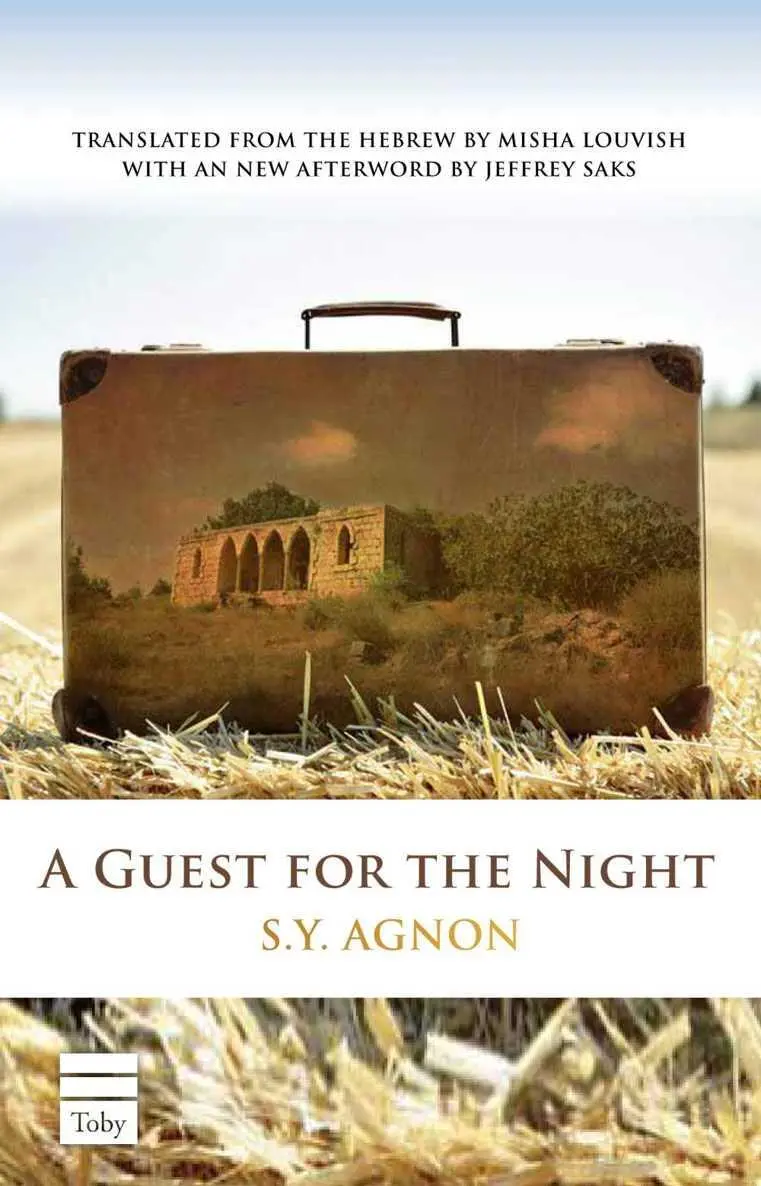
S. Agnon - A Guest for the NIght
Здесь есть возможность читать онлайн «S. Agnon - A Guest for the NIght» весь текст электронной книги совершенно бесплатно (целиком полную версию без сокращений). В некоторых случаях можно слушать аудио, скачать через торрент в формате fb2 и присутствует краткое содержание. Год выпуска: 2014, Издательство: The Toby Press, Жанр: Современная проза, на английском языке. Описание произведения, (предисловие) а так же отзывы посетителей доступны на портале библиотеки ЛибКат.
- Название:A Guest for the NIght
- Автор:
- Издательство:The Toby Press
- Жанр:
- Год:2014
- ISBN:нет данных
- Рейтинг книги:5 / 5. Голосов: 1
-
Избранное:Добавить в избранное
- Отзывы:
-
Ваша оценка:
A Guest for the NIght: краткое содержание, описание и аннотация
Предлагаем к чтению аннотацию, описание, краткое содержание или предисловие (зависит от того, что написал сам автор книги «A Guest for the NIght»). Если вы не нашли необходимую информацию о книге — напишите в комментариях, мы постараемся отыскать её.
depicts Jewish life in Eastern Europe after World War I. A man journeys from Israel to his hometown in Europe, saddened to find so many friends taken by war, pogrom, or disease. In this vanishing world of traditional values, he confronts the loss of faith and trust of a younger generation. This 1939 novel reveals Agnon’s vision of his people’s past, tragic present, and hope for the future.
Cited by National Yiddish Book Center as one of "The Greatest Works of Modern Jewish Literature".
A Guest for the NIght — читать онлайн бесплатно полную книгу (весь текст) целиком
Ниже представлен текст книги, разбитый по страницам. Система сохранения места последней прочитанной страницы, позволяет с удобством читать онлайн бесплатно книгу «A Guest for the NIght», без необходимости каждый раз заново искать на чём Вы остановились. Поставьте закладку, и сможете в любой момент перейти на страницу, на которой закончили чтение.
Интервал:
Закладка:
There sat that old man, who many years before had been young, with a glass of tea before him, poured out by Reb Hayim’s daughter. The old man puts his hand on the glass, the steam rises from the glass, and his hands and his heart grow warmer and warmer. His lips are opened and all that was hidden in his heart rises to his tongue. And he goes on telling about days gone by, days when Reb Hayim lived honored by all, and half the town followed him and wished to appoint him rabbi. The old man looks at Reb Hayim’s daughters and says, “Days like those that have gone will never come back.” And although they have to mourn for those days, of which not the slightest trace has remained, their hearts are moved, and they want to hear more. Especially the eldest daughter, who can remember the greatness of her father when she was little, and when that old man who sits and tells the story used to dandle her on his knees, making one eyeball run away and then bringing it back.
As the old man speaks, the house grows more spacious, and its furnishings are transformed, as if the light of early days shone upon them. For many years the daughters have not sat so peacefully and at ease or heard such pleasant things as those the old man tells. While he was sitting he began thinking again: I am wealthy and my livelihood is sure, but I cannot give a dowry to Reb Hayim’s daughters, for my wife’s daughters from her first husband are also growing up and I must find them husbands. He began arguing with himself: I, who used to look after Reb Hayim’s affairs, cannot look after my own. He took his glass, drank what was left of the tea, said the appropriate blessing, “Creator of all lives and of their needs,” and went away.
When he returned home he was gripped by nostalgia for Reb Hayim’s house. Little by little he began to put out of his mind the needs of the daughters and began to think about himself, living as he was without a wife. And it could really be said that all his life he had been without a wife. Although he had already been married and had had children from his wife, he had only married her because of the home and the livelihood she brought him, and now that she was dead he ought to look for his true mate. That was easy to say and hard to do, for his mate was twenty years younger than he, and moreover she was Reb Hayim’s daughter. True, the world had changed: superior people had declined and inferiors had risen. This war had made the poor goodly and the rich ugly. If he had had it in his power, he would have crowned Reb Hayim’s daughters with gold, especially his oldest daughter, who had reached her ripeness and was ready for marriage. But if he gave her his money he would be robbing the sons and daughters his wife had brought him from her first husband, as well as those she had borne for himself. And moreover, was there anyone who was fit to be that girl’s husband? In any case, there was one way out of all these complications. And what was that? If he married her he would rid her of the worry of finding a dowry.
And what were the thoughts of the girl? She took after her father, who relied on Naphtali Zvi his attendant. When he visited them again, he said to her, “I do not know if it is clear to you why I have come. And if it is clear to you, I ask you not to reply immediately. I will stay in the town two or three days. During that time consult your mother and yourself, and then give me a clear answer. Now I am going away to look after my affairs and I will bid you goodbye.”
When he returned he did not repeat what he had said, nor did she say anything to him. When her mother came in he rose and told her he had said thus-and-thus to her daughter. “And what did you answer him?” the mother asked her daughter. She lowered her head and said, “I do not know what to answer.” “Yesterday,” said the mother, “you knew, and today you have forgotten.” “I have not forgotten,” said the daughter. “If so,” said the mother, “answer our friend, or perhaps I should answer in your place.” “I will answer myself,” said the girl. The mother rose, called her other daughters, and said, “Come and wish your sister good luck.” So they set up the bridal canopy and she went with him. Since she was weak and tender, she asked one of her sisters to live with her to help her.
I have not seen Reb Hayim’s daughters, except the little one, who lives with her mother and used to come to her father to wash his linen, for the eldest was married in another town, and one daughter lives with her, and one has run away to Russia or to a training farm for emigrants. This little one, whose name is Zippora, is a silent girl; when I would ask her something she would fix her eyes on me in alarm, as one who is afraid and pleads that no one touch her. In the course of time she grew accustomed to me and would greet me with “Shalom” in the Holy Tongue — although she did not know the Holy Tongue, and I am doubtful if she even knew how to read. I wanted to hint to her father that he should teach her to read, but I changed my mind. I said to myself: He himself does not study; why then should he teach his daughter?
Chapter four and thirty. About the Houses of Prayer in Our Town
Let us return to the Beit Midrash. The quorum assembles as usual, and we offer up public prayer. In the course of time, we have been joined by several shopkeepers, who come for the Morning Service so as to warm their bones before going out to their shops. It has gone so far that we hold three services, one after the other. In the course of time, even Hasidim have begun to come to our old Beit Midrash.
And here I must digress to talk about the various houses of prayer — Batei Midrashot, shtiblech, shilechlech, kloisen , and kleislech— that existed in our town.
At first all the communities from Germany, Poland and Lithuania, Bohemia and Moravia used to pray according to the Ashkenazi rite, which they received from their fathers, and their fathers from their fathers, directing their prayer toward the gate that is meant for them in heaven. And just as they all used the same rite in their prayer, so did they use special melodies, some of which were handed down at Sinai, and others received from the martyrs of Germany, who, when their enemies offered them up at the stake and they rose to heaven in the flames, uttered songs and praises in ecstasy and thanksgiving, their souls filled with ardor as they approached the Lord. They did not know that they were singing, but the voice sang by itself; and the early cantors wove this melody into the words of the prayers. And a man can still feel, when he is praying truly, that the voice sings by itself, even if he himself is not really a melodious singer. It is because of this that, wherever a Jew prays, the prayers of all Israel are uttered. And even the heavens intended their prayer to be like the prayer of Israel, as it is said, “The heavens declare the glory of God; and the firmament showeth His handiwork.” Who is the handiwork of the Holy One, blessed be He? These are the children of Israel, of whom the Scriptures testify, “He hath made thee, and established thee.” When the higher ones saw this, they thought in error that the days of the Messiah were near, and they revealed to the chosen individuals of that generation the secrets of prayer, the secrets of its purposes and combinations and meanings, so that these individuals should try with the power of prayer to bring nearer the End. But the time of redemption had not yet arrived for Israel in that generation; and their hearts were confused and they mistook the promise of redemption for the redemption itself. And so there were a number of men of Israel who mistakenly thought that their redemption was already here, and they abandoned the customs of their forefathers and adopted new ones, especially in their way of praying. The gates of heaven were confounded and their prayers entered in confusion, and had it not been for the Baal Shem Tov, of blessed memory, and his disciples, who knows what would have happened to us — heaven forbid?
Читать дальшеИнтервал:
Закладка:
Похожие книги на «A Guest for the NIght»
Представляем Вашему вниманию похожие книги на «A Guest for the NIght» списком для выбора. Мы отобрали схожую по названию и смыслу литературу в надежде предоставить читателям больше вариантов отыскать новые, интересные, ещё непрочитанные произведения.












Обсуждение, отзывы о книге «A Guest for the NIght» и просто собственные мнения читателей. Оставьте ваши комментарии, напишите, что Вы думаете о произведении, его смысле или главных героях. Укажите что конкретно понравилось, а что нет, и почему Вы так считаете.