Gail Hareven - Lies, First Person
Здесь есть возможность читать онлайн «Gail Hareven - Lies, First Person» весь текст электронной книги совершенно бесплатно (целиком полную версию без сокращений). В некоторых случаях можно слушать аудио, скачать через торрент в формате fb2 и присутствует краткое содержание. Год выпуска: 2015, Издательство: Open Letter, Жанр: Современная проза, на английском языке. Описание произведения, (предисловие) а так же отзывы посетителей доступны на портале библиотеки ЛибКат.
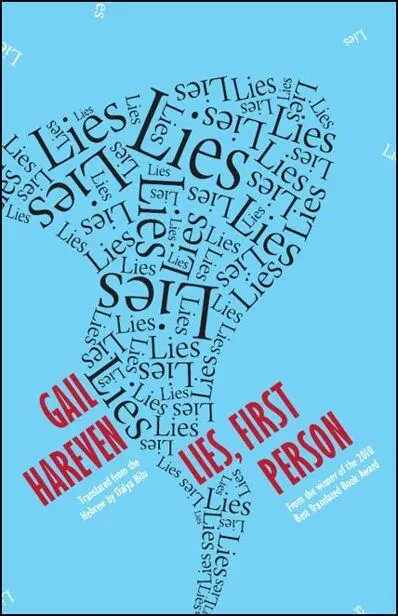
- Название:Lies, First Person
- Автор:
- Издательство:Open Letter
- Жанр:
- Год:2015
- ISBN:нет данных
- Рейтинг книги:3 / 5. Голосов: 1
-
Избранное:Добавить в избранное
- Отзывы:
-
Ваша оценка:
Lies, First Person: краткое содержание, описание и аннотация
Предлагаем к чтению аннотацию, описание, краткое содержание или предисловие (зависит от того, что написал сам автор книги «Lies, First Person»). Если вы не нашли необходимую информацию о книге — напишите в комментариях, мы постараемся отыскать её.
Elinor's comfortable life — popular newspaper column, stable marriage, well-adjusted kids — is totally upended when she finds out that her estranged uncle is coming to Jerusalem to give a speech asking forgiveness for his decades-old book,
.
A shocking novel that galvanized the Jewish diaspora,
was Aaron Gotthilf's attempt to understand — and explain — what it would have been like to be Hitler. As if that wasn't disturbing enough, while writing this controversial novel, Gotthilf stayed in Elinor's parent's house and sexually assaulted her "slow" sister.
In the time leading up to Gotthilf's visit, Elinor will relive the reprehensible events of that time so long ago, over and over, compulsively, while building up the courage — and plan — to avenge her sister in the most conclusive way possible: by murdering Gotthilf, her own personal Hilter.
Along the way to the inevitable confrontation, Gail Hareven uses an obsessive, circular writing style to raise questions about Elinor's mental state, which in turn makes the reader question the veracity of the supposed memoir that they're reading. Is it possible that Elinor is following in her uncle's writerly footpaths, using a first-person narrative to manipulate the reader into forgiving a horrific crime?
Lies, First Person — читать онлайн бесплатно полную книгу (весь текст) целиком
Ниже представлен текст книги, разбитый по страницам. Система сохранения места последней прочитанной страницы, позволяет с удобством читать онлайн бесплатно книгу «Lies, First Person», без необходимости каждый раз заново искать на чём Вы остановились. Поставьте закладку, и сможете в любой момент перейти на страницу, на которой закончили чтение.
Интервал:
Закладка:
“The Marquis de Sade. I may have read something once. A long time ago.”
I read The 120 Days of Sodom , large parts of it anyway, in the university library. I read it there. The book was on the psychology department’s “reserved” list, the ones you can’t check out, and I sat in the library among the well-meaning psychology students, and in the exhausting neon light I forced myself to read the volume that, according to the stamps on it, had seldom been taken down from the shelves.
I read The 120 Days of Sodom because the Not-man had forced my sister to read it aloud to him, and because she had difficulty in reading, he read it aloud to her. That’s why.
And mainly I read it because before he forced my sister, the Not-man almost tempted me to read it.
It was on one of my visits home, when with the encouragement of Erica and Shaya—“You know what our Elinor is studying now at school? They’re studying Kafka”—we entered into a conversation, he and I.
I was well aware of the fact that the remarks made in a loud voice when I joined the table were directed at the guests sitting at the next table, and intended to feed my parent’s self-esteem. I was aware of this, and the slightly amused expression on the face of the professor told me that he was aware of it too. The look he gave the high school student invited her to share in his amusement before the eyes and behind the backs and at the expense of the vulgar people who happened to be her mother and father.
He leaned toward me, singling me out from the others, and questioned me about what I was studying and what I thought about what I was studying. Shaya, I remember, tried to embark on one of his speeches about our-Israeli-education-system, but his cousin ignored him, and concentrated his attention on the clever daughter. He said that he was not familiar with the Hebrew translation of Kafka, and made some remark about translations into other languages. He asked me how I imagined Samsa as an insect — I shrugged my shoulders and replied “an insect”—and then he turned to the table at large and told them that Kafka had forbade any illustrations of the metamorphosis, because he wanted his readers to imagine the insect for themselves, each according to his own nightmares.
He said that he had another question for Elinor, and proceeded to ask me a question that I had not considered: was there any sense, in my opinion, in which “this petty clerk, Samsa” deserved the fate that befell him? I clearly remember this sentence with the “petty clerk” and the “befell him.” The Not-man, perhaps I have already said, spoke impressive Hebrew. Embarrassed, I replied, “Obviously no one, even if he’s a petty clerk, deserves to turn into an insect,” and as far as I remember he took off from my reply to the Marquis, whose writings I might be interested in reading one day, and in whose opinion virtue could not expect a reward: in this world of ours the very expectation of a deserved reward was foolishness.
I think that the conversation was along these lines, perhaps it was a little different, but these were the main points, and once the name of de Sade was mentioned my mother raised the threads of her eyebrows and said: “Really, Aaron, our Elinor is still too young for such things,” and Aaron replied: “Your mother is right. Your mother is always right,” and smirked apologetically. And then, as if to relieve her embarrassment, he went on to play the buffoon and thumped himself a couple of times on the chest and said: “Forgive me, I am at fault. Mea culpa. Mea maxima culpa.” And my mother giggled.
If he had informed me that he had works by the Marquis in his room, I would have followed him upstairs to borrow them. The Not-man was interesting: far more intriguing than a Jesuit monk and an acrobat. And that same week, when I returned to boarding school, I was foolish and innocent enough to go to the school library and search the shelves for a book by the French writer de Sade.
If I had been asked, if I had spoken to anyone about it, I wouldn’t have been able to point to any resemblance between Hitler, First Person and The 120 Days ; no resemblance but for the piles of bodies heaped up by their writers: dead bodies in one, and copulating bodies in the other.
A different reader would have put them in two different categories. But I, even though I could see that the monotonous recording of the Marquis was obviously different from the elaborately detailed zigzags in style and consciousness of the First Person — nevertheless I sensed — more than sensed, it was as if I knew — that a single hand, a single entity, stood behind them both.
“Hand,” I say, and “entity,” but it wasn’t really a hand. And it definitely didn’t “stand.” More accurately: a kind of buffoonish essence that seeped and soiled, a single fluid presence stealing in, changing one face for another.
Hitler, First Person remained in the garbage can of the O’Hare Airport, where I dumped it with a demonstrative flourish, to my husband’s relief. But the person wasn’t a person, and it had no boundaries, and the filth I had read penetrated and remained, with me and in me. I thought that I had to stabilize myself and confront the filth rationally and with my eyes open.
I thought: today I’m stable, stable and rational. Today it’s different.
The more I thought about the First Person, the less rational my thoughts became, and the more difficult it became to fence them in or hold them in check. And it was impossible to explain any of this to the clean-shaven profile of the man by my side. Did I honestly believe that the Not-man was pursuing me and might still harm my sister? That’s what the profile would have asked, that’s the question my husband put to me, repeatedly and tactfully, and this rhetorical question is one that I wholeheartedly reject, because it has no right to exist.
This man, this First Person Hitler crushed my sister and destroyed what little dysfunctional family I had. But dysfunctional families have the right to exist too, and it’s the only one I had. He came and crushed, and from the moment he reappeared, he haunted me, and I was indeed pursued.
— 2 -
It took us close to an hour to find our way out of Chicago, and when we got onto Route 57 I covered myself with my coat and fell asleep. Even during the most difficult periods, sleep was always available to me and it always came to me easily. One small step in my mind and I was already on the escalator carrying me to sweetness.
Oded kept quiet. I kept quiet. We drove south into plains of brown fields. Dry stalks of cut corn stretching to the horizon. Huge trucks. Road signs, a passing tractor, a bird of prey — in this yellow-brown limbo there was almost nothing for the eye or the imagination to take hold of. What could I do but sleep? I was nasty to my husband, and I knew that he would restrain himself and forgive me. The sun faded and paled beyond the flat gray expanse of clouds, and shortly before I fell asleep I was deceived into thinking that it was a full moon shining in the morning sky.
My sister lived in a town with a musical name, Monticello—“Limoncello” Oded called it jokingly — and not in Monticello itself but nearby, in a place we would be hard put to find by ourselves. After discussing it with my husband, who was confident of his ability to navigate anywhere, I arranged with Elisheva for her and her Barnett to meet us in the hotel where we were to stay, in a different town, a twenty minute drive from their home.
About thirty minutes after I fell asleep, Oded woke me up in the parking lot of a McDonald’s in a quasi urban landscape. “Did you sleep a bit?” he asked in a relaxed tone and put a warm Styrofoam cup in my hand.
Читать дальшеИнтервал:
Закладка:
Похожие книги на «Lies, First Person»
Представляем Вашему вниманию похожие книги на «Lies, First Person» списком для выбора. Мы отобрали схожую по названию и смыслу литературу в надежде предоставить читателям больше вариантов отыскать новые, интересные, ещё непрочитанные произведения.











Обсуждение, отзывы о книге «Lies, First Person» и просто собственные мнения читателей. Оставьте ваши комментарии, напишите, что Вы думаете о произведении, его смысле или главных героях. Укажите что конкретно понравилось, а что нет, и почему Вы так считаете.