Gail Hareven - Lies, First Person
Здесь есть возможность читать онлайн «Gail Hareven - Lies, First Person» весь текст электронной книги совершенно бесплатно (целиком полную версию без сокращений). В некоторых случаях можно слушать аудио, скачать через торрент в формате fb2 и присутствует краткое содержание. Год выпуска: 2015, Издательство: Open Letter, Жанр: Современная проза, на английском языке. Описание произведения, (предисловие) а так же отзывы посетителей доступны на портале библиотеки ЛибКат.
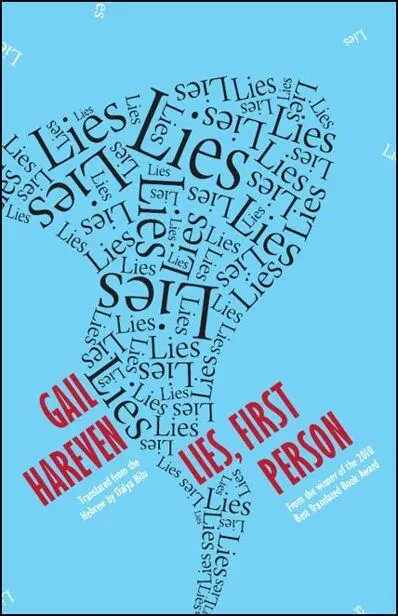
- Название:Lies, First Person
- Автор:
- Издательство:Open Letter
- Жанр:
- Год:2015
- ISBN:нет данных
- Рейтинг книги:3 / 5. Голосов: 1
-
Избранное:Добавить в избранное
- Отзывы:
-
Ваша оценка:
Lies, First Person: краткое содержание, описание и аннотация
Предлагаем к чтению аннотацию, описание, краткое содержание или предисловие (зависит от того, что написал сам автор книги «Lies, First Person»). Если вы не нашли необходимую информацию о книге — напишите в комментариях, мы постараемся отыскать её.
Elinor's comfortable life — popular newspaper column, stable marriage, well-adjusted kids — is totally upended when she finds out that her estranged uncle is coming to Jerusalem to give a speech asking forgiveness for his decades-old book,
.
A shocking novel that galvanized the Jewish diaspora,
was Aaron Gotthilf's attempt to understand — and explain — what it would have been like to be Hitler. As if that wasn't disturbing enough, while writing this controversial novel, Gotthilf stayed in Elinor's parent's house and sexually assaulted her "slow" sister.
In the time leading up to Gotthilf's visit, Elinor will relive the reprehensible events of that time so long ago, over and over, compulsively, while building up the courage — and plan — to avenge her sister in the most conclusive way possible: by murdering Gotthilf, her own personal Hilter.
Along the way to the inevitable confrontation, Gail Hareven uses an obsessive, circular writing style to raise questions about Elinor's mental state, which in turn makes the reader question the veracity of the supposed memoir that they're reading. Is it possible that Elinor is following in her uncle's writerly footpaths, using a first-person narrative to manipulate the reader into forgiving a horrific crime?
Lies, First Person — читать онлайн бесплатно полную книгу (весь текст) целиком
Ниже представлен текст книги, разбитый по страницам. Система сохранения места последней прочитанной страницы, позволяет с удобством читать онлайн бесплатно книгу «Lies, First Person», без необходимости каждый раз заново искать на чём Вы остановились. Поставьте закладку, и сможете в любой момент перейти на страницу, на которой закончили чтение.
Интервал:
Закладка:
The text was written in the first person singular, but the arbitrary changes of personality and style created the impression that it was not one but a number of people speaking, and therefore, in some sense, it was no one: a kind of entity that lacked permanence and solidity, that could be called by any name you chose to give it, that evaporated and evaded description by any fixed adjective. It wasn’t Chemi’s fault that I failed to describe the thing he put in my hands by the poolside that day on the Costa del Sol.
One of the many “I”s in the book suffers from an agonizing hypersensitivity of the senses: an ugly building, the discordant performance of a sonata, a stuffy office, all bring him to the point of fainting and the desire to put a bullet through his brain. But on the battlefield, in the stench of the trenches of the Western Front, the very same first person doesn’t smell a thing, and even brags about reading Homer and feeling quite at home.
Another “I” burdens his readers with surrealistic memories and visions of death: animal carcasses and grinning skulls pile up in heaps. Living people, corpses and inanimate objects are all mixed up together, and most of the characters have no names. In this part of the text, and perhaps in the book as a whole, there seem to be more inanimate objects than humans.
One lengthy vision of a woman’s body covered with “filthy snails” reminded me of something, and later on I remembered what it was: a drawing by Salvador Dali.
You couldn’t call any of the narrators a necrophile, because the morbid interest of the “I” is focused mainly on the moments preceding death itself. The death in agony of “my poor, dear mother” is described in banal generalizations, but from this description the monologue passes directly to the horrors of the spring offensive at Arras where the “I” lingers at length next to a dying soldier from his company. And by the light of a hurricane lamp he observes like a scientist the seconds when life retreats and “death conquers my comrade.”
The narrator hopes to see something there, some kind of revelation, he doesn’t know what himself, and when he gets up and stands over the dead body of his comrade, he realizes that “there is nothing there.”
This obscure conclusion is strengthened later on when the same apparent “I” goes on to observe dying enemy soldiers. He admits that the sight of their dying holds him spellbound. And years later, on the Night of the Long Knives, the narrator is unable to restrain himself from asking about the murdered men: did any of the executioners “see anything there”? The embarrassed interlocutor assures his Führer that nothing out of the ordinary was reported, and in the wake of this confirmation, the narrator is overjoyed, and confesses that he now feels as clean as a baby.
Looking into the void — says the first person — freed him from the cunning bonds of the devil.
“There’s nothing there,” the voice proclaims defiantly, and with the seductive swagger of a rock star he challenges his readers: “Who but me would dare to feel the pure terror of the void?”
Time and time again he fantasizes about clean ground and an unprecedented conflagration that would burn a thousand years and return its virginity to the soil. And at great length he prophecies a planet empty of human beings, where giant marble statues would take the place of the empty rotten flesh.
The first person decorated with a medal and two iron crosses is not afraid of being killed in battle, but for all his boasting, a constant dread of oblivion encircles him and threatens him like “a cloud of gas.” Mocking laughter accompanies the continuing erosion of the void, the laughter returns again and again like a motif, until ringing laughter, erosion, and rot all seem one and the same.
A few of the first persons endure undoubted suffering. The reader is invited to pity the lonely, beaten, and haunted sufferer: the defeated soldier, the failed artist shivering in his poverty-stricken shelter, and especially the child, who is of course abused. But the expected empathy diminishes with the rise in the self-pitying pathos, and evaporates in the sudden transitions from self-pity to satanic pride, crude hectoring, or tedious lectures.
The hero is as proud of his suffering as his achievements, and points out among other things that at moments when others are overcome by hesitation, he alone understands that the choice is between existence and extinction, and in his genius and “the exhilaration of being backed against the wall” is able to turn defeat into victory.
On a number of occasions he compares himself to Jesus: in one place he says that death had him in its grip like Jesus, and like him he was destined to rise again, to resurrect others and to purify the earth. And in the fifth chapter, if I’m not mistaken, he threatens to expel the Jewish speculators from the Temple with a whip, just like Jesus.
The whip is also a motif: failures spur him into action like a whip. His voice lashes his audience in the beer cellar like a whip. A whip is thrust down the throat of a reporter from the Munich Post in a scene that seems very realistic. And in another scene, no less realistic, he beats his dog with a whip because if you don’t master the dogs — the dogs will master you.
These are the whips I remember, but there were certainly more.
In one of the more coherent transitions the narrator, in his terror of the void, attempts to realize his existence in ecstasy. The ecstasy is born on the night when the boy “I” emerges from Wagner’s Rienzi with his “faithful friend” and unfolds his “visions” to him with Linz spread out at their feet. He knows that he is destined to lead, and draws his strength from the friend and the city beneath him. Years later, during a course on “National Thinking” this formative experience returns to him before an audience of a few people, later on their numbers multiply, first tens and hundreds and then thousands and millions, and the roar of their blood “crystallizes in my flesh” into a single spirit, and silences the laughter. From now on — the narrator threatens — he is the only one who will laugh.
Art is ecstasy and ecstasy is art, he states, and as artist-actor he continuously teaches himself methods to summon the spirit and lift it from peak to peak and thrill to thrill, until it reaches the absolute realization, which is also oblivion. Loneliness vanishes when the “I” and the crowd become one, and it sometimes happens that “I come to the end of a rally so bathed in sweat that my underwear is dyed by the color of my uniform.”
When he speaks of the mass rallies, the narrator ridicules the people he calls “the Jesuits,” who eat the flesh of their savior and drink his blood. In a series of cannibalistic metaphors he describes how the flesh and blood of the destined redeemer is not consumed, but on the contrary: he is nourished by his audience and sucks his strength from them, until their voices emerge from his throat as one voice and their dreams unite within him into one idealistic vision.
The first person sometimes appears at three rallies on the same day, and declares that he is never tired. Youngsters like “my dear Heidrich” sit around his table at night struggling to stay awake and trying to hide their exhaustion from him, while he, who is not deceived by their attempts, has no need to struggle: strength and movement are what create reality, and the strength that realizes itself in movement never tires and knows no mercy. It tramples those that stand in its way and grinds them to dust. One of the knights of his round table shows him a letter he received from a childhood neighbor, in which she pleads for mercy for her brother. Humanistic sentiment must be rooted out, is the leader’s response. Pleas for mercy are the cunning venom of the parasites, and must be treated like the poison they are.
Читать дальшеИнтервал:
Закладка:
Похожие книги на «Lies, First Person»
Представляем Вашему вниманию похожие книги на «Lies, First Person» списком для выбора. Мы отобрали схожую по названию и смыслу литературу в надежде предоставить читателям больше вариантов отыскать новые, интересные, ещё непрочитанные произведения.









Обсуждение, отзывы о книге «Lies, First Person» и просто собственные мнения читателей. Оставьте ваши комментарии, напишите, что Вы думаете о произведении, его смысле или главных героях. Укажите что конкретно понравилось, а что нет, и почему Вы так считаете.