Gail Hareven - Lies, First Person
Здесь есть возможность читать онлайн «Gail Hareven - Lies, First Person» весь текст электронной книги совершенно бесплатно (целиком полную версию без сокращений). В некоторых случаях можно слушать аудио, скачать через торрент в формате fb2 и присутствует краткое содержание. Год выпуска: 2015, Издательство: Open Letter, Жанр: Современная проза, на английском языке. Описание произведения, (предисловие) а так же отзывы посетителей доступны на портале библиотеки ЛибКат.
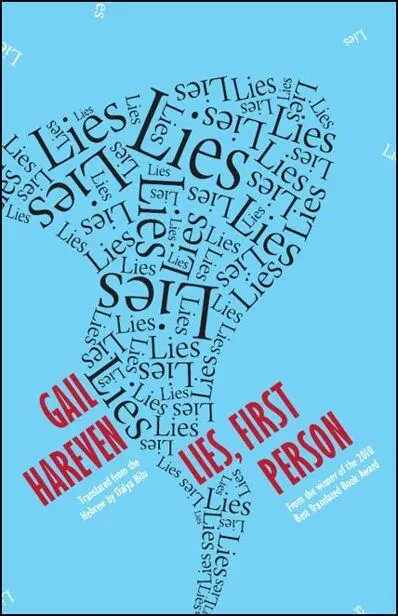
- Название:Lies, First Person
- Автор:
- Издательство:Open Letter
- Жанр:
- Год:2015
- ISBN:нет данных
- Рейтинг книги:3 / 5. Голосов: 1
-
Избранное:Добавить в избранное
- Отзывы:
-
Ваша оценка:
Lies, First Person: краткое содержание, описание и аннотация
Предлагаем к чтению аннотацию, описание, краткое содержание или предисловие (зависит от того, что написал сам автор книги «Lies, First Person»). Если вы не нашли необходимую информацию о книге — напишите в комментариях, мы постараемся отыскать её.
Elinor's comfortable life — popular newspaper column, stable marriage, well-adjusted kids — is totally upended when she finds out that her estranged uncle is coming to Jerusalem to give a speech asking forgiveness for his decades-old book,
.
A shocking novel that galvanized the Jewish diaspora,
was Aaron Gotthilf's attempt to understand — and explain — what it would have been like to be Hitler. As if that wasn't disturbing enough, while writing this controversial novel, Gotthilf stayed in Elinor's parent's house and sexually assaulted her "slow" sister.
In the time leading up to Gotthilf's visit, Elinor will relive the reprehensible events of that time so long ago, over and over, compulsively, while building up the courage — and plan — to avenge her sister in the most conclusive way possible: by murdering Gotthilf, her own personal Hilter.
Along the way to the inevitable confrontation, Gail Hareven uses an obsessive, circular writing style to raise questions about Elinor's mental state, which in turn makes the reader question the veracity of the supposed memoir that they're reading. Is it possible that Elinor is following in her uncle's writerly footpaths, using a first-person narrative to manipulate the reader into forgiving a horrific crime?
Lies, First Person — читать онлайн бесплатно полную книгу (весь текст) целиком
Ниже представлен текст книги, разбитый по страницам. Система сохранения места последней прочитанной страницы, позволяет с удобством читать онлайн бесплатно книгу «Lies, First Person», без необходимости каждый раз заново искать на чём Вы остановились. Поставьте закладку, и сможете в любой момент перейти на страницу, на которой закончили чтение.
Интервал:
Закладка:
I don’t remember what exactly I mumbled in reply, presumably that I didn’t judge people by the groups they were affiliated to, because what else could I say? But I do remember how the gray-haired auntie took off her glasses, wiped away a blue-tinted tear, and said that even though she shouldn’t perhaps say what she was about to say, she would like me to know that she, as a Christian, felt a great need to ask for my forgiveness.
In my embarrassment I blurted out that there was nothing to forgive, and immediately corrected myself and said that she was not among those who needed to ask for forgiveness, and certainly not from me. The auntie replaced her glasses, even though there were still tears in her eyes, patted the back of my hand, and thanked me with a gentle smile “for being so kind and so understanding.”
Politeness obliged me to thank them for their kindness to my sister: from the moment of her release from the hospital she had spent most of her time with their group.
Respect for my sister obliged me to at least make a show of reluctance to part with her.
But I behaved without politeness and without respect.
The five of us parted outside the front door. My sister went with the three evangelists to meet the other members of their group, and I went to hell.
I told Oded that what little I knew about Barnett, he already knew. “As far as I remember he’s rather short, much shorter than you are, that’s for sure. I don’t have a picture of him, but Elisheva sent a photo of Sarah this morning. Come and have a look.”
Sitting on a picket fence in denim overalls, shining wavy ginger hair and two front teeth missing — the little girl on the computer screen looked like the cheeky heroine of a children’s book, or the star of a commercial for vitamins. She was as cute as they come, but it was almost impossible for me to grasp that she was family.
My sister became pregnant with Sarah when she was already over forty. Without her saying it in so many words, I understood that she had had difficulties in becoming pregnant, and I guessed, perhaps wrongly, that the problem was connected to what had happened to her. Rosemary’s baby had been disposed of a long time ago, but the womb — so I imagined — had been damaged.
“Nice,” Oded said looking at the picture, and massaged the back of his neck. “In the meantime it all looks very nice.”
We told Menachem and Rachel that on our way to the boys in Seattle we would meet my sister, and on the Friday when we said goodbye, Rachel hugged me and carefully said that she hoped I would find my sister in good health and that we would have a good meeting.
And Menachem said: “Enjoy the boys and the trip, and come back to us soon. I understand that Alice is taking a break, and two weekends without ‘Alice in the Holy City’ is more than enough. In all the negativity of the weekend papers a person wants to find a ray of light as well.”
Two days before the flight, when I was downtown making final arrangements, I suddenly changed direction and completely cast off the illusion of the tourist vacation. In a last minute decision I went up to the men’s office, and after greeting the secretary, without waiting to hang up my coat — I slipped into the library.
When I left the house to do some last minute shopping for the trip, I had no idea that I was about to do an about-face, no such plan entered my mind, and only when I was standing in a children’s boutique to choose one more cute little garment for my niece, I was suddenly overtaken by a recognition of what was really ahead of us. Suddenly I couldn’t stand the illusion of sweetness and light and the pretense. Things are not what they seem, and collaboration with deceivers is a crime.
I left the pile of sweet little dresses and blouses on the counter, and got ready to prepare myself — and perhaps also my husband — to confront reality. I had been cocooned enough, I had let him cocoon me enough, and I couldn’t carry on like this.
Among the thick law books it wasn’t hard to locate the single paperback. It was still covered in the brown wrapping paper in which Menachem had covered it a few years before.
A moment after I took Hitler, First Person from the shelf, Oded entered the room. My husband immediately recognized the book, and the welcoming smile died on his face.
“What are you doing?” he blurted, and then: “Aren’t we done with that business yet?”
“What’s the problem?” I looked him in the eye. “We have a long flight ahead of us, you know, I need something to read on the way.”
My husband pulled up a chair and sat down on it with the ostentatious slowness of a long-suffering man. He was in the middle of the day’s work. They told him that his wife had come, he popped out of his office to say hello, and was greeted by her crazy bitch version, smiling coldly as if to say, “Go on, let’s see you handle this.”
“Be serious. Talk to me seriously: I remember how reluctant you were when my father pressed you to read it.”
“That’s true.”
“And you didn’t want to go on reading it.”
“No, I didn’t want to. But apparently I’ve changed my mind.”
“Elinor. . Elinor, do you really seriously believe that that book is relevant to anything?”
“Why not? Why shouldn’t it be relevant? What, don’t you think Hitler is always relevant?”
— 13 -
Flying is an inconceivable situation. When I sit in a plane, for moments at a time it seems to me that the movement of the metal through the air is nothing but a figment of my imagination. But precisely in this setting, within this inconceivability and between here and there, I succeeded in facing what had to be faced and doing what I should have done a long time ago.
The flight attendants served and cleared. Oded tried to make me read a new novel he had bought in the duty free shop. In front of us a baby cried and cried with earache. And I, strapped into my seat, the book on the tray in front of me, persevered in my task, even when we passed from light to darkness, and after the exhausted baby fell asleep, and after my husband gave up and switched off the light over his head and fell asleep.
I didn’t read page by page. Submitting to the order imposed on me by this first person was out of the question. But chapter by chapter, skipping back and forth, I got through it anyway, and I read almost all of it.
On a second and calmer reading, without Chemi breathing down my neck, I realized how wrong Oded had been when he described it as “history for lazy students.” Although it’s possible that he wasn’t really mistaken, and that he had wrapped the book in a disdainful definition simply in order to appease his wife.
No high school student could have learned history from this voice, which moved back and forth in time and mixed fact with fantasy. I am only familiar with the well-known bits of Mein Kampf , perhaps there were parts of this book that drew their inspiration from it, but I can say that it wasn’t a manifesto along the lines of Mein Kampf . And as a one-time student of literature, I was struck again, this time more forcefully, by the lack of stylistic unity.
The stream of consciousness spoke in different voices that changed frequently, as if in the absence of some fixed “I”: one minute it was that of a young boy gripped by self-doubt and criticism, searching for meaning, and sensitive to insult — the same Holden Caulfield with whom I was already familiar — and the next minute he was boring his readers with a bourgeois discussion of furniture. Certain paragraphs were sentimental to the point of parody — with the speaker unable to call simple things by their names — and others were full of obscenities. A pretentious philosopher gave way to a dry strategist, followed by a hurt child, a political cynic, an inspired Messiah, and a bully. Pedantry gave way to fantasy. The allusive dreams of a psychoanalytic patient were stuck onto speeches. An artist with a stereotypical sensitive and stormy soul was pasted onto an inarticulate, unfeeling brute.
Читать дальшеИнтервал:
Закладка:
Похожие книги на «Lies, First Person»
Представляем Вашему вниманию похожие книги на «Lies, First Person» списком для выбора. Мы отобрали схожую по названию и смыслу литературу в надежде предоставить читателям больше вариантов отыскать новые, интересные, ещё непрочитанные произведения.










Обсуждение, отзывы о книге «Lies, First Person» и просто собственные мнения читателей. Оставьте ваши комментарии, напишите, что Вы думаете о произведении, его смысле или главных героях. Укажите что конкретно понравилось, а что нет, и почему Вы так считаете.