Gail Hareven - Lies, First Person
Здесь есть возможность читать онлайн «Gail Hareven - Lies, First Person» весь текст электронной книги совершенно бесплатно (целиком полную версию без сокращений). В некоторых случаях можно слушать аудио, скачать через торрент в формате fb2 и присутствует краткое содержание. Год выпуска: 2015, Издательство: Open Letter, Жанр: Современная проза, на английском языке. Описание произведения, (предисловие) а так же отзывы посетителей доступны на портале библиотеки ЛибКат.
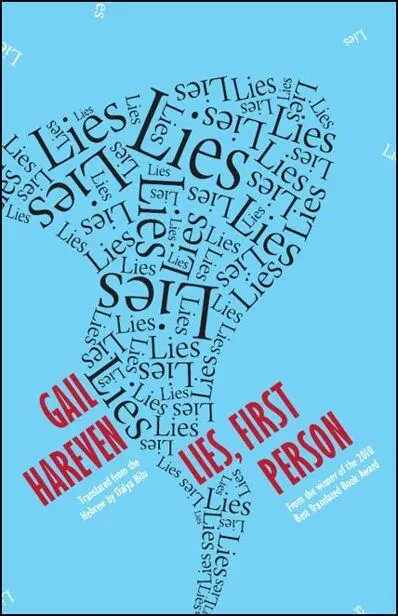
- Название:Lies, First Person
- Автор:
- Издательство:Open Letter
- Жанр:
- Год:2015
- ISBN:нет данных
- Рейтинг книги:3 / 5. Голосов: 1
-
Избранное:Добавить в избранное
- Отзывы:
-
Ваша оценка:
Lies, First Person: краткое содержание, описание и аннотация
Предлагаем к чтению аннотацию, описание, краткое содержание или предисловие (зависит от того, что написал сам автор книги «Lies, First Person»). Если вы не нашли необходимую информацию о книге — напишите в комментариях, мы постараемся отыскать её.
Elinor's comfortable life — popular newspaper column, stable marriage, well-adjusted kids — is totally upended when she finds out that her estranged uncle is coming to Jerusalem to give a speech asking forgiveness for his decades-old book,
.
A shocking novel that galvanized the Jewish diaspora,
was Aaron Gotthilf's attempt to understand — and explain — what it would have been like to be Hitler. As if that wasn't disturbing enough, while writing this controversial novel, Gotthilf stayed in Elinor's parent's house and sexually assaulted her "slow" sister.
In the time leading up to Gotthilf's visit, Elinor will relive the reprehensible events of that time so long ago, over and over, compulsively, while building up the courage — and plan — to avenge her sister in the most conclusive way possible: by murdering Gotthilf, her own personal Hilter.
Along the way to the inevitable confrontation, Gail Hareven uses an obsessive, circular writing style to raise questions about Elinor's mental state, which in turn makes the reader question the veracity of the supposed memoir that they're reading. Is it possible that Elinor is following in her uncle's writerly footpaths, using a first-person narrative to manipulate the reader into forgiving a horrific crime?
Lies, First Person — читать онлайн бесплатно полную книгу (весь текст) целиком
Ниже представлен текст книги, разбитый по страницам. Система сохранения места последней прочитанной страницы, позволяет с удобством читать онлайн бесплатно книгу «Lies, First Person», без необходимости каждый раз заново искать на чём Вы остановились. Поставьте закладку, и сможете в любой момент перейти на страницу, на которой закончили чтение.
Интервал:
Закладка:
“So you’re happy with your life,” I said. My voice sounded artificial and stiff, but my sister didn’t notice. “Happy? I’m blessed. I don’t know why God saw fit to bless me with so much happiness.”
— 3 -
Alittle house on the prairie, built of wood painted white, a chimney, and the triangular tower of an attic rising from its roof. Sheltered by luxuriant trees, with a squirrel trembling on a window sill and nibbling some orange vegetable. The kind of house children draw. And on the door a sign written in a childish hand: “Welcome Aunt Elinor and Uncle Oded.”
A giant bulldozer had flattened hundreds of kilometers in this part of the planet. But in the place where my sister lived, on the outskirts of a little town with a musical name, the vegetation fenced off the horizon, and even hid the neighboring houses.
When we arrived the Chevrolet was already parked in the yard. My brother-in-law waved to us from the kitchen window, and an ugly old mongrel dog lying on the porch stood up to wag its tail in our honor.
“This is Soda. She’s twenty-one years old,” said my sister, and as she opened the door she added: “Did you hear that Daddy and his girlfriend adopted a puppy?”
As soon as we entered the house we were caught up in the inevitable exchange: were we very hungry?
“Tonight we’re celebrating,” Barnett announced. “But in the meantime there’s lasagna for lunch. Should I make a salad as well? Will it be enough?” Were we cold? Would we like him to light a fire? What exactly were our sons doing in America? And how did they feel here? There were quite a few Israelis in Urbana, most of them connected to the university. A lot of Israelis did very well in the United States.
Oded talked about his work, and elaborated a little on the question of land ownership in Jerusalem and its political context: “The Holy City is a conflicted city.”
I talked about “Alice in the Holy City” and my sister, in response, clapped her hands excitedly like a baby penguin. “So Daddy was right,” she said. “Daddy always said that you would be a writer.”
It was only when we laid the table that I dared to remark, and against my will my voice came out stiff and flat again: “So I understand that you’re in touch with Shaya,” and this time my sister registered the tone, and reacted with a look of alarm.
“Sometimes by email. More often since Sarah was born. I know how angry you are with him, because of how he left me with you and everything. You were such a heroine, I know how awful it was for you. .” She fixed her eyes on her husband coming out of the kitchen and switched to English, and in the flood of English words coming out of her mouth everything sounded different.
In English her father was “a good man but weak, who never really recovered from all the sorrow he endured.” Her father was an old man now—“we should be forgiving toward the old,” my sister stated — and after Sarah was born, the old man wrote a really wonderful letter to them both, she’d been wanting to tell me about it for a long time. Among other things he wished Barnett that he would be a better father to his daughter than he himself had been to his daughters—“isn’t that touching?”—and also expressed his confidence that he would be. Grandpa also sent his granddaughter an antique music box in the shape of a merry-go-round, which was one of her favorite toys. When the little girl arrived she would show me.
“I haven’t forgotten,” my sister said when we sat down at the table. “I know what a terrible thing he did to you and to both of us, but Daddy was never a strong person, and after Mother died, he was simply unable to function. It was so sudden. Nobody took her sickness seriously, and until the ambulance arrived, none of her doctors really listened to her or believed her. And neither did Daddy. So he must have felt. .”
My sister’s eyes filled with tears; later on I discovered that whenever our mother was mentioned, her eyes welled up like this, and my brother-in-law reached out over his plate to take her hand. As they held hands, my husband’s leg moved under the table and lightly nudged my foot, but I withdrew my leg and looked down stubbornly at my lap. I felt enough, I felt too much, and my leg quickly drew back from an additional helping of feeling.
We were silent for a moment, not necessarily in embarrassment, and Barnett broke the silence by politely and rather shyly asking our permission to say a few words of prayer before we ate. With his hands clasped and his eyes closed my brother-in-law thanked God for the food before us, and went on to thank him “for bringing us Elinor and Oded who we always prayed to meet. May they take joy in us as we take joy in them. And may each of us find in this coming together what he wishes for and what he needs.”
After that we ate lasagna.
Believable things order themselves. Those that are beyond belief have to be described in an orderly fashion: We drove, we arrived, we spoke. She said to me. I replied. And I shall try to record things in order: the first day with my sister, the second day, the third day—
There was no third day with my sister. I stayed in her unbelievable world for only two days, and after we parted, things became disturbed and disordered in the extreme. Not things — everything became disturbed and disordered, but in the meantime there was order: order and sweetness, bright sweetness and order, and unbelievable goodness poured down abundantly on the white wooden house on the prairies of Illinois.
It seemed that my sister was eager to present me with the entire contents of her life in the brief time we spent together, and the afternoon of the first day was crammed with introductions, here’s a ginger tomcat and here’s a she cat. This iron pot Barnett inherited from his grandmother, feel how heavy it is. Here, in the back, is the entrance to the clinic. Barnett doesn’t actually spend much time there, he does most of his work on the farms. He bought those two peacocks last summer. He calls them his conceit. They’re beautiful, that’s true, but their screaming is really ghastly, and the worst of all is when they suddenly scream in the middle of the night. You’d think that such a beautiful bird would sing like a canary, but no. The Creator likes surprises.
If we go past the clump of trees over there, we’ll be able to see the stream. The water’s clean, in the summer Sarah swims in it with the dog, but now that Soda’s getting old she’s begun to develop an aversion to swimming. Perhaps they should get another dog for the child, take in a puppy like Daddy and Gemma did, but Barnett says that even though Soda’s very tolerant with the cats, another dog in the house is liable to make her jealous and embitter her old age.
•
The house is crammed full of photographs. Group portraits with gleaming teeth. Children stiff in suits. Children in swimsuits decorated with medals on ribbons. Sports teams, one row kneeling and two standing. The boy Barnett on a horse. The adult Barnett on a horse. Sarah on a horse. Barnett with the baby Sarah on a horse. My sister carrying a white tower of a cake.
Bright testimonies to happiness as happiness ought to be hung in the living room and the bedrooms and even on the wall of the clinic. And because of this overload of family happiness it was only in the evening that I noticed the photographs of our parents, standing side by side on a shelf over the fireplace. They were photographs that I knew: the young Shaya, in faded half-profile, emphasizing the jaw muscle and exposing the weak mouth, holding a sheet of music, and directing his gaze obliquely upward.
Erica, about half my age, looks as if she has dressed up as an actress from the thirties: eyebrows thin as a hair. Eyelids shining with Vaseline. Mouth darkly painted. A perfect complexion and an exhausted expression. A wreath of babies-breath flowers on her wavy hair.
Читать дальшеИнтервал:
Закладка:
Похожие книги на «Lies, First Person»
Представляем Вашему вниманию похожие книги на «Lies, First Person» списком для выбора. Мы отобрали схожую по названию и смыслу литературу в надежде предоставить читателям больше вариантов отыскать новые, интересные, ещё непрочитанные произведения.











Обсуждение, отзывы о книге «Lies, First Person» и просто собственные мнения читателей. Оставьте ваши комментарии, напишите, что Вы думаете о произведении, его смысле или главных героях. Укажите что конкретно понравилось, а что нет, и почему Вы так считаете.