Russell Banks - Continental Drift
Здесь есть возможность читать онлайн «Russell Banks - Continental Drift» весь текст электронной книги совершенно бесплатно (целиком полную версию без сокращений). В некоторых случаях можно слушать аудио, скачать через торрент в формате fb2 и присутствует краткое содержание. Год выпуска: 2007, Издательство: Harper Perennial Modern, Жанр: Современная проза, на английском языке. Описание произведения, (предисловие) а так же отзывы посетителей доступны на портале библиотеки ЛибКат.
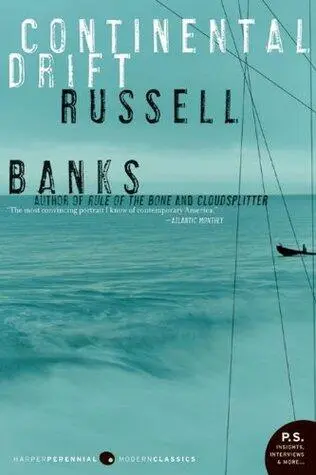
- Название:Continental Drift
- Автор:
- Издательство:Harper Perennial Modern
- Жанр:
- Год:2007
- ISBN:нет данных
- Рейтинг книги:4 / 5. Голосов: 1
-
Избранное:Добавить в избранное
- Отзывы:
-
Ваша оценка:
Continental Drift: краткое содержание, описание и аннотация
Предлагаем к чтению аннотацию, описание, краткое содержание или предисловие (зависит от того, что написал сам автор книги «Continental Drift»). Если вы не нашли необходимую информацию о книге — напишите в комментариях, мы постараемся отыскать её.
is a masterful novel of hope lost and gained, and a gripping, indelible story of fragile lives uprooted and transformed by injustice, disappointment, and the seductions and realities of the American dream.
Continental Drift — читать онлайн бесплатно полную книгу (весь текст) целиком
Ниже представлен текст книги, разбитый по страницам. Система сохранения места последней прочитанной страницы, позволяет с удобством читать онлайн бесплатно книгу «Continental Drift», без необходимости каждый раз заново искать на чём Вы остановились. Поставьте закладку, и сможете в любой момент перейти на страницу, на которой закончили чтение.
Интервал:
Закладка:
Wal, now. Who dis ? The man’s voice is low and comes rumbling from his chest, and he smiles with the expression of a man who has unexpectedly won a small prize. His two front teeth are rimmed in gold, his wide, full lips shiny like his scars.
Vanise and Claude examine the ground at their feet. The dog gnaws at the hambone, hurriedly now.
You Robbie’s woman?
Vanise knows he is speaking to her; she looks up and says nothing. The baby has awakened and turns uneasily in her arms.
C’mon, gal, talk to me. Where Robbie at? Him send you over here to say him sick again? Ras-clot, dat mon, me cyan deal wid him no more! Him s’posed to work dat patch by de salt flats, an’ me check him all day, an’ him never show once, lazy, simple sonofabitch. You tell him, sister, you tell him find himself another job. Me cyan deal wid him no more .
The man turns and swings open the screened door, stops and looks back at the woman. G’wan, now, nothin’ more to say. Go home, sister, and tell Robbie him fired.
Vanise stands there in silence, looking away from the man, waiting.
What your name, gal?
She says nothing, shifts her weight and looks down at her baby’s face. The man lets go of the screened door and takes a step toward her. For several seconds he studies the people before him, a young and pretty black woman with a baby in her arms, and a boy, and two baskets on the ground.
Suddenly, he smiles broadly. He knows everyone in town, practically everyone on the whole island, and he’s never seen this woman before, or the boy. He drives a taxi between the landing strip in Bottle Creek and the Whitby Hotel, and he moves around the island a lot, and these faces are new to him. They are strangers’ faces. You one of dem Haitians, dat’s what . Putting out his hand, he places it heavily on her narrow shoulder and says loudly into her face, Haytee? You from Hay-tee, gal ? He removes his paw from her shoulder and turns to Claude. Hay-tee? C’mon, bwoy, you can tell me. Me nagwan do you no harm, bwoy. Me a fren , he says, pointing to his beefy chest. Me like Hay-shuns! Sonofabitch, fucking Haitians, dem, dey cyan understan’ English, even. Then to Vanise, Hay-tee, gal?
She nods her head slowly up and down. Haiti.
Ah-ha ! The man flashes his gold-rimmed teeth. He swings open the screened door again and this time waves the woman into his house, but she stands rooted to the ground. Giving up, the man walks inside alone and returns a second later with a bottle of white overproof rum in his hand. He takes a long slug from the bottle, sighs as if relieved of a burden and sits down on the steps, looks back and forth from the boy to the woman. So, the man says to no one in particular, me kotched me a coupla Haitians . He takes another drink, extends the bottle to Vanise, who shakes her head no. You gotta name, gal? What dem call you ? he tries.
Silence. Claude, wide-eyed at the sight of the large, loud man, clings to the side of his basket with both hands. Vanise’s face is expressionless, impassive, as if she has turned herself into a stone.
The man points to his thick chest. Me George. George McKissick. George , he repeats, stabbing himself with his finger. All dem other Haitians, your frens, dem, dey got kotched already, got ’em dis mawnin’ near Bellefield Landing. Jus’ sittin’ on de beach, thinkin’ dem in America. Now dey in de jail over on Grand Turk. What you think o’ dat, gal? You lucky, dat’s what. Lucky.
Vanise listens closely, but nothing the man says makes sense. Now and then a word or string of words sounds familiar, but she loses the meaning instantly. She can read the man’s face, however, and his body and the tones of voice he uses, bass tones, not harsh, not sweet, either, but rising and falling in a low range, as if he were trying to tell her a funny story.
He’s playing with them, she knows, treating them like babies. And he likes to drink, drinks quickly and deeply with obvious pleasure and need. He lives alone: the house and yard are of a man alone; no signs of a woman or children here; no clothes drying on a rope, no toys scattered in the dirt, no curtains in the windows. Except for the yellow dog, no animals, either. The henhouse seems empty, and there are no chickens or roosters in the yard scratching and pecking in the dust. No pigs or goats. The man probably doesn’t even eat here much; he comes home to drink alone and sleep and go out again. His scars tell her what happens when he is out at night in the bars. Another man must tend his crops, she decides, because this man is too bulky to be a farmer, too quick and nervous in his movements. And he has a calculating look, the look of a man who likes to buy things low and sell them high, who likes to haggle with people, not with the ground, the rain and the sun. And despite his playfulness, she can tell that he is not a kind man.
George goes on talking to Vanise, almost as if she understands his words. He tells her about the other Haitians from the boat, how they’ll be kept in jail until they can be shipped back to Haiti, how stupid they were for trusting someone to bring them all the way to America in a boat small enough to get through the reef off North Caicos. The police are used to Haitians coming ashore here, and most of them get caught and sent right back. A few hide out, they’re good farmers and stonemasons and sometimes metalworkers, and they work cheap, because they’ll be turned over to the police if they don’t, same as up north in the Bahamas. The Haitians who got caught this morning, he points out, were not as smart as Vanise. They stayed bunched up like cattle at Bellefield Landing, where they were bound to be seen. They should have separated and run into the bush, as she did, where they might have been lucky enough to meet up with someone like George McKissick, who would be willing to help them. Instead, they’re in jail tonight, and she and her baby and little brother are here, with George McKissick, on his farm.
He goes silent for a few seconds, scratches his belly, swigs from the rum bottle, stands and takes up the white enameled cup from in front of the dog. He fills it from the barrel and drinks. Refilling the cup, he passes it to Vanise, and she drinks, hands it back. Then the boy. George sets the cup afloat in the rain barrel and studies it for a moment.
He’s decided not to turn them in to the police, he announces. At least not tonight. He smiles, faces them and goes inside.
The sun has edged close to the horizon beyond the field, and the sky is splashed with long, broad, plum- and silver-colored streaks of cloud moving in from the east. The sea breeze has shifted and become a land breeze, bringing with it the smell of cassia trees and heat-dried corn stalks from the meadow in front of the low house.
What’s he going to do? Claude asks.
Vanise looks over her shoulder at the yellow dog, who lifts his pointed head and stares at them a second, then resumes working at the hambone. Don’t worry, Vanise says to the boy.
A moment later, George kicks open the screened door and comes out carrying a small, stained mattress. He motions with his burly head for them to follow and hurries across the yard past the dog to the shed. Hefting the mattress onto one shoulder, he unlocks a rusty padlock on the low door and yanks it open. Then he tosses the mattress inside. He stands away and points into the darkness and says, Dere, gal, nobody gwan fine you dere. Put you in de house, but someone soon come an’ fine you, turn you in first chance.
Vanise leans forward and peers into the darkness and heat of the hut. She smells chickens of long ago, the remnants of dried, powdered droppings ground into the dirt floor, old feathers and tufts, bits of grass and seeds, yellow hulls of ancient corn in corners, dust motes floating in the air.
Читать дальшеИнтервал:
Закладка:
Похожие книги на «Continental Drift»
Представляем Вашему вниманию похожие книги на «Continental Drift» списком для выбора. Мы отобрали схожую по названию и смыслу литературу в надежде предоставить читателям больше вариантов отыскать новые, интересные, ещё непрочитанные произведения.











Обсуждение, отзывы о книге «Continental Drift» и просто собственные мнения читателей. Оставьте ваши комментарии, напишите, что Вы думаете о произведении, его смысле или главных героях. Укажите что конкретно понравилось, а что нет, и почему Вы так считаете.