Russell Banks - Continental Drift
Здесь есть возможность читать онлайн «Russell Banks - Continental Drift» весь текст электронной книги совершенно бесплатно (целиком полную версию без сокращений). В некоторых случаях можно слушать аудио, скачать через торрент в формате fb2 и присутствует краткое содержание. Год выпуска: 2007, Издательство: Harper Perennial Modern, Жанр: Современная проза, на английском языке. Описание произведения, (предисловие) а так же отзывы посетителей доступны на портале библиотеки ЛибКат.
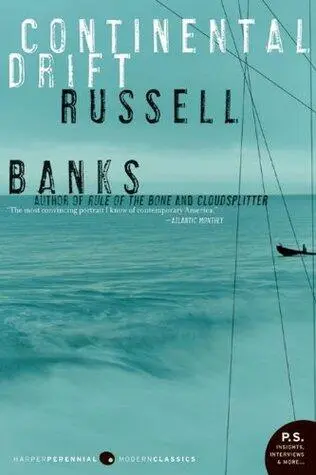
- Название:Continental Drift
- Автор:
- Издательство:Harper Perennial Modern
- Жанр:
- Год:2007
- ISBN:нет данных
- Рейтинг книги:4 / 5. Голосов: 1
-
Избранное:Добавить в избранное
- Отзывы:
-
Ваша оценка:
Continental Drift: краткое содержание, описание и аннотация
Предлагаем к чтению аннотацию, описание, краткое содержание или предисловие (зависит от того, что написал сам автор книги «Continental Drift»). Если вы не нашли необходимую информацию о книге — напишите в комментариях, мы постараемся отыскать её.
is a masterful novel of hope lost and gained, and a gripping, indelible story of fragile lives uprooted and transformed by injustice, disappointment, and the seductions and realities of the American dream.
Continental Drift — читать онлайн бесплатно полную книгу (весь текст) целиком
Ниже представлен текст книги, разбитый по страницам. Система сохранения места последней прочитанной страницы, позволяет с удобством читать онлайн бесплатно книгу «Continental Drift», без необходимости каждый раз заново искать на чём Вы остановились. Поставьте закладку, и сможете в любой момент перейти на страницу, на которой закончили чтение.
Интервал:
Закладка:
pou’ les morts ‘bandonné nan gran bois,
pou’ les morts ‘bandonné nan gran dlo,
pou’ les morts ‘bandonné nan gran plaine,
pou’ les morts tué pa’ couteau,
pou’ les morts tué pa’ épée,
pou’ tou les morts, au nom de Mait’ Carrefour et de Legba;
pou’ tou generation paternelle et maternelle,
ancêtre et ancètere, Afrique et Afrique;
au nom de Mait’ Carrefour, Legba, Baltaza, Miroi….
Then, suddenly, they are through. The reef and the white crashing waves are behind them, and before them lies the land, extended like a dark wall beneath velvet sky, with a white seam of beach between the water and the low palmettos. A rickety pier reaches like a bony arm from the beach, with a clearing in the trees beyond and what looks like a sandy road or lane leading inland.
The captain cuts quickly from the reef across the bay and brings the boat around and against the pier. He shuts down the motor, and the mate leaps from the boat and swiftly ties the bow and then the stern to the pilings.
Be quick! Be quick! he says, and the people scramble from the boat, lugging suitcases and baskets, shoving one another to get free of the boat. Quickly! the mate repeats. Already he is untying the line at the stern.
Suddenly, with one arm curling her baby against her breast, Vanise steps away from the group of refugees and touches the mate on his naked shoulder.
Eh? What do you want?
With her chin, she points toward the shore and the bush beyond. This, she says, This is not Miami.
He’s silent for a second. Over there, he says at last, pointing east along the beach. Then he runs forward to untie the bow of the boat. They’re ready to depart. The captain races the engine impatiently.
But Vanise has pursued the mate, and when he stands to leap aboard the boat, she grabs his wrist and yanks him back. Where is the man to help us? she demands. Where?
Soon! Let go of me! he shouts. Then, suddenly, his voice changes, goes soft, and looking way down at her, he says, Don’t worry, miss. Miami’s not far. We land you here to avoid the American police. It’s not so easy now as it used to be. Just don’t be afraid.
She releases him, and he takes one long stride and is aboard the boat. The captain guns the motor, the propeller churns a foamy wake behind it, and the boat wallows a moment and pulls rapidly away from the pier. Vanise watches the small, dark boat cross in a straight line the silky waters of the bay and slow briefly before the low white ridge marking the reef, where it picks its way through, and is gone.
Then, slowly, in silence, the people walk one by one down the narrow length of the pier toward land, step to the hard-packed beach and begin their wait. Some lie down on the witchgrass and watch the sky, star-pocked, circle overhead, some stroll slowly up the beach a ways and talk in low, nervous voices to one another, some sit on the pier and dangle their legs over the edge. Vanise and her baby and the boy, Claude, walk to the end of the pier and look out to the sea, to where the boat has gone, back to Haiti.
This is not America, she says in a low, cold voice. The boy places the basket down, and Vanise sits on it, opens her blouse and starts nursing her baby.
Are we lost! the boy asks, his voice about to break.
No! she answers. Then, more softly. No. But this is not America. Vanise, landed, dropped off, abandoned on the north coast of North Caicos Island, a nearly empty, flat, impoverished island six hundred miles from where she’d expected to land — what’s one to say to her now? Sit down, Vanise, be rational and find out where you really are, Vanise, and then find out where America really is, and then Haiti, Le Mole, Allanche, your sister-in-law’s hurricane-battered cabin up on the ridge. Get it all in perspective.
No, Vanise, don’t. Don’t find out where you really are. That will only make you believe that you are indeed lost. To the boy’s frightened question, Are we lost? you would have to say, Yes, Claude, lost.
To be lost is not to be able to return or go on, for the world is not lost, you are. It’s the fear behind the old joke told by parents about their child, who, they say, got lost, and when they found her the child calmly said. No, I wasn’t lost, you were. And the parents chuckle gratefully, knowing that if the child had not believed that she would have fallen into terror.
In one sense, Vanise knows where she is. She just doesn’t know where America is. She’s standing on a hard white beach at high tide in the Caribbean. The wind blows from the east. Immediately before her is a lane that winds into the low bush, and when she walks along the lane, she discovers that it connects to a marlpaved road, chalky white, now that the moon has risen. As she walks, her map gets extended ahead of her to the horizon, which keeps receding in the distance. Her map is a living, coiling and uncoiling thing, moving in undulant waves before her the way a manta ray sweeps the bottom of the sea. Her map is a process, the kind of map you must keep moving into, if you want to read it.
By dawn, Vanise and her infant and the boy are within sight of the inland village of Kew. Though they do not know the name of the place yet, they do know that this is still not America. There are goats here, tethered in the gutters alongside the road, and roosters crowing, and tin-roofed cabins the same as in Allanche, set off the road a ways, with tiny outhouses and laundry lines in back, patchy vegetable gardens, pole beans, yams, spindly corn stalks. A scrawny brown dog yips at them as they pass, and Vanise hurries the boy along ahead of her, looking back over her shoulder.
What are we going to do? Claude asks his aunt. Where are we?
Don’t worry! she snaps. We’ll find out soon what we’re to do. She clicks her tongue against the roof of her mouth, as if to scold the boy.
The sky is turning pearly white, like the belly of a fish, and the palm fronds, the glittery leaves of nmhoe trees and the pebbled sides of cabins stand sharply forward from the shadows. It’s a familiar light to Vanise,’falling at the same crisp angles with the same clear intensity as at this hour and season in Haiti. But the soil is different, pale gray here instead of blood red, and the houses seem more scattered, less clustered against one another, with narrow, unpaved roads instead of footpaths leading from one house to another.
The roosters arch their short backs and cut the still air with harsh calls from the edge of town down to the square in the middle and back out to the opposite side, and soon the dry, clean smell of new woodsmoke reaches Vanise and the boy, and they realize at once that they are hungry.
The boy speaks of it first. Should we stop to eat? he asks. We have the ham. And the yams, he reminds her, and the rose apples and guavas they picked on the walk from Allanche to Le Mô1e — when was it? Only yesterday morning? Is the last dawn they saw yesterday’s, and that on Haiti? Has it all happened so quickly? How did they move so soon from a known world to an unknown one, and why aren’t they more frightened than they are? The boy cannot understand this. He can ask the questions, but he cannot answer them, and that frightens him more than any answers might. He feels like a boy in a dream, not quite responsible for his actions. If something appears in the dream that can kill him, he knows he will just fly up and over it.
At the center of the town there is a crossroads and a low wall encircling a Cottonwood tree. Here Vanise stops and sits. The boy stands before her, looking around him at the four roads that seem to come from above to this low place in the middle, there to cross and rise up on the opposite side. A half-dozen houses, mostly un-painted masonry buildings tacked onto smaller, older, daub-and-wattle cabins, face the several roads, with overgrown yards in front and here and there an old American car, dented and rusting, parked beside the house. Doors open now and then, and a person, usually a child, appears, runs to the outhouse and returns slowly, languidly, walking barefoot across wet grass, opens the door and disappears into the warm darkness inside. Little girls in short cotton smocks march out and back, little boys in white saggy underpants, lean shirtless men wearing jeans or gym shorts, fat women in sleeveless, baglike dresses.
Читать дальшеИнтервал:
Закладка:
Похожие книги на «Continental Drift»
Представляем Вашему вниманию похожие книги на «Continental Drift» списком для выбора. Мы отобрали схожую по названию и смыслу литературу в надежде предоставить читателям больше вариантов отыскать новые, интересные, ещё непрочитанные произведения.




Обсуждение, отзывы о книге «Continental Drift» и просто собственные мнения читателей. Оставьте ваши комментарии, напишите, что Вы думаете о произведении, его смысле или главных героях. Укажите что конкретно понравилось, а что нет, и почему Вы так считаете.