Russell Banks - Continental Drift
Здесь есть возможность читать онлайн «Russell Banks - Continental Drift» весь текст электронной книги совершенно бесплатно (целиком полную версию без сокращений). В некоторых случаях можно слушать аудио, скачать через торрент в формате fb2 и присутствует краткое содержание. Год выпуска: 2007, Издательство: Harper Perennial Modern, Жанр: Современная проза, на английском языке. Описание произведения, (предисловие) а так же отзывы посетителей доступны на портале библиотеки ЛибКат.
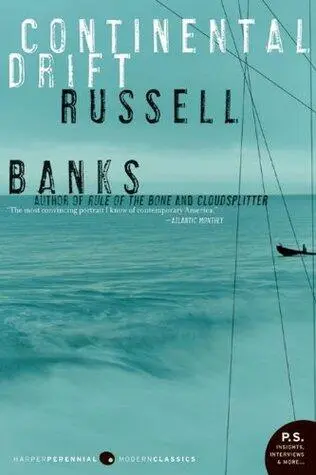
- Название:Continental Drift
- Автор:
- Издательство:Harper Perennial Modern
- Жанр:
- Год:2007
- ISBN:нет данных
- Рейтинг книги:4 / 5. Голосов: 1
-
Избранное:Добавить в избранное
- Отзывы:
-
Ваша оценка:
Continental Drift: краткое содержание, описание и аннотация
Предлагаем к чтению аннотацию, описание, краткое содержание или предисловие (зависит от того, что написал сам автор книги «Continental Drift»). Если вы не нашли необходимую информацию о книге — напишите в комментариях, мы постараемся отыскать её.
is a masterful novel of hope lost and gained, and a gripping, indelible story of fragile lives uprooted and transformed by injustice, disappointment, and the seductions and realities of the American dream.
Continental Drift — читать онлайн бесплатно полную книгу (весь текст) целиком
Ниже представлен текст книги, разбитый по страницам. Система сохранения места последней прочитанной страницы, позволяет с удобством читать онлайн бесплатно книгу «Continental Drift», без необходимости каждый раз заново искать на чём Вы остановились. Поставьте закладку, и сможете в любой момент перейти на страницу, на которой закончили чтение.
Интервал:
Закладка:
It’s as if no one sees the young Haitian woman in the red headscarf and blue-gray skirt and blouse, her baby in her arms, and the boy, a lad slightly taller than she, wearing a short-sleeved white shirt and dark pants and black sneakers. Their baskets lie at their feet next to the low marl wall, and while the woman sits on the wall and nurses her infant, the boy gropes through the baskets in search of breakfast — fruit, a pair of egg-shaped, pale green jambosien and a pair of lemony goyaoiers. It’s almost as if the strangers are invisible in this tiny town, for though no one stepping from his door could fail to see them at the crossroads in the milky dawn light beneath the tall cottonwood tree, no one calls them or even hails them with a tentatively raised hand.
Vanise and Claude hear them call and hail one another, however: Tyrone, you fetch me wood now, bwoy, or me beat you! And: Get dat dog from out de house! G’wan now, get ’im from de house, y’ hear? There’s a familiar enough roll to the words, the grumpy, early-morning sounds they themselves make back in Allanche, but Vanise and Claude can’t understand the words. It’s garble to them, as if the people are speaking backwards. The boy’s eyes open wide in wonder, and Vanise cocks her head, listens more closely. She hears music from a radio, not Haitian music, certainly, and nothing like it, either, not calypso or reggae or salsa. It’s a twangy, slow music, and though thinned by the cheap transistor radio inside the cabin, it’s unmistakably American country and western music. They’ve heard that sound before, now and then, from the radio and on records brought back on holidays from Port-au-Prince by cousins returning to the country intent on impressing those who refused or weren’t able to move to the city.
The boy says, Maybe this is America. Only not Miami, that’s all. Miami’s probably someplace near here, that’s all.
Vanise looks at him with scorn. America doesn’t look like this, she says in a low voice, almost a whisper.
But where are we, then?
Vanise shoves her face close to the boy’s and hisses. We’re in the center of a village, at a crossroads, and we’re eating our breakfast there! Anybody can see that. You can see that. She’s not angry at the boy, but she sends her words to him as if they had been heated and cast into cold water. Give me the jambosier , she says.
He passes her the fruit, and she tears off a fleshy chunk with her teeth. The baby, finished sucking at her breast, has fallen asleep and lolls back against her shoulder. Holding the rose apple with her teeth, Vanise buttons her blouse quickly and resumes eating. She hadn’t realized how hungry she had become, with all the excitement — first the fear of the boat ride and the sea, then the joy at the sight of land, and then the disappointment and anger, and now the complex fight to stave off being lost — and she’s almost startled by the intensity of her own hunger and the pleasure she takes from satisfying it. The boy, too, eats ravenously and with sudden joy.
When they have finished the fruit, the boy decides to risk another question. What are we going to do, Vanise? He wipes his mouth with the back of his hand and studies the door of the house across the road from them.
We shall wait. She says it firmly, as if waiting were an action, like hiding or running away or building a house. She passes the boy the sleeping baby, which he holds expertly in the crook of his skinny arm, and she breaks off a leafless branch of the tree behind them, squats in the dust and begins to draw. As she draws, she prays in a broken way that she knows is amateurish and incomplete, but it’s all she can remember from her sister-in-law’s teaching. She knows the names of the cardinal points, and she addresses them properly: to the east, À Table ; to the west, Dabord ; in the north, Olande ; and in the south, Adonai . She draws a long horizontal line from east to west in the dust, then two verticals, one long and one short, that cut the horizontal into three parts. She crosses herself, and while she draws elaborations and curls, circles and lines around the crossbars, she salutes the two trinities, first the Christian God, his son Jesus and the Holy Ghost, then les Mystères , les Morts , and la Marassa , the sacred twins.
Standing, she crosses her arms and examines the drawing at her feet, a vever for Papa Legba. Now, she says, we wait.
The boy relaxes and sits down on the low wall, the baby still in his arms. He’s no longer afraid. He did not know that his Aunt Vanise possessed so much rada knowledge, that she was a mambo , or he would not have been frightened before, when he did not know where they were. They will wait now, here at the crossroads under the sacred cottonwood tree, for old Papa Legba to help them.
The sun rises above the trees, and soon the day is dry and hot. A car rumbles down the lane to the crossroads and slows as it passes; the driver, a skinny black man wearing a painter’s cap, does not seem to notice them. A few minutes later, a boy on a red Honda putts by, changing gears and gunning his motor at the intersection, spinning his rear wheel as he turns to the left and heads up the rise and over it out of sight. Soon schoolchildren emerge from the houses and from the woods on narrow pathways. They are dressed in white and blue uniforms and carry books and papers under their arms and in satchels. Behind them, on the far side of the crossroads, a store has opened to the street, and several of the children stop there in the shade for box milk or Coke. They ignore Vanise and Claude and the baby as they pass, but look back at the trio when they have got behind them.
At the tops of breadfruit trees and utility poles, turkey buzzards perch and show their backs and stretch dew-wet wings to the sun. Doves coo in the crackling underbrush, and long-legged egrets stalk the marshes and gutters and now and then rise awkwardly from the moist ground and soar, suddenly graceful, against the cloudless blue sky. The sun moves slowly higher in the sky, and the shadow of the cottonwood tree in the center of the village of Kew shrinks until it is no larger than the circumference of the tree itself, a blot on the dusty gray round. Vanise and the boy are thirsty now, and the boy, Claude, finally, after thinking about it for close to an hour, asks his aunt if he can try to buy a Coca-Cola at the store behind them.
No, she says. We must wait for Papa Legba. We cannot leave. Besides, we have no more money. She reaches down and plucks from the ground next to the vever a smooth round pebble she has suddenly spotted there, as if it were a new plant that broke through the ground a second before. There, she says, passing the pebble to the boy, who puts it into his dry mouth. You see, Old Bones is looking after us.
The lad smiles and sucks contentedly on the stone. After a moment, he, too, reaches to the ground and retrieves a smooth pebble, which, with a broad, understanding smile, he gives to his aunt.
The hours pass, and as the afternoon comes on and the day begins to cool slightly, women and older girls emerge from the darkness of their houses and stroll down the road past the cottonwood tree to the store, to the butcher over the low rise beyond, to their neighbors’ houses. All of them ignore the strangers, the boy and the woman and her baby. They see them, of course, but this is a shy, careful people, a patient people as well, not like Jamaicans or Bahamians, not like Cubans, either, all of whom would have accosted the strangers by now and demanded to know why they were sitting in the center of their town, where did they come from, what do they want here.
It’s nearly four in the afternoon when a yellow, three-legged dog steps with precise delicacy from the brush at the top of the rise in the road facing Vanise and Claude, looks toward them, turns and approaches them at a lopsided trot. Vanise saw the dog the instant it emerged from the trees and recognized him at once.
Читать дальшеИнтервал:
Закладка:
Похожие книги на «Continental Drift»
Представляем Вашему вниманию похожие книги на «Continental Drift» списком для выбора. Мы отобрали схожую по названию и смыслу литературу в надежде предоставить читателям больше вариантов отыскать новые, интересные, ещё непрочитанные произведения.





Обсуждение, отзывы о книге «Continental Drift» и просто собственные мнения читателей. Оставьте ваши комментарии, напишите, что Вы думаете о произведении, его смысле или главных героях. Укажите что конкретно понравилось, а что нет, и почему Вы так считаете.