Russell Banks - Continental Drift
Здесь есть возможность читать онлайн «Russell Banks - Continental Drift» весь текст электронной книги совершенно бесплатно (целиком полную версию без сокращений). В некоторых случаях можно слушать аудио, скачать через торрент в формате fb2 и присутствует краткое содержание. Год выпуска: 2007, Издательство: Harper Perennial Modern, Жанр: Современная проза, на английском языке. Описание произведения, (предисловие) а так же отзывы посетителей доступны на портале библиотеки ЛибКат.
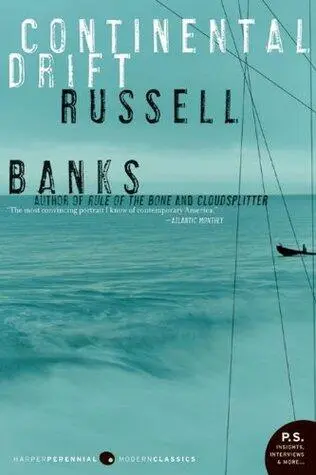
- Название:Continental Drift
- Автор:
- Издательство:Harper Perennial Modern
- Жанр:
- Год:2007
- ISBN:нет данных
- Рейтинг книги:4 / 5. Голосов: 1
-
Избранное:Добавить в избранное
- Отзывы:
-
Ваша оценка:
Continental Drift: краткое содержание, описание и аннотация
Предлагаем к чтению аннотацию, описание, краткое содержание или предисловие (зависит от того, что написал сам автор книги «Continental Drift»). Если вы не нашли необходимую информацию о книге — напишите в комментариях, мы постараемся отыскать её.
is a masterful novel of hope lost and gained, and a gripping, indelible story of fragile lives uprooted and transformed by injustice, disappointment, and the seductions and realities of the American dream.
Continental Drift — читать онлайн бесплатно полную книгу (весь текст) целиком
Ниже представлен текст книги, разбитый по страницам. Система сохранения места последней прочитанной страницы, позволяет с удобством читать онлайн бесплатно книгу «Continental Drift», без необходимости каждый раз заново искать на чём Вы остановились. Поставьте закладку, и сможете в любой момент перейти на страницу, на которой закончили чтение.
Интервал:
Закладка:
“Oh, damn, I’m really sorry,” Bob says. “That’s okay, he can take all the time he needs. Tell him … Hey, George,” he calls, and he walks around the woman and comes up behind the old man, putting an arm around his sagging shoulders. “Hey, listen, George, I’m awful sorry about your brother.”
George turns his face up to Bob’s. “Thank you, Mistah Bob.”
“No problem. About your job, I mean. We need you, sure, but we can get along for a week or so without you. You just go on up there to Georgia and … just do whatever you have to do, George.”
“I will. You is the one man in the worl’ can understand,” George says. “’Cause of you an’ your brother Mistah Eddie.”
“Right, you’re right. I do know how you must feel, George, so you just take off as much time as you feel you need, and when you come back to work, why, you just show up here at the store, and your job’ll be waiting for you.” Bob gives the old man’s narrow, slumped shoulders a hearty hug.
“Thank you, Mister Dubois,” the woman says. “Come on now, Daddy, we best be going now.” Taking the old man by an elbow, she leads him toward the car.
“Are you driving up to Georgia?” Bob asks.
“Yes.”
“Well … drive carefully, then.”
“Thank you, I will.” She leads her father around to the passenger’s side and opens the door for him.
Bob takes a few steps toward them. “That your car?”
She looks up. “Yes.”
“Nice car. V-eight or six?”
“It’s a V-eight.”
“Burns a lot of gas, I bet.”
She smiles and opens the door on the driver’s side. Then, without answering him, she slides into the car and closes the door.
Standing in the middle of the parking lot, Bob watches the woman and her father leave, turn left at the highway and head north. And though it’s not the first time since leaving New Hampshire that he’s thought of Doris Cleeve, it’s the first time he’s missed her.
4
What kind of man is Bob Dubois, who, although married, keeps for himself the secret privilege of sleeping with women other than his wife? A more sophisticated man than Bob would instantly recognize the lie, and if the lie persisted, if it refused to get itself corrected, would name it a symptom, and before too long, the marriage might be dissolved. But for men like Bob Dubois, it’s different.
For Bob, the facts are these: he loves his wife; he loves other women too, but not as much as he loves his wife; if he betrays his wife by sleeping with other women, and she does not discover it, then he has not been cruel to her. And, naturally, he does not want to be cruel to her, for, as said, he loves his wife. Also, he knows that the facts are the same for her, that if she sleeps with other men and he does not discover it, so long as she loves him as deeply as he loves her, then she has not been cruel to him. And he knows she does not want to be cruel to him. Of course, everything changes if he discovers it. As with Ave.
It’s a very painful and delicate balance, and one cannot be neurotic and hold it, because it depends for its sustenance on a willingness to endure mutual suspicion, jealousy, watchfulness and now and then a deliberate averting of one’s gaze when one’s mate has been careless with evidence of transgression. It might be said that acceptance of these facts is immoral or, at best, self-destructive, but it’s better said that acceptance of these facts indicates a mature realism, especially among people for whom the continuation of marriage has a higher priority in life than establishing one’s personal integrity, higher even than believing in the personal integrity of one’s mate, and higher, too, than the utter luxury of making public a private truth. Privacy, the secret knowledge of oneself, is, for the poor and the ignorant, that is, for most of the people in this world, what publicity often is for the rich and the educated. It’s their best available way to keep their lives from disappearing into meaninglessness.
For this reason, even though his wife has recently learned that she is pregnant with their third child, Bob does not feel particularly guilty or even secretive, but merely private, when, in the presence of Marguerite Dill, he imagines and longs to be making love to her and says and does everything he can think of to make that possible.
He learned of Elaine’s pregnancy before George Dill returned from his brother’s funeral in Macon, and for a few days he forgot about the man’s lovely daughter and spent his hours at the store lost in fantasies focused on the future exploits of his son, for he knew the child would be a son. He had never heard of a man fathering two daughters and then a third, though he knew, of course, that it sometimes happens, the way any kind of bad luck sometimes happens. But when it has never happened to someone you know personally, you have difficulty believing it will happen to you. Thus, until the day George returned, accompanied by his daughter, Bob used his long, boring hours at the store to imagine his life with a son. And though his imaginings were common and sentimental — his son fishing from the bow of the boat, his son playing baseball, hockey and basketball, his son winning the spelling bee — many of the details through which he visualized these scenes were sufficiently vivid and personal for him to remember details and episodes from his own childhood that he had forgotten.
He caught glimpses of himself as someone else, as perhaps his own father might have seen him. He saw his hair, at first wavy and blond and then, by the time he started school, straight and chestnut brown, like Ruthie’s. He saw the fear and sheer envy in his blue eyes of his father’s great, iron-hard size, the wonder of it, his awestruck gaze when, at his father’s urging, he punched the man in the tightened belly with all his force, and the man went on laughing until the boy hurt his hand and had to stop, which only made the man laugh all the harder. And he saw the terrible tremble of his lips when his father told him that to teach him to swim he and Uncle Richard were going to toss him from the dock into the lake, which they did, and indeed he did learn to swim that day, gasping and spitting water, slashing at it as if it were a beast, until he got his body close enough to the shore to feel the pebbly bottom against his feet. And then he saw his bizarre grin as he scrambled back to the dock and full speed ran its length, his skinny arms pinwheeling, and threw his body into the water himself, over and over again, slashing his way back to shore, rushing to the dock and racing to the end of it and tossing himself into the water, until finally the men stopped laughing at him and walked back to the women at the picnic table in the pine grove. And gradually Bob began to see his unborn son as he had never seen himself, for he saw the boy as pretty and frightened and sad. This confused him somewhat, muddled his fantasies, because he did not know what he should do to keep his son from being like that, from being like him, pretty and frightened and sad. Bob knew his own father had loved him and that he had been a kind, gentle, good-humored man, and with his son, Bob would have no choice but to try to be the same man his father had been with him. Any other kind of man, any other kind of father, was unimaginable to him.
The morning George Dill returns to work, he comes accompanied by his daughter. Bob has already opened the store and is sweeping the floor with a push broom, when he looks up and sees the tomato red Plymouth drive into the lot, Marguerite at the wheel. Her father, wearing his usual blue cap, white short-sleeved shirt and khaki trousers, looks small and fragile next to the woman, as if he were her child and she were driving him to school. Bob quickly puts the broom behind the stockroom door and walks to the cash register, pulls out his pen and order book and bends over the book, dropping deeply into the intricacies of the retail liquor business.
Читать дальшеИнтервал:
Закладка:
Похожие книги на «Continental Drift»
Представляем Вашему вниманию похожие книги на «Continental Drift» списком для выбора. Мы отобрали схожую по названию и смыслу литературу в надежде предоставить читателям больше вариантов отыскать новые, интересные, ещё непрочитанные произведения.









Обсуждение, отзывы о книге «Continental Drift» и просто собственные мнения читателей. Оставьте ваши комментарии, напишите, что Вы думаете о произведении, его смысле или главных героях. Укажите что конкретно понравилось, а что нет, и почему Вы так считаете.