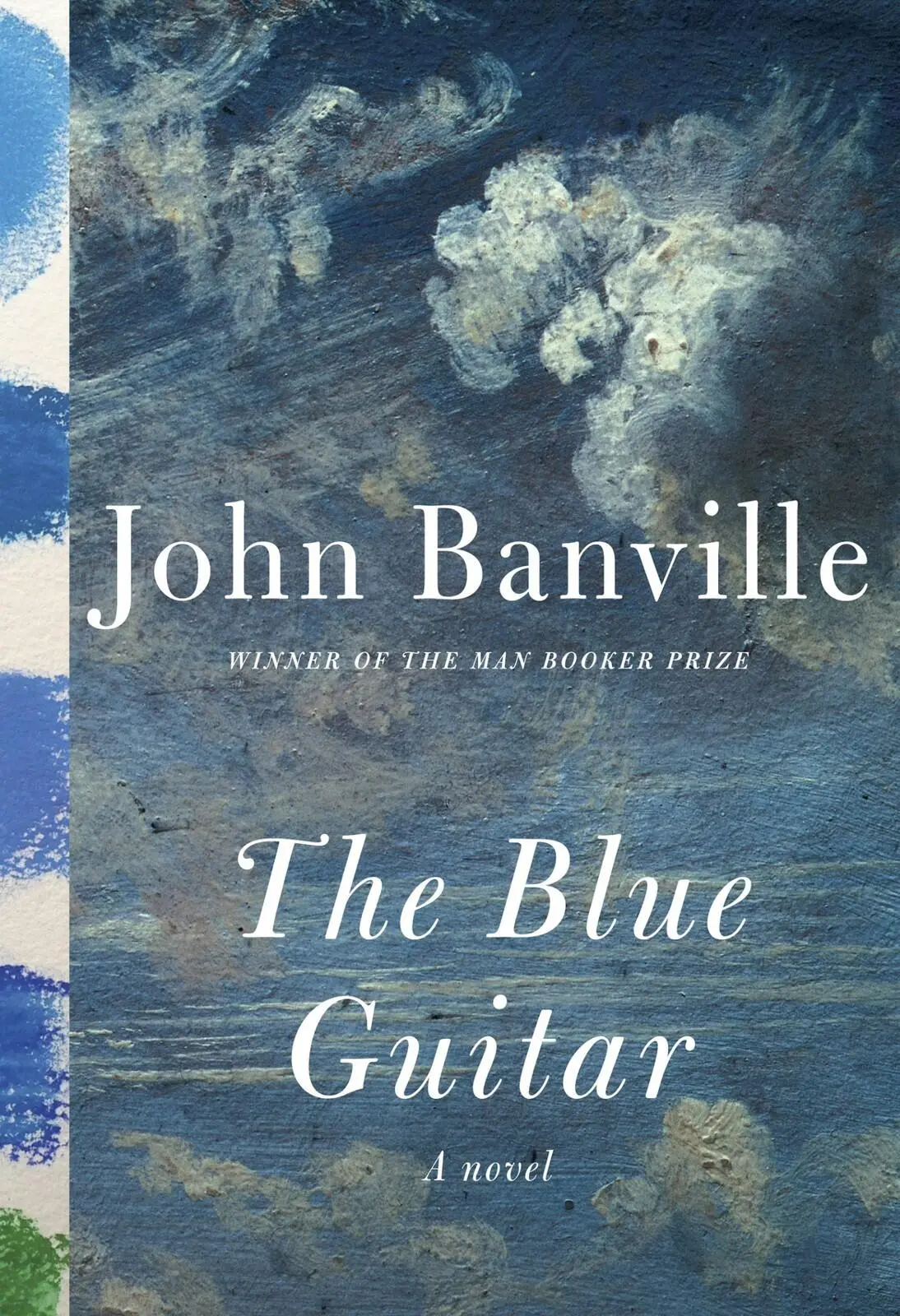
John Banville - The Blue Guitar
Здесь есть возможность читать онлайн «John Banville - The Blue Guitar» весь текст электронной книги совершенно бесплатно (целиком полную версию без сокращений). В некоторых случаях можно слушать аудио, скачать через торрент в формате fb2 и присутствует краткое содержание. Год выпуска: 2015, Издательство: Knopf, Жанр: Современная проза, на английском языке. Описание произведения, (предисловие) а так же отзывы посетителей доступны на портале библиотеки ЛибКат.
- Название:The Blue Guitar
- Автор:
- Издательство:Knopf
- Жанр:
- Год:2015
- ISBN:нет данных
- Рейтинг книги:4 / 5. Голосов: 1
-
Избранное:Добавить в избранное
- Отзывы:
-
Ваша оценка:
The Blue Guitar: краткое содержание, описание и аннотация
Предлагаем к чтению аннотацию, описание, краткое содержание или предисловие (зависит от того, что написал сам автор книги «The Blue Guitar»). Если вы не нашли необходимую информацию о книге — напишите в комментариях, мы постараемся отыскать её.
and
a new novel-at once trenchant, witty, and shattering-about the intricacies of artistic creation and theft, and about the ways in which we learn to possess one another, and to hold on to ourselves. Equally self-aggrandizing and self-deprecating, our narrator, Oliver Otway Orme, is a painter of some renown, and a petty thief who does not steal for profit and has never before been caught. But he's pushing fifty, feels like a hundred, and things have not been going so well lately. Having recognized the "man-killing crevasse" that exists between what he sees and any representation he might make of it-any attempt to make what he sees his own-he's stopped painting. And his last purloined possession-aquired the last time he felt the "secret shiver of bliss" in thievery-has been discovered. The fact that it was the wife of the man who was, perhaps, his best friend, has compelled him to run away: from his mistress, his home, his wife, from whatever remains of his impulse to paint and from the tragedy that haunts him, and to sequester himself in the house where he was born, trying to uncover in himself the answer to how and why things have turned out as they did. Excavating memories of family, of places he's called home, and of the way he has apprehended the world around him ("no matter what else is going on, one of my eyes is always swivelling towards the world beyond"), Ollie reveals the very essence of a man who, in some way, has always been waiting to be rescued from himself.
The Blue Guitar — читать онлайн бесплатно полную книгу (весь текст) целиком
Ниже представлен текст книги, разбитый по страницам. Система сохранения места последней прочитанной страницы, позволяет с удобством читать онлайн бесплатно книгу «The Blue Guitar», без необходимости каждый раз заново искать на чём Вы остановились. Поставьте закладку, и сможете в любой момент перейти на страницу, на которой закончили чтение.
Интервал:
Закладка:
The tiny house is made tinier still by Olive’s great height. She’s much taller than I am, though that’s not a hard thing to be, and moves at a slow stoop, looming in doorways or at the foot of the stairs with her head thrust out and her bowed arms dangling behind her, so that her progress seems a permanent state of incipient toppling over. Of the four of us she is the one who most resembles my father, and as the years go on and her few womanly lines become ever less pronounced the likeness grows more and more marked. Her nickname in school, of course, was Olive Oyl. What an emblematic contrast we must have looked, she and I, back then: sceptre and orb, wishbone and drumstick, whip handle and little fat top. In her young days she had a reputation for outrageousness and rebellion — she wore a jacket and tie, like a man, and for a while even smoked a pipe — but in time all that became mere eccentricity. The town has many Olives, of all genders and varieties.
“Well well, if it isn’t the genius of the family,” she said. Answering my knock she had put her head around the front door cautiously and peered at me out of my mother’s — mine, too — large, blue and, in Olive, incongruously lovely eyes. She wore an apron over a brown cardigan; her skirt was hitched crookedly on the two knobs of her hip-bones. Someone should introduce her to Polly’s mother, they would make a matching pair, like Miss Vandeleur’s porcelain beauties, only in reverse. “What brings you down among the common folk?” She always had a sharp tongue, our Olive. “Come through,” she said, walking ahead along the hall and flapping a hand the size of a paddle behind her to beckon me on. She chuckled phlegmily. “Dodo will be delighted to see you.”
The house inside was redolent of fresh-cut wood and varnish. My sister’s latest hobby, as it would turn out, was the cutting and assembling of miniature crucifixes.
In the kitchen a wood stove burned with a muted roar, and the soupy atmosphere was heavy with heat. The smell here, where the air seemed to have been used many times over, was a medley of stewed tea, floor polish and a tarry reek from the stove, and came straight at me out of childhood. A square table covered with patterned oilcloth took up most of the room; it stood there on its four square legs, stubborn as a mule, to be edged around awkwardly and with caution, for its corners were sharp and could deliver a painful prod. There were dented pots and blackened pans on hooks over the stove, and on the windowsill stood a jam-jar of flowers, which, even though they were made of plastic, somehow managed to appear to be wilting. The ceiling was low and so was the metal-framed window that gave on to a concrete yard and a mean-looking stretch of overgrown garden. Windows are so strange, I find, seeming no more than a last-minute concession to the incarcerated, and always if I look for long enough I will seem to make out a trace of the missing bars. “See who’s here, Dodo,” Olive said, or shouted, rather. “It’s the prodigal brother!”
Dodo, whose full name I have forgotten or perhaps never knew — Dorothy somebody, I suppose — is my sister’s companion of many years. She is a stout though compact person with a bullfinch’s sharp little face and an unsettlingly piercing gaze. A concoction of frazzled pure-white hair sits proud of her tiny head, like a halo fashioned from spun sugar. I greeted her warily. Her disapproval of me is deep, bitter and abiding, for reasons I can only begin to guess at. That eye of hers, I suspect, sees deep inside my soul. She used to be a bus conductress until she was forcibly retired — something to do with a shortfall in the fare returns, I seem to remember Olive confiding to me, in an unaccustomed access of frankness.
Olive drew a chair out from the table for me, its legs scraping on the uneven, red-tiled floor, and once again the past tipped its hat to me. Olive herself rarely sits, but keeps sinuously on the move, like a large lean stoop-backed creature of the trees. She produced a packet of cigarettes from somewhere about her person, lit up, took a drag, then leaned forwards with her hand pressed on the table and treated herself to a long, racking and, in the end, seemingly satisfying bout of coughing. “Look at you,” she gasped at last, turning to me with teary eyes, the lower rims of which pinkly sagged, “look at the state of you — what have you been doing to yourself?” I said blandly that I was very well, thank you, determined to keep my temper. “You don’t look it,” she said, with a rasping snort.
Dodo, wedged into a small upright armchair beside the stove, watched me with a vengeful glitter; she is somewhat deaf, and is always convinced that she is being talked about. Her years of standing about on the buses left her with enormously swollen legs, and by now she has almost entirely lost the power of locomotion, and has to be helped everywhere. How Olive, whose own legs are as meagrely fleshed as a heron’s, and as complicatedly jointed, manages to joggle her friend out of her chair and manoeuvre her about the narrow confines of that gingerbread house I can’t imagine. I once offered to pay out of my own pocket — it was quite deep at the time — for the two of them to move to somewhere roomier, and in reply got only a terrible, white-lipped stare. Olive for many years worked as a clerk for Hyland & Co., in the timber factory, until it shut down. I suspect Dodo has a little stash of money put away — those fares again, I don’t doubt. They get by, somehow. Olive is fiercely protective of what she is pleased to think of as her independence.
“That wife of yours,” she said, returning to the attack, “how is she?”
Gloria also was well, I replied, very well. To this Olive said, “Huh!” and glanced across at Dodo with a lopsided grin and even, if I wasn’t mistaken, the shadow of a wink. Tongues in the town, it seemed, must have been wagging.
“She don’t come round,” Dodo said loudly, addressing me. “Not round here, she don’t.” Have I mentioned that Dodo is, or was originally, a Lancashire lass? Don’t ask me how she landed up in these parts. “I can’t say as I’d even recognise her,” she shouted, sounding more aggrieved than ever, “that Mrs. Orme.”
“Now now, Dodo,” Olive said scoldingly, but with a merry glint, as if indulging a favoured though misbehaving child. “Now now.”
I sat on the straight chair at an awkward angle to the crowding table, my hands on my knees, which were splayed, necessarily, to accommodate the pendulous soft melon that is my lower belly. I don’t like being fat, it doesn’t suit me at all, yet whatever I do I can’t seem to lose weight. Not, mind you, that I do much in the weight-losing line. Maybe I should give Perry Percival’s colourless diet a try. My father, for his amusement, used to call me Jack Sprat, however many times I informed him, with icy contempt but in a voice that shook, that it was Jack Sprat who would eat no fat, and therefore must have been thin, while his wife was the obese one. Odd, and oddly out of character, those flashes of cruelty he subjected me to, my dad; they had the power, some of them, of reducing me to tears. Perhaps he didn’t mean to be cruel. My mother never remonstrated with him over his teasing, which makes me think him innocent of malice. I think him innocent in general, and I believe I’m not wrong.
“Having a picnic, outside, in this weather,” Dodo yelled, more loudly still, in the tone of a town crier. “I ask you.”
How strange to think that I shall never see myself from behind. It’s probably for the best — imagine that waddle — but all the same. I could rig up an arrangement of mirrors, though that would be to cheat. Anyway, I would be conscious of looking at myself, and self-consciousness, that kind of self-consciousness, always leads to falsity, or misconception, at least. Is that true? In this context it is, the context of my looking at myself. The fact is I’ll never see myself, back or front, in the round, so to speak — aptly to speak, in my case — and certainly not as others do. I can’t be natural in front of a mirror; I can’t be natural anywhere, of course, but especially not there. I approach my reflection like an actor stepping on to the stage — as don’t we all? True, on occasion I get the odd unprepared-for glimpse by accident, in shop windows on sunny days, or in a shadowy mirror on the return of a staircase, or in my own shaving glass, even, on a morning when I am fuddled with sleep, or crapulous from the night before. How anxious I look in these moments, how furtive, like one caught out in some base and shameful act. But these glancing encounters are no good either: the unprepared I is no more convincing than any other. The inevitable conclusion being, in my reading of the case, that there is no I–I’ve definitely said that before, and so have others, I’m not alone — that the I I think of, that upright, steadfast candle-flame burning perpetually within me, is a will-o’-the-wisp, a fatuous fire. What is left of me, then, is little more than a succession of poses, a concatenation of attitudes. Don’t mistake me, I find this notion invigorating. Why? Because, for one thing, it multiplies me, sets me among an infinity of universes all of my own, where I can be anything that occasion and circumstance demand, a veritable Proteus whom no one will hold on to for long enough to make him own up. Own up to what, exactly? Why, to all the base and shameful acts that I am guilty of, of course.
Читать дальшеИнтервал:
Закладка:
Похожие книги на «The Blue Guitar»
Представляем Вашему вниманию похожие книги на «The Blue Guitar» списком для выбора. Мы отобрали схожую по названию и смыслу литературу в надежде предоставить читателям больше вариантов отыскать новые, интересные, ещё непрочитанные произведения.



Обсуждение, отзывы о книге «The Blue Guitar» и просто собственные мнения читателей. Оставьте ваши комментарии, напишите, что Вы думаете о произведении, его смысле или главных героях. Укажите что конкретно понравилось, а что нет, и почему Вы так считаете.