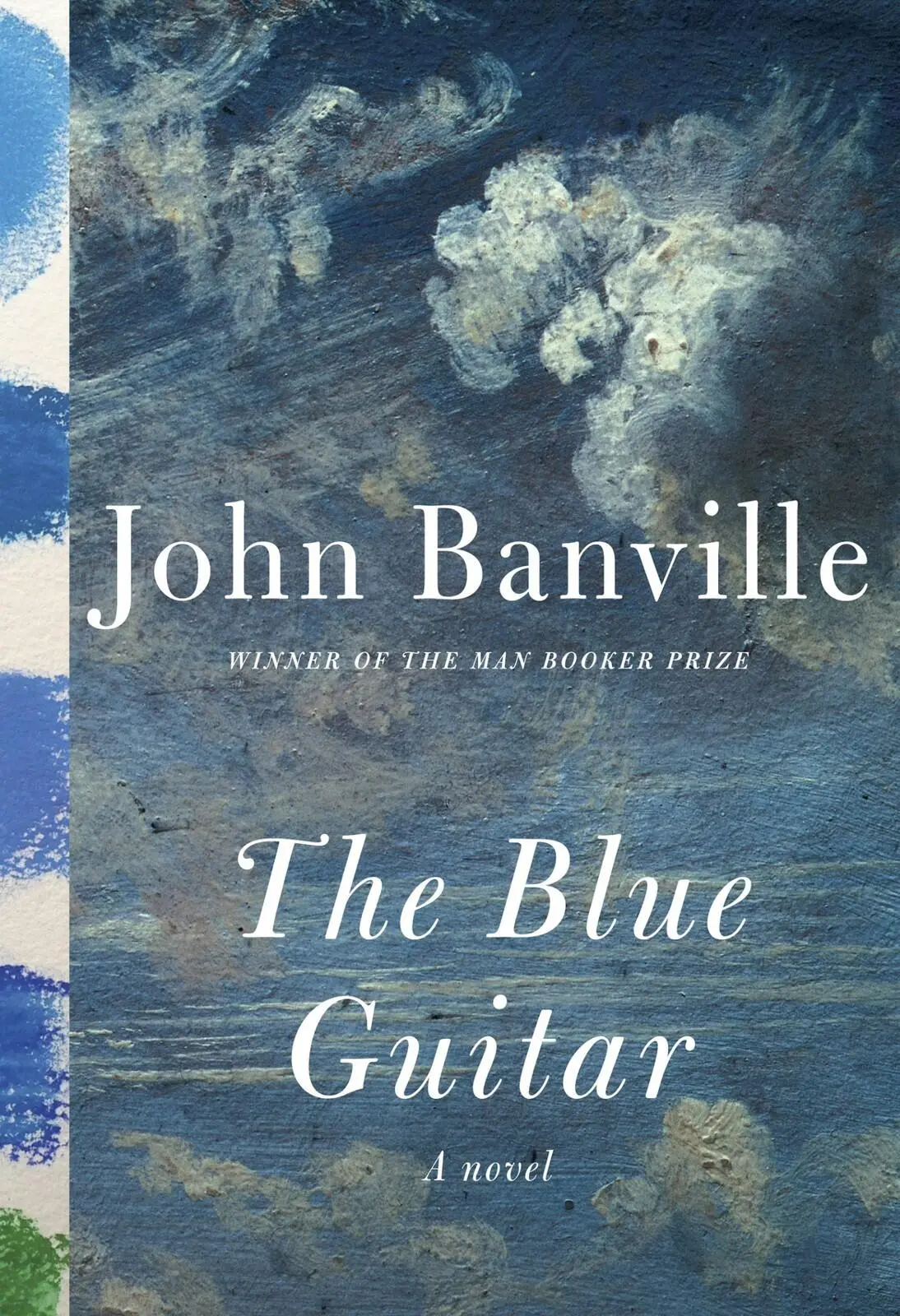
John Banville - The Blue Guitar
Здесь есть возможность читать онлайн «John Banville - The Blue Guitar» весь текст электронной книги совершенно бесплатно (целиком полную версию без сокращений). В некоторых случаях можно слушать аудио, скачать через торрент в формате fb2 и присутствует краткое содержание. Год выпуска: 2015, Издательство: Knopf, Жанр: Современная проза, на английском языке. Описание произведения, (предисловие) а так же отзывы посетителей доступны на портале библиотеки ЛибКат.
- Название:The Blue Guitar
- Автор:
- Издательство:Knopf
- Жанр:
- Год:2015
- ISBN:нет данных
- Рейтинг книги:4 / 5. Голосов: 1
-
Избранное:Добавить в избранное
- Отзывы:
-
Ваша оценка:
The Blue Guitar: краткое содержание, описание и аннотация
Предлагаем к чтению аннотацию, описание, краткое содержание или предисловие (зависит от того, что написал сам автор книги «The Blue Guitar»). Если вы не нашли необходимую информацию о книге — напишите в комментариях, мы постараемся отыскать её.
and
a new novel-at once trenchant, witty, and shattering-about the intricacies of artistic creation and theft, and about the ways in which we learn to possess one another, and to hold on to ourselves. Equally self-aggrandizing and self-deprecating, our narrator, Oliver Otway Orme, is a painter of some renown, and a petty thief who does not steal for profit and has never before been caught. But he's pushing fifty, feels like a hundred, and things have not been going so well lately. Having recognized the "man-killing crevasse" that exists between what he sees and any representation he might make of it-any attempt to make what he sees his own-he's stopped painting. And his last purloined possession-aquired the last time he felt the "secret shiver of bliss" in thievery-has been discovered. The fact that it was the wife of the man who was, perhaps, his best friend, has compelled him to run away: from his mistress, his home, his wife, from whatever remains of his impulse to paint and from the tragedy that haunts him, and to sequester himself in the house where he was born, trying to uncover in himself the answer to how and why things have turned out as they did. Excavating memories of family, of places he's called home, and of the way he has apprehended the world around him ("no matter what else is going on, one of my eyes is always swivelling towards the world beyond"), Ollie reveals the very essence of a man who, in some way, has always been waiting to be rescued from himself.
The Blue Guitar — читать онлайн бесплатно полную книгу (весь текст) целиком
Ниже представлен текст книги, разбитый по страницам. Система сохранения места последней прочитанной страницы, позволяет с удобством читать онлайн бесплатно книгу «The Blue Guitar», без необходимости каждый раз заново искать на чём Вы остановились. Поставьте закладку, и сможете в любой момент перейти на страницу, на которой закончили чтение.
Интервал:
Закладка:
After lunch we walked together to the studio. He had not been there before, I had made sure to keep him away. Why did I bring him now — what was there for me to show him, except elaborate failures? I had to lend him an overcoat, comically too long for his little arms. The rain had stopped and the sky was overcast and the streets had a watery sheen. Perry, his hands lost in the sleeves of my coat, cast a deprecating eye about him, taking in again the paltry scene. The houses and the shops, the very streets themselves, seemed to flinch before him. “You know what a fool you’re making of yourself,” he said, “don’t you, skulking in this ridiculous place and pretending you can’t paint?”
Skulk: that foxy word again. I answered nothing — what should I say?
When we got to the studio he flopped into a corner of the lovelorn sofa, complaining anew of the cold.
“Well, show me something,” he said crossly.
“No,” I said, “I won’t.”
He bent on me an injured glance. “After I flew all this way?”
I said I hadn’t asked him to come.
He got up moodily and began poking about the room. I watched as he made for the canvases standing against the wall. I could swear his little bloodless nose was twitching. The manner he adopts towards his trade is a calculated mixture of disdain and long-suffering impatience. On everything offered to his regard, everything, he turns at first a jaded eye, as if to say, Oh, what further dreary piece of trumpery is this? He doesn’t fool me: he’s ever on the lookout for something to hawk. Now he picked up that big unfinished thing, my last effort before lapsing into silence — this is silence? you ask — and held it up before him, drawing his head back and grimacing as at a bad smell. “Hmm,” he said, “this is new.”
“On the contrary.”
“I meant, it’s a new departure.”
“It’s not. It’s the end of the line.”
“Don’t be absurd.” He carried the canvas into the full fall of light from the window. “Are you going to finish it?” On the contrary, I said, it had finished me. He wasn’t listening. “Anyway,” with a sniff, “I can sell it as it is.”
I leaped from the sofa and ran at him across the room, but he saw me coming and whisked the canvas aside, pouting back at me over his shoulder. I made a grab, he trotted out of my reach; I reached further, caught him. There followed an unseemly tussle, with a lot of heavy breathing and muffled grunts. At length he had to concede. I snatched the canvas from him and raised it high above my head, meaning to smash it down on something. However, as anyone who has ever tried to hang a picture will know, they are damnably unwieldy things, big and flat and frail as they are, and I had to content myself by flinging it from me into a corner, where it landed with a satisfying clatter and crunch, like the sound of bones breaking.
“For God’s sake!” Perry, panting, cried. “Have you gone mad?”
I am thinking yet again of that dream, the world lodged in my gullet. They say a baby screaming for its bottle would destroy all creation if it could. My picture was smashed. What was I now, maker or breaker? And did I care?
“Look here,” Perry said, putting on a bluffly fraternal tone, “what’s the matter with you, exactly, will you tell me that?” I laughed, a sort of wild hee-haw. Brother donkey! Perry was not to be put off. “Is all this about some woman?” he said, trying not to sound overly incredulous. “I hear you’re having an affaire, or had. Is that the trouble? Tell me it’s not.”
One of the things from my painting days that I sorely miss is a certain quality of silence. As the working day progressed and I sank steadily deeper into the depths of the painted surface, the world’s prattle would retreat, like an ebbing tide, leaving me at the centre of a great hollow stillness. It was more than an absence of sound: it was as if a new medium had risen up and enveloped me, something dense and luminous, an air less penetrable than air, a light that was more than light. In it I would seem suspended, at once entranced and quick with awareness, alive to the faintest nuance, the subtlest play of pigment, line and form. Alive? Was that life, after all, and I didn’t recognise it? Yes, a kind of life, but not life enough for me to say I was living.
I wished Perry would go away now, just go away, be taken up into the air, and leave me here, alone and quiet. How tired I was; am.
Perry was prodding exploratively with the toe of his shoe at the wreckage of my poor painting. There it lay all in a heap in the corner, a tangle of wood and torn canvas, my final masterpiece. I was reminded of the giant kite that when I was a lad my mother paid Joe Kent the hunchbacked cobbler to make for me, from laths and brown paper, in his cave-like workshop down Lazarus Lane. It turned out to be too heavy, and I threw it on the grass and danced on it in a rage when it refused to fly. Yes, breaking things, that has been for me one of life’s small consolations — and maybe not so small — I see that clearly now.
“Have you nothing at all to show to me?” Perry asked, sounding both peevish and plaintive, eyeing again the dusty stacks of canvases against the walls. Yes, I said, I had nothing. I could see him losing heart; it was like watching the needle of mercury in a thermometer sliding down its groove. He consulted his watch yet again, more pointedly this time. “Such a shame,” he said, “to destroy a painting.” The pleasures of acquisition are well known — says the thief, the former thief — but who ever mentions the quiet joy of letting things go? All those botched attempts stacked there, I would gladly have stamped on them, too, as long ago I’d stamped on Joe Kent’s flightless kite. When Perry went, there would go with him my last claim to being a painter — not that I claim it, but you know what I mean — he would be yet another bag of ballast heaved out of the basket. You see how, with these figurative tropes, my fancy turns on thoughts of ascent and heady flight? And indeed, an hour later, when Gloria had driven Perry and me out to Wright’s field, and Perry had strapped himself into his neat little craft and was taxiing along the grassy runway, I had a sudden urge to race after him through the twilight and grab on to a wing and swing myself up into the seat behind him and make him take me with him to France. I imagined us up there, whirring steadily through the night, suspended above deeps of blue-grey darkness, the clouds below us like motionless thick folds of smoke and overhead a sky of countless stars. To be gone! To be gone.
We stood beside the hangar, Gloria and I, and watched the plane climb the murky air until it vanished into a cloud, the same one, it might be, that we had seen it descend from that morning. The shroud of silence that had fallen over the darkening field spoke somehow of deserted distances, forgotten griefs. Far at the back of the hangar a bare bulb was burning, and one of the Wright boys was hammering finically at something, making a metallic, melancholy tinkling. The night massed around us. I shivered, and Gloria, putting her arm through mine, pressed my elbow tightly against her ribs. Had she felt my sense of desolation, and was it comfort she was offering me? We walked away. I thought of Perry, bustling out of the lavatory after a final visit there, kneading his damp hands and giving me a disapproving, disappointed, frown. Yes, he had washed his hands of me. He need not have bothered: I had already washed my own hands of my own so-called self.
—
One day on my aimless rambles about the town — yes, I’ve become quite the walker, despite myself — I dropped in to see my sister. She is called Olive. I know, outrageous, these names. I don’t often have cause to visit her, and didn’t have that day. She lives in a little house in Malthouse Street. The narrow thoroughfare, hardly more than an alley, falls away at either end, but there is a rise in the middle, where her house is, and this, along with the fact that the footpath outside her door is very high, for what reason I do not know, always gives me the impression that access to the house entails a desperate scramble, as though it were a shrine, a fabled outpost, the way to which had been purposely made arduous. At the far end of the street is the malt store, long disused, a squat building of pinkish-grey granite with low, barred windows and big medallion-like rusted iron braces sunk into the walls. When I was little it was a place to avoid. There was always an unpleasant sour smell of malting barley that made my nostrils sting, and sounds of shifting and scurrying could be heard from within, where the rats, so Olive enjoyed assuring me, swam freely about like otters in the knee-deep stores of grain.
Читать дальшеИнтервал:
Закладка:
Похожие книги на «The Blue Guitar»
Представляем Вашему вниманию похожие книги на «The Blue Guitar» списком для выбора. Мы отобрали схожую по названию и смыслу литературу в надежде предоставить читателям больше вариантов отыскать новые, интересные, ещё непрочитанные произведения.




Обсуждение, отзывы о книге «The Blue Guitar» и просто собственные мнения читателей. Оставьте ваши комментарии, напишите, что Вы думаете о произведении, его смысле или главных героях. Укажите что конкретно понравилось, а что нет, и почему Вы так считаете.