Larry Bond - Shattered Trident
Здесь есть возможность читать онлайн «Larry Bond - Shattered Trident» весь текст электронной книги совершенно бесплатно (целиком полную версию без сокращений). В некоторых случаях можно слушать аудио, скачать через торрент в формате fb2 и присутствует краткое содержание. Город: New York, Год выпуска: 2013, ISBN: 2013, Издательство: Forge Books, Жанр: prose_military, thriller_techno, на английском языке. Описание произведения, (предисловие) а так же отзывы посетителей доступны на портале библиотеки ЛибКат.
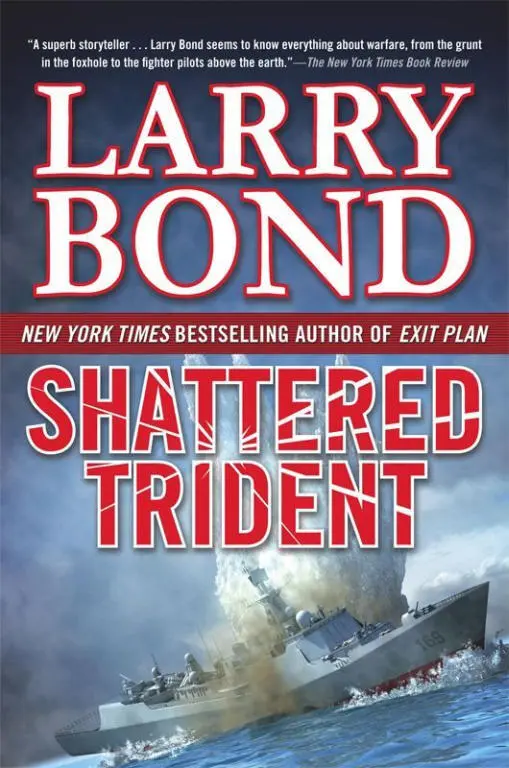
- Название:Shattered Trident
- Автор:
- Издательство:Forge Books
- Жанр:
- Год:2013
- Город:New York
- ISBN:978-0-7653-3147-2
- Рейтинг книги:5 / 5. Голосов: 1
-
Избранное:Добавить в избранное
- Отзывы:
-
Ваша оценка:
Shattered Trident: краткое содержание, описание и аннотация
Предлагаем к чтению аннотацию, описание, краткое содержание или предисловие (зависит от того, что написал сам автор книги «Shattered Trident»). Если вы не нашли необходимую информацию о книге — напишите в комментариях, мы постараемся отыскать её.
is shocked to see the Chinese boat torpedo a Vietnamese merchant ship.
This blatant act of aggression is the opening gambit in a war that has blindsided the U.S. and quickly embroiled all nations in the western Pacific. These nations, bound together in the newly formed Littoral Alliance, have begun a covert submarine campaign aimed at crippling China’s economy before China can set in motion its own plot to dominate the region.
In a desperate attempt to buy the president enough time to resolve the crisis diplomatically, Mitchell’s submarine squadron is ordered to interfere with attacks by both sides. China and the Littoral Alliance are both determined to win, no matter the cost, and as each side increases the level of violence, they approach a dangerous tipping point. In a race against time, the submarines of Mitchell’s squadron must execute their mission before the world witnesses an economic catastrophe—or worse, a nuclear exchange.
Shattered Trident — читать онлайн бесплатно полную книгу (весь текст) целиком
Ниже представлен текст книги, разбитый по страницам. Система сохранения места последней прочитанной страницы, позволяет с удобством читать онлайн бесплатно книгу «Shattered Trident», без необходимости каждый раз заново искать на чём Вы остановились. Поставьте закладку, и сможете в любой момент перейти на страницу, на которой закончили чтение.
Интервал:
Закладка:
Jerry was awestruck; his anger washed away as fast as it had formed. He heard Simonis’s words, but he had trouble wrestling with their meaning. It was not what he expected.
“But, sir… I failed to get Santa Fe home. I left them all behind,” Jerry croaked, his voice heavy with emotion.
Simonis stopped and looked at Jerry. “Captain, get it through your thick skull, there was nothing you could have done that would have changed the final outcome. Given the circumstances, there was no way you were going to pull that rabbit out of the hat. I know it sucks, but this was a no-win situation.”
“But, sir…”
“But nothing!” exclaimed Simonis firmly. “I know about your ties to the SEAL community. They are damn fine warriors, and they have a right to be proud of the fact that they bring everyone home. But Jerry, we don’t have that kind of luxury.”
Simonis then raised his right arm and made a large sweeping motion toward the Pacific. “We lost fifty-two submarines out there during World War Two, and you can add Scorpion and Thresher to that tally. In almost every case, we lost entire crews, every single last man! And, we lost them permanently! There’s a reason why we say they are on eternal patrol. In our line of work, Jerry, if a boat goes down, everyone on board is left behind. That’s just the way it is.”
Swallowing heavily, and fighting back the tears, Jerry nodded stiffly. Simonis was right, but that wasn’t much comfort at the moment. A boat had been lost, colleagues, fellow submariners were dead, all because of the misfortunes of war. And then there were the Chinese sailors on the destroyer he had torpedoed; most of them probably died as well. Ironically, there were no indications the Chinese ships knew it was an American sub they were attacking. Life seemed so damned unfair at times.
As the emotional turmoil settled down, Jerry was finally able to talk. “I hear you, sir. I don’t like it. But I understand, now.”
“Good,” replied Simonis, satisfied. “I need you firing on all cylinders. This war is getting worse by the day, and if the rumor mill is correct, we’ll soon be in the thick of it. I’ll need every boat to be operating at one hundred percent, and that includes their skippers.”
Jerry pushed himself away from the table and stood. He needed to get back to his boat. He had to get her ready for war. Extending his hand, he responded confidently, “Understood, sir. North Dakota will be ready to set sail, whenever you give the order.”
“Very good, Captain. That’s all I can realistically expect.”
“Thank you for the coffee, sir, it was really good. So was the advice,” Jerry added sheepishly.
“You’re welcome, Jerry. Just let my staff know what your boat needs, and I’ll see to it that you get it ASAP.”
A slight smile popped on Jerry’s face. “If I know my XO, sir, your staff already has all the requisitions. Good afternoon, Commodore.”
12 September 2016
1700 Local Time
August 1st Building, Ministry of National Defense Compound
Beijing, People’s Republic of China
General Xi Ping walked wearily into the CMC conference room. It had been a long two days, and judging by the way the war was progressing, the days were likely to get even longer. He saw President Chen and General Su sitting at the conference table; each was reading one of the myriad of daily reports. Xi signaled an aide to bring him coffee, and an army major rushed a cup over to him. The general gulped the contents down quickly and returned the cup to the aide. Fortified with caffeine, Xi approached the two senior members of the Central Military Commission.
“Good afternoon, President Chen, General Su,” he greeted.
Chen looked up; his serious expression immediately became one of surprise, then concern. “General! Please forgive me, but you look dreadful!”
Xi chuckled lightly. “That’s because I feel dreadful, Comrade President.”
“I take it you have the final analysis of the third missile attack?” Su asked impatiently. They were all fatigued, thought the chief of the General Staff. And if Xi had to work extra-long hours to support final victory, well, that was the price of his promotion.
“Yes, General Su,” Xi answered testily. “And it’s as we feared. The Littoral Alliance nations are jamming the Beidou navigation system signals over their territories. The accuracy of our ballistic missiles was severely degraded. We missed most of the targets of interest in the last attack.”
“But how?!” Chen demanded. “General Hu assured us that the satellite navigation systems on all our missiles were highly resistant to jamming!”
“He was partially correct, sir,” Xi explained. “The receivers are upward-looking and are very resistant to jammers on the ground . Unfortunately, the Littoral Alliance has put the jammers in high-altitude, long-endurance UAVs. The receivers on our missiles looked right at them and accepted the more powerful, flawed signals as valid. It threw the missiles far off course.”
“Wonderful!” replied Su sarcastically. “So now instead of hitting important military and economic targets, our missiles are destroying hospitals, schools, and civilian residences—with photographs posted instantly on the Internet for the whole world to see!” Su’s face became crimson with anger. “Do you have any idea as to the magnitude of the propaganda bonanza we’ve handed the Littoral Alliance!?”
Xi became equally angry and stood his ground. “I believe, General, I explicitly briefed this commission that we would have two or three attacks before the Littoral Alliance would probably deploy countermeasures. General Hu disagreed, and you, sir, accepted his argument!”
“Generals!” shouted Chen Dao. “Fighting amongst ourselves will not help us win this war!”
Vice Chairmen Tian and Li, and General Shi, heard the president’s raised voice and immediately came over to the conference table. Su was silent, but obviously fuming. President Chen looked at Xi. “Do you have any recommendations on how to counter the jamming?”
“I have some ideas, but I need to discuss them with General Wang,” Xi responded. “Until then, I would recommend delaying any further large-scale ballistic missile attacks. Our inventory is now limited and we must husband our remaining resources.”
“I agree with General Xi,” said Tian. “We may have to look at using more missiles to support our attacks on Vietnamese defensive positions. We lost fourteen aircraft this morning during the saturation attack on their line at Cao-bang. Our bombers delivered their ordnance and were suddenly pounced on by low-flying fighters. We were ultimately successful in smashing through the Vietnamese defenses, but the losses in the air and on the ground were higher than we expected. We’ll have to reinforce both the air regiments and group armies with our reserves.”
Chen was perplexed. “How did the Vietnamese muster the necessary forces to oppose the strike? I thought we had command of the air over the front?”
“It would appear that a squadron or two of Indian Flankers have deployed to Vietnam, Comrade President,” a chagrined Li volunteered. “General Xi’s people suggested this was a possibility. But I discounted it as a foolish notion given India’s massive assault on Pakistan.” Li faced Xi and bowed. “Please accept my apology, Ping.”
Xi silently bowed in return.
“President Chen,” interrupted General Shi, the head of the political department, “while I agree we need to exercise caution in conducting future missile strikes, we can’t afford to lose the momentum we’ve achieved. Militarily speaking, the situation has turned to our advantage. We’ve plunged nearly fifty kilometers into Vietnam across the entire border in only three days. We’ve largely gained air and surface dominance in the seas around China, and Admiral Wei reports that he has confirmed the sinking of three enemy submarines. And, of course, we’ve inflicted considerable damage to our enemy through ballistic missile strikes. However, as positive as these indicators are, our position is far more tenuous from an economic and political perspective.
Читать дальшеИнтервал:
Закладка:
Похожие книги на «Shattered Trident»
Представляем Вашему вниманию похожие книги на «Shattered Trident» списком для выбора. Мы отобрали схожую по названию и смыслу литературу в надежде предоставить читателям больше вариантов отыскать новые, интересные, ещё непрочитанные произведения.
![Никки Сикс - Героиновые дневники. Год из жизни павшей рок-звезды[The Heroin Diaries - A Year in the Life of a Shattered Rock Star]](/books/78612/nikki-siks-geroinovye-dnevniki-god-iz-zhizni-pavshej-rok-zvezdy-the-heroin-diaries-a-yea-thumb.webp)






Обсуждение, отзывы о книге «Shattered Trident» и просто собственные мнения читателей. Оставьте ваши комментарии, напишите, что Вы думаете о произведении, его смысле или главных героях. Укажите что конкретно понравилось, а что нет, и почему Вы так считаете.