Larry Bond - Shattered Trident
Здесь есть возможность читать онлайн «Larry Bond - Shattered Trident» весь текст электронной книги совершенно бесплатно (целиком полную версию без сокращений). В некоторых случаях можно слушать аудио, скачать через торрент в формате fb2 и присутствует краткое содержание. Город: New York, Год выпуска: 2013, ISBN: 2013, Издательство: Forge Books, Жанр: prose_military, thriller_techno, на английском языке. Описание произведения, (предисловие) а так же отзывы посетителей доступны на портале библиотеки ЛибКат.
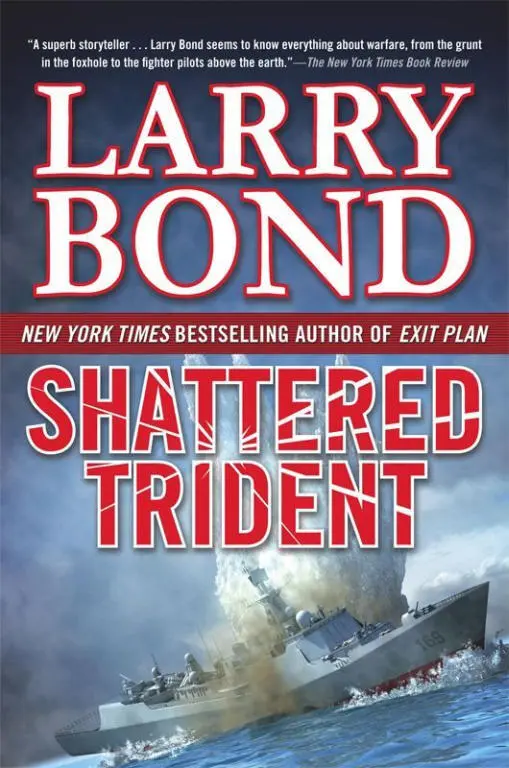
- Название:Shattered Trident
- Автор:
- Издательство:Forge Books
- Жанр:
- Год:2013
- Город:New York
- ISBN:978-0-7653-3147-2
- Рейтинг книги:5 / 5. Голосов: 1
-
Избранное:Добавить в избранное
- Отзывы:
-
Ваша оценка:
Shattered Trident: краткое содержание, описание и аннотация
Предлагаем к чтению аннотацию, описание, краткое содержание или предисловие (зависит от того, что написал сам автор книги «Shattered Trident»). Если вы не нашли необходимую информацию о книге — напишите в комментариях, мы постараемся отыскать её.
is shocked to see the Chinese boat torpedo a Vietnamese merchant ship.
This blatant act of aggression is the opening gambit in a war that has blindsided the U.S. and quickly embroiled all nations in the western Pacific. These nations, bound together in the newly formed Littoral Alliance, have begun a covert submarine campaign aimed at crippling China’s economy before China can set in motion its own plot to dominate the region.
In a desperate attempt to buy the president enough time to resolve the crisis diplomatically, Mitchell’s submarine squadron is ordered to interfere with attacks by both sides. China and the Littoral Alliance are both determined to win, no matter the cost, and as each side increases the level of violence, they approach a dangerous tipping point. In a race against time, the submarines of Mitchell’s squadron must execute their mission before the world witnesses an economic catastrophe—or worse, a nuclear exchange.
Shattered Trident — читать онлайн бесплатно полную книгу (весь текст) целиком
Ниже представлен текст книги, разбитый по страницам. Система сохранения места последней прочитанной страницы, позволяет с удобством читать онлайн бесплатно книгу «Shattered Trident», без необходимости каждый раз заново искать на чём Вы остановились. Поставьте закладку, и сможете в любой момент перейти на страницу, на которой закончили чтение.
Интервал:
Закладка:
“Keep your shirt on, Skipper. I’m almost ready,” Thigpen squealed as he walked into his captain’s stateroom.
Jerry took one look at Thigpen and emitted a guttural cry of frustration. “Gak! XO!!”
“What!?” yelled Thigpen, completely confused.
“Your shirt!”
“Huh?” Thigpen looked down and saw that he had buttoned his shirt incorrectly. “Oh shit!”
While Thigpen wrestled with his buttons, Jerry shoveled him out into the passageway, and drove him toward the control room. The two made a comical entry with Thigpen still trying to button his shirt and Jerry mimicking a tug pushing him toward the ladder well. As they passed through control, the occupants watched with amusement as the two senior officers acted more like a comedy team than the boat’s command element. As Jerry propelled Thigpen through the door, he called to the ship’s engineer. “Mr. Sobecki, the ship is yours until we get back. I’ll expect it to be here.”
“Aye, aye, Skipper. Have a good time,” shouted Sobecki as he desperately tried to keep a straight face. The control room watchstanders all attempted to stifle their laughter; Lymburn failed and uttered a loud snort. From the behind the door, the XO’s faint voice wafted through. “I heard that, Q!”
Everyone in control lost it.
They barely made it in time. With only a minute to spare, Jerry and his XO hustled into the Squadron Fifteen conference room. Simonis’s stern glare sent a clear message: I am not amused! Jerry shrugged an apology as he shuffled by the commodore.
The two quickly took their seats and looked up at the large display screen. Jerry noted that the connection with the White House Situation Room had been established, and the display showed a number of people milling about and talking. In the background, Jerry saw Joanna Patterson and her boss, Dr. Kirkpatrick. Jerry remembered fondly his meeting with the national security advisor soon after the Iranian incident.
Suddenly, a harried-looking man appeared in the camera’s field of view. He strode quickly up to the mike and announced, “Squadron Fifteen, this is the White House, stand by for the President of the United States.”
“Attention on deck!” commanded Simonis. Everyone in the conference room jumped to their feet and stood rigidly at attention.
Within seconds, President Myles appeared on the screen, followed by Vice President Randall, and the secretaries of state and defense. Myles took his seat with Randall to his right and Kirkpatrick to his left. Pulling the microphone closer, the president addressed the Guam-based squadron. “Good evening, Commodore. Thank you for getting everyone together on such short notice. As you can imagine, we’re in full-fledged crisis mode here. Meetings like this tend to occur at the last minute. Please, be seated.”
“It was no inconvenience at all, Mr. President,” Simonis replied as he sat down. “We are honored to have you with us tonight.”
Myles slowly shook his head. Jerry thought the man looked exhausted. “No, Commodore. It is I who am honored. Your squadron has shouldered the load of this crisis, and I am very grateful for your exquisite service. You took on a very difficult and unusual assignment to buy me time; time to learn why the war started, who the belligerents were, and to attempt a diplomatic resolution of the conflict. My orders tied your hands behind your back, and yet your squadron executed their mission brilliantly and gave me the time I asked for. It is unfortunate that I wasn’t as successful in negotiating a cease-fire.”
Jerry saw the bitter disappointment on the president’s face. He’s holding himself solely responsible, thought Jerry to himself. The president’s admission was a harsh judgment on himself, perhaps too harsh. In diplomacy, it takes two to tango, and it’s really tough if one of the partners doesn’t even want to dance.
“That is why I wanted to have this VTC, Commodore,” continued Myles. “To personally thank you and your crews for all your hard work and sacrifice, and to express my sincerest regrets and condolences on the loss of USS Santa Fe and her crew. I know your command is grieving. I only wish there was something I could do to ease the pain.”
The president paused for a moment, totally silent. Jerry couldn’t tell if he was trying to compose himself or praying. Either would be acceptable given the circumstances.
“Commander Mitchell,” called Myles.
“Yes, Mr. President.” Jerry stood as he replied.
For the first time that evening, Myles had a smile on his face. “You continue to amaze me with your resourcefulness and dedication, Captain. I’ve been briefed on your engagement with the Chinese destroyer, and both Captain Simonis and the CNO strongly endorse your actions. You followed, to the letter, the restrictive rules of engagement I placed upon you, and I commend you on your sound decision-making skills. I only regret having placed you in a position where you had to make such a decision. Taking lives is never easy to do.”
“Thank you for your kind sentiments, sir,” responded Jerry. In the background he could see Joanna wiping her eyes.
President Myles then acknowledged Dobson, Pascovich, and Simonis for their diligence and skills in successfully executing the spoiler campaign. Once again the president noted that the combined efforts of the squadron exceeded all expectations. Finally, he concluded his remarks with a short awards presentation. “Captain Simonis, moments ago I authorized the awarding of the presidential unit citation to Squadron Fifteen and the four participating submarine crews. Individual personal awards will be forthcoming. It is the least I can do to acknowledge your efforts on behalf of the United States of America.”
“Thank you, Mr. President, for your kind words. They are greatly appreciated,” accepted Simonis.
“Now, Commodore, before we end the VTC, do you have any questions for me?”
“Just one, Mr. President. There is a lot of scuttlebutt, rumors, which suggests that we will soon be at war with China. Are we truly that close?” asked Simonis with deep concern.
Myles sighed. “I’m afraid, Commodore, that we are on the brink of war. There are already rumors on the Internet concerning the loss of Santa Fe . References to the sinking of USS Maine and Pearl Harbor are coming up frequently in the media, with much the same result. I daresay that with the formal acknowledgement of a Chinese attack on one of our submarines, there will be significant congressional and public pressure for the United States to become an active participant on the side of the Littoral Alliance. I will keep Santa Fe ’s loss secret for as long as I can, but the release of basic information in the near term is unavoidable.”
“It seems incredible!” remarked Simonis. “Do Congress and the public comprehend the risks of going to war with another nuclear superpower?”
“Some do. But most assume we’ll be able to ‘control’ the escalation, that China won’t risk national destruction. I find this assumption to be preposterous. Too much blood has been spilled; neither side has any inclination of backing down. Thus, escalation is all but inevitable. And yes, I firmly believe nuclear weapons will ultimately be used.”
Simonis looked shaken. “Surely this has been brought up in negotiations?”
Myles nodded. “Lord knows we’ve been beating that drum, Commodore. I’ve struggled hard to retain our neutrality, so we could serve as an uninvolved mediator. We’ve been soundly rebuffed by both sides—no one wants to listen.”
The president paused and took a deep breath. “I’ve studied Asian cultures for most of my life, Commodore, and the only way to get them to listen at this stage is to deal them a serious emotional shock. The last time we did this, in 1945, we had to use nuclear weapons to get our point across. That’s not an option today.”
Читать дальшеИнтервал:
Закладка:
Похожие книги на «Shattered Trident»
Представляем Вашему вниманию похожие книги на «Shattered Trident» списком для выбора. Мы отобрали схожую по названию и смыслу литературу в надежде предоставить читателям больше вариантов отыскать новые, интересные, ещё непрочитанные произведения.
![Никки Сикс - Героиновые дневники. Год из жизни павшей рок-звезды[The Heroin Diaries - A Year in the Life of a Shattered Rock Star]](/books/78612/nikki-siks-geroinovye-dnevniki-god-iz-zhizni-pavshej-rok-zvezdy-the-heroin-diaries-a-yea-thumb.webp)




Обсуждение, отзывы о книге «Shattered Trident» и просто собственные мнения читателей. Оставьте ваши комментарии, напишите, что Вы думаете о произведении, его смысле или главных героях. Укажите что конкретно понравилось, а что нет, и почему Вы так считаете.