Larry Bond - Shattered Trident
Здесь есть возможность читать онлайн «Larry Bond - Shattered Trident» весь текст электронной книги совершенно бесплатно (целиком полную версию без сокращений). В некоторых случаях можно слушать аудио, скачать через торрент в формате fb2 и присутствует краткое содержание. Город: New York, Год выпуска: 2013, ISBN: 2013, Издательство: Forge Books, Жанр: prose_military, thriller_techno, на английском языке. Описание произведения, (предисловие) а так же отзывы посетителей доступны на портале библиотеки ЛибКат.
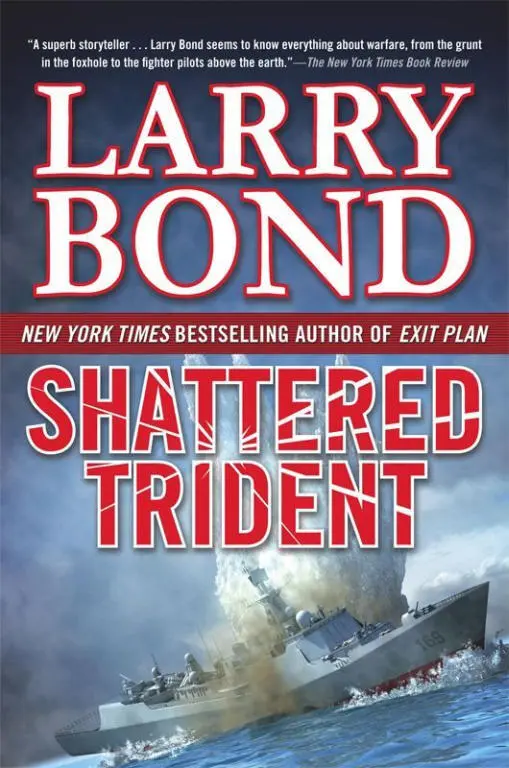
- Название:Shattered Trident
- Автор:
- Издательство:Forge Books
- Жанр:
- Год:2013
- Город:New York
- ISBN:978-0-7653-3147-2
- Рейтинг книги:5 / 5. Голосов: 1
-
Избранное:Добавить в избранное
- Отзывы:
-
Ваша оценка:
Shattered Trident: краткое содержание, описание и аннотация
Предлагаем к чтению аннотацию, описание, краткое содержание или предисловие (зависит от того, что написал сам автор книги «Shattered Trident»). Если вы не нашли необходимую информацию о книге — напишите в комментариях, мы постараемся отыскать её.
is shocked to see the Chinese boat torpedo a Vietnamese merchant ship.
This blatant act of aggression is the opening gambit in a war that has blindsided the U.S. and quickly embroiled all nations in the western Pacific. These nations, bound together in the newly formed Littoral Alliance, have begun a covert submarine campaign aimed at crippling China’s economy before China can set in motion its own plot to dominate the region.
In a desperate attempt to buy the president enough time to resolve the crisis diplomatically, Mitchell’s submarine squadron is ordered to interfere with attacks by both sides. China and the Littoral Alliance are both determined to win, no matter the cost, and as each side increases the level of violence, they approach a dangerous tipping point. In a race against time, the submarines of Mitchell’s squadron must execute their mission before the world witnesses an economic catastrophe—or worse, a nuclear exchange.
Shattered Trident — читать онлайн бесплатно полную книгу (весь текст) целиком
Ниже представлен текст книги, разбитый по страницам. Система сохранения места последней прочитанной страницы, позволяет с удобством читать онлайн бесплатно книгу «Shattered Trident», без необходимости каждый раз заново искать на чём Вы остановились. Поставьте закладку, и сможете в любой момент перейти на страницу, на которой закончили чтение.
Интервал:
Закладка:
“According to General Ye in the logistics department, we’ve lost approximately fifteen percent of our tanker fleet, and about twenty percent of our refining capacity. We’ve sustained less damage to our storage and production facilities, but it is still noteworthy. And, of course, we have been completely cut off from any external sources of petroleum. Even if the war were to end right now, the long-term damage to our economy will be considerable, but ultimately recoverable.
“Current estimates point to a five-to-ten-year period required to regain our pre-war gross domestic product. However, the longer this war continues, the more damage our economy will suffer and the longer that recovery period becomes. Some of the analyses suggest there is a tipping point where economic collapse becomes likely, and that we are closer to that point than we think.
“Politically, we have a growing internal security issue looming before us. The people are getting more and more restive. The short-term economic downturn is causing significant anxiety, the fuel rationing policy is highly unpopular, and they are absolutely incensed about the complete cutoff of access to the Internet and social networking sites. If we do not successfully conclude this war soon, we may have an internal crisis on our hands as severe as the external one.”
Chen nodded his understanding. “Thank you, General Shi, your wisdom is greatly appreciated.” Turning toward the other members of the CMC, Chen continued, “We must regain the initiative in the aerospace dimension. We’ve started to turn the tide on the seas, and we’ve made great progress on land, but it is our air and missile strikes that will ultimately give us victory. General Xi, please work with General Wang’s staff to implement your ideas. As for the rest of you, any suggestions that you can come up with will be considered. The sooner we can resume effective missile attacks, the better.”
“Yes, Comrade President, I will attend to it immediately,” Xi replied. Then he hesitantly added, “But… there is another issue that I wish to bring to your attention.”
Chen was momentarily confused, then quickly realized that the conversation had wandered far afield shortly after the intelligence chief’s initial report. “I’m sorry, General, we became so fixated on the missile problem that I didn’t realize you had additional business. Please go on.”
Xi shuffled a little, uncomfortable with the topic he needed to raise. “Comrade President, I have an intelligence officer who is particularly gifted. He is socially inept, rude, and lives like a hermit in the basement of our building. In fact, his only redeeming quality is that he thinks darkly, and does it extremely well.”
The president and the other members of the CMC looked at Xi with a mixture of impatience and curiosity. Only Su seemed mildly amused. “I don’t know if I would call the ability to think evil thoughts a redeeming quality, Ping,” he said, smiling broadly.
“Normally, General Su, I would completely agree with you. But this intelligence officer is the one who wrote the assessments on the jamming of the Beidou system and the Indian Flanker deployment.”
The smile abruptly disappeared from the general’s face; the other members were suddenly keen to hear more. “Please continue,” ordered Chen.
“In the folder I just gave you, sir, there is a synopsis of Major Geng’s latest work. In this paper he presents a frightening argument as to why Japan will develop nuclear weapons, and will do so soon.”
The members of the CMC all looked at Xi with surprise and shock. It was several moments before some even tried to speak; Xi politely cut them off. “Please, listen to me first, then we can debate the merits of Geng’s work.
“First of all, their constitution does not forbid Japan from possessing nuclear weapons. Yes, it has been their national policy since the mid-1950s to forbid their development, but that is only a piece of paper. Yes, their national psyche is still scarred and that has had a significant influence on their past decision to not pursue them, or even allow them to be transported through Japanese territory. But that memory has dimmed. It’s been over seventy years since the Hiroshima and Nagasaki bombings. Most important, however, is that these two factors are predicated on the belief that Japan does not need to produce nuclear weapons because they are under the American nuclear shield. Geng argues that may no longer be the case.
“The Japanese, indeed the entire Littoral Alliance, has snubbed the American president’s attempts to broker a cease-fire. They have boldly told the Americans they are no longer needed to ensure Japan’s security, and yet they made the hypocritical assumption that they would still be covered by America’s nuclear deterrent. Our recent ballistic missile attacks have shaken this belief badly. The fact that we have not launched any ballistic missiles at India, a nuclear power, reinforces their perception of vulnerability.
“Furthermore, Japan possesses the technological base and knowledge to develop a nuclear weapon. A number of their civilian reactors use mixed oxide, or MOX fuels, which use a mixture of plutonium and uranium. What most people do not realize is that while the plutonium only makes up about five to seven percent of the reactor fuel by weight, it is of weapons-grade quality—at least ninety percent pure plutonium-239.
“As of last year, Japan has increased its production capacity of MOX fuels to one hundred and forty metric tons a year. Simple math suggests that Japan has access to tons of weapons-grade material. Depending on the sophistication of the bomb design, only a few tens of kilograms are needed to produce a fission weapon. Japanese engineers also have access to weapon design expertise through India, should they run into problems.
“Comrades, Major Geng has argued that there is now a strong political motivation to develop nuclear weapons in Japan. When coupled with their technological capabilities, and the close alliance with India, this becomes a substantial new strategic threat to the People’s Republic of China.”
An awestruck silence greeted Xi’s finale. The senior members of the Communist Party looked back and forth at each other. Some had the look of disbelief, others shock, a few, outright fear. It was General Su who finally broke the silence. “Is there any evidence the Japanese are pursuing this path?”
Xi took a deep breath and answered, “No, General. But I must caveat that by saying we really haven’t looked all that hard. Our collection assets have been heavily tasked to support the war effort.”
“Then, General Xi, this becomes your number-one priority,” announced Chen sternly. “We must know if Japan has an active nuclear weapons program, and we need to know soon.”
12 September 2016
2045 Local Time
USS North Dakota
Apra Harbor, Guam
“My God, Bernie! What the hell are you doing! We have to be there in fifteen minutes!” shouted Jerry; there was a distinct note of panic in his voice.
“I had to shower, Skipper! I was filthy!” cried Thigpen from his stateroom. A towel came flying out and landed on the floor of the head the two men shared. Sounds of drawers being opened and slammed shut echoed from the XO’s quarters. “Now where did I put my cover?”
Jerry collapsed into his desk chair and cradled his head in his hands. “Simonis will just shoot me!” he moaned. Looking up at the clock on the bulkhead, he saw the seconds relentlessly ticking by. The thought of being late sent a chill down Jerry’s spine.
“You know, XO, it is not considered career-enhancing to show up fashionably late for a video teleconference WITH THE PRESIDENT OF THE UNITED STATES!” he bellowed.
Читать дальшеИнтервал:
Закладка:
Похожие книги на «Shattered Trident»
Представляем Вашему вниманию похожие книги на «Shattered Trident» списком для выбора. Мы отобрали схожую по названию и смыслу литературу в надежде предоставить читателям больше вариантов отыскать новые, интересные, ещё непрочитанные произведения.
![Никки Сикс - Героиновые дневники. Год из жизни павшей рок-звезды[The Heroin Diaries - A Year in the Life of a Shattered Rock Star]](/books/78612/nikki-siks-geroinovye-dnevniki-god-iz-zhizni-pavshej-rok-zvezdy-the-heroin-diaries-a-yea-thumb.webp)



Обсуждение, отзывы о книге «Shattered Trident» и просто собственные мнения читателей. Оставьте ваши комментарии, напишите, что Вы думаете о произведении, его смысле или главных героях. Укажите что конкретно понравилось, а что нет, и почему Вы так считаете.