Larry Bond - Shattered Trident
Здесь есть возможность читать онлайн «Larry Bond - Shattered Trident» весь текст электронной книги совершенно бесплатно (целиком полную версию без сокращений). В некоторых случаях можно слушать аудио, скачать через торрент в формате fb2 и присутствует краткое содержание. Город: New York, Год выпуска: 2013, ISBN: 2013, Издательство: Forge Books, Жанр: prose_military, thriller_techno, на английском языке. Описание произведения, (предисловие) а так же отзывы посетителей доступны на портале библиотеки ЛибКат.
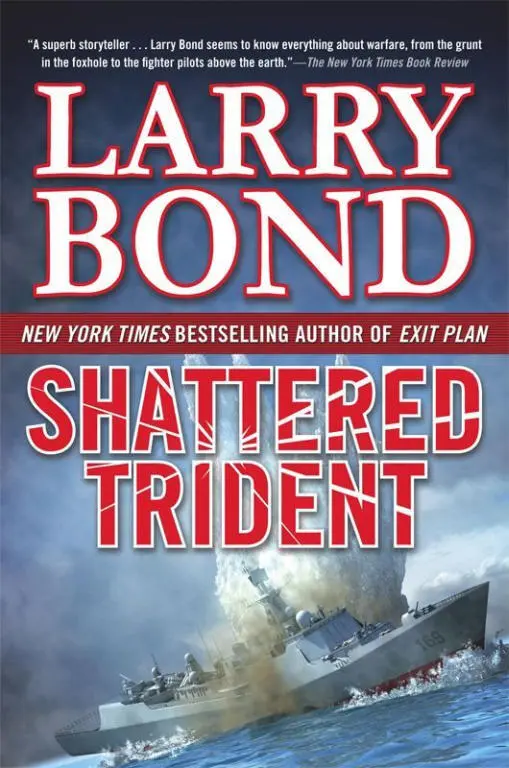
- Название:Shattered Trident
- Автор:
- Издательство:Forge Books
- Жанр:
- Год:2013
- Город:New York
- ISBN:978-0-7653-3147-2
- Рейтинг книги:5 / 5. Голосов: 1
-
Избранное:Добавить в избранное
- Отзывы:
-
Ваша оценка:
Shattered Trident: краткое содержание, описание и аннотация
Предлагаем к чтению аннотацию, описание, краткое содержание или предисловие (зависит от того, что написал сам автор книги «Shattered Trident»). Если вы не нашли необходимую информацию о книге — напишите в комментариях, мы постараемся отыскать её.
is shocked to see the Chinese boat torpedo a Vietnamese merchant ship.
This blatant act of aggression is the opening gambit in a war that has blindsided the U.S. and quickly embroiled all nations in the western Pacific. These nations, bound together in the newly formed Littoral Alliance, have begun a covert submarine campaign aimed at crippling China’s economy before China can set in motion its own plot to dominate the region.
In a desperate attempt to buy the president enough time to resolve the crisis diplomatically, Mitchell’s submarine squadron is ordered to interfere with attacks by both sides. China and the Littoral Alliance are both determined to win, no matter the cost, and as each side increases the level of violence, they approach a dangerous tipping point. In a race against time, the submarines of Mitchell’s squadron must execute their mission before the world witnesses an economic catastrophe—or worse, a nuclear exchange.
Shattered Trident — читать онлайн бесплатно полную книгу (весь текст) целиком
Ниже представлен текст книги, разбитый по страницам. Система сохранения места последней прочитанной страницы, позволяет с удобством читать онлайн бесплатно книгу «Shattered Trident», без необходимости каждый раз заново искать на чём Вы остановились. Поставьте закладку, и сможете в любой момент перейти на страницу, на которой закончили чтение.
Интервал:
Закладка:
“China has also announced that it will begin convoying ships bound for Chinese ports, but has not released any details, or whether they will be coordinating with the NATO effort.
“NATO has ruled nothing out, although direct intervention in either conflict seems unlikely. In addition to possible further sanctions against China, seen as the aggressor in that war, and against India, NATO could authorize emergency transfers of arms to the Littoral Alliance countries, except India, and Pakistan, and sharing intelligence with the Littoral Alliance and Pakistan to assist in their defense.
“Newton Thursbury, the U.S. Representative to NATO, has lobbied aggressively that any measures should be defensive only, and designed to encourage the combatants in both wars to seek an immediate cease-fire. The U.S. representative spoke strongly. ‘A war between five countries in the South China Sea was bad enough. We now have ten countries involved in two separate wars. The last thing we need is to add NATO to the mix.’”
“In a follow-up to this morning’s report, new photographs from last night’s massive ballistic missile attack on Littoral Alliance capitals have been posted on the Internet. These photographs, many of which are extremely graphic, reveal a disturbing change in Chinese targeting strategy. Instead of striking military, political, or economic targets, the missiles largely hit the residential sections of Tokyo, Taipei, Seoul, and Hanoi. Initial casualty estimates are in the thousands, but an accurate count is proving to be difficult as a number of residential areas and schools were hit in this latest attack. Due to the high number of casualties from previous missile barrages, and damage to some of the hospitals, medical facilities in those cities have been filled to capacity, forcing the use of public buildings as emergency medical wards.
“Civil authorities have brought in rescue dogs to aid in finding survivors, but the destruction is so great that heavy equipment cannot get close to the disaster scene, forcing rescuers to dig through the wreckage with hand tools.
“A Littoral Alliance foreign affairs spokesman issued a statement saying, ‘This latest attack shows just how desperate China has become. They are unable to counter our combined militaries, so they resort to terror attacks against our citizens. Their defeat is near, we will continue to press on!’”
12 September 2016
0800 Local Time
Littoral Alliance Headquarters
Okutama, Nishitama District
Tokyo, Japan
With eight nations making up the Littoral Alliance, the sixteen representatives to the working group, with the necessary translators, took up a fair amount of room. Admiral Orihara could not use the commons area for his briefing, given the level of security, but luckily the Hirano estate’s dojo made an excellent venue. The weapons racks, although empty, still gave the place a martial atmosphere, a perfect setting.
The representatives of each country sat in pairs at western-style desks, complete with national flags. The only jarring feature was the sight of dozens of cable runs taped to the floor carrying power and secure data to each delegation. This information was most definitely not going on a Wi-Fi network.
“Gentlemen and ladies, thank you for your time this morning. This is my first official duty as Japan’s military representative to the working group.” He bowed slightly. “Please take good care of me.”
The first slide said simply “Project Ryusei,” and below in English, “Project Meteor.” He quickly brought up a second slide, a map of China with symbols marking oil installations.
“We’ve been striking oil refineries along the coast with submarine-launched cruise missies, as well as unconventional sabotage and cyber attacks. The refineries at Juijang, Ningbo, Zibo, Beihai, and Panjin have all been reduced to below twenty percent output, effectively crippling them, but this takes time and great effort. There are also many refineries that are simply outside our reach.
“The South Korean land-attack cruise missile, the Hyunmoo 3, can only fly fifteen hundred kilometers after being launched from a submarine. While this sounds like a great distance, it is not compared to the vast expanse of China.” He pressed a control and an irregular red line appeared on the map, a little less than one-third of the way across China from its eastern coast. “Of greater concern is the land-attack Klub missile, employed by the Vietnamese and Indian navies, which has a far more limited range of three hundred kilometers. This severely restricts our ability to strike critical targets in the South China Sea area. All of the refineries that have been hit lie within this area,” Orihara pointed out.
He called up a picture of the South Korean missile, along with its specifications. “The Hyunmoo 3 has a five-hundred-kilogram warhead, which is enough to destroy most individual targets, but many oil refineries cover one or two square kilometers, with hundreds of components.”
An after-strike photo appeared of the Huabei Petrochemical Company petroleum refinery in northern China. “This is a major refinery, with an output of a hundred thousand barrels per day. It was struck by nine missiles fired by the submarine ROKS Ra Kyungji . Aiming for vital components like distillation towers and piping manifolds, the installation’s output was reduced by twenty-seven percent, and repairs are estimated to take several months.
“But the Korean Hyunmoo-3 and the Russian Klub, like most cruise missiles, are subsonic, and although both have very small radar signatures, they can be detected if the searching radar is close enough. The Chinese air defenses discovered the Huabei raid, which took just under twenty minutes to fly from the launch point to the target, and destroyed three of the missiles, or one-quarter of the twelve missiles launched. This is essentially the submarine’s entire load, the maximum number of missiles most subs can carry while still leaving an adequate torpedo loadout for self-defense.
“Another issue is the time it takes a submarine to load weapons in port, sail to the launch area while evading enemy defenses, and return to port after launch. While it is engaged in this type of mission, it’s not doing what it does best: sinking other ships and subs.”
Orihara turned and bowed slightly toward the South Korean delegation. “While the strike went well, and did great damage, we need to reach targets farther inland, with greater striking power, and less chance of interception.”
His next slide drew a surprised murmur from the delegates. It was a photo of a rocket, an orbital launch vehicle, with labeled arrows pointing to different components. The arrow pointing to the nose read “warhead.”
“This is a Japanese H II-series launch vehicle. It was first used in 2002, and has proven to be a dependable heavy-lift platform. Even the basic version can lift four metric tons to a high orbit.”
He changed the slide to show a cutaway diagram of the nose section. “The Self-Defense Agency, working with the Japanese Space Exploration Agency, has developed a simple modification that allows the vehicle to act as a ballistic missile, able to reach any location in China. Since it doesn’t have to reach orbit, it can carry a payload of six metric tons of explosive. Instead of a single unitary warhead, it will carry sixty one-hundred-kilogram charges, which will spread out over an area hundreds of meters across. Each charge includes an incendiary component as well as a high-explosive blast and fragmentation warhead.”
As he’d been describing first the vehicle and then the payload, Orihara had heard soft voices, then discussion, and finally the Filipino military delegate spoke. “How can you even consider this when your constitution explicitly forbids offensive weapons?” Other delegates were nodding as well, with expressions ranging from curiosity to concern.
Читать дальшеИнтервал:
Закладка:
Похожие книги на «Shattered Trident»
Представляем Вашему вниманию похожие книги на «Shattered Trident» списком для выбора. Мы отобрали схожую по названию и смыслу литературу в надежде предоставить читателям больше вариантов отыскать новые, интересные, ещё непрочитанные произведения.
![Никки Сикс - Героиновые дневники. Год из жизни павшей рок-звезды[The Heroin Diaries - A Year in the Life of a Shattered Rock Star]](/books/78612/nikki-siks-geroinovye-dnevniki-god-iz-zhizni-pavshej-rok-zvezdy-the-heroin-diaries-a-yea-thumb.webp)






Обсуждение, отзывы о книге «Shattered Trident» и просто собственные мнения читателей. Оставьте ваши комментарии, напишите, что Вы думаете о произведении, его смысле или главных героях. Укажите что конкретно понравилось, а что нет, и почему Вы так считаете.